Introduction
Picture this: you're driving into work along one of Hot Springs' main commercial corridors, and there's a familiar billboard you pass every single morning. After a few weeks, you don't even need to read it — you just know that business. That involuntary, repeated recognition is the core mechanism behind out-of-home billboard advertising, and it's why the format has outlasted dozens of media trends over more than a century.
Out-of-home (OOH) advertising refers to any advertising displayed in a public space outside the home. Billboards are the most recognized format within that category — and they remain one of the most cost-efficient ways for local businesses to build awareness with a specific geographic audience.
This guide covers what OOH billboard advertising actually is, the different formats available, why the channel still performs, how to design an ad that works, what it costs, and how Hot Springs businesses can get started.
Key Takeaways
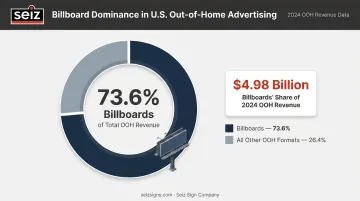
- Billboards are the dominant OOH format, representing nearly 74% of total OOH ad revenue in 2024
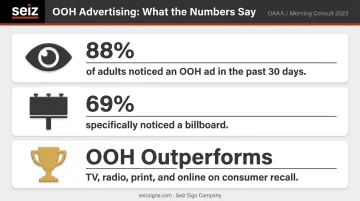
- 88% of adults noticed an OOH ad in the past 30 days, per OAAA/Morning Consult research
- Effective billboards follow a simple rule: seven words or fewer, one strong visual, one clear call to action
- Billboard rentals run around the clock with no overtime fees, click costs, or ad blockers to contend with
- Seiz Sign Company operates 90+ billboard locations with 225 faces across Hot Springs and Garland County
What Is Out-of-Home (OOH) Billboard Advertising?
The OAAA defines OOH advertising as "all media formats specifically intended to reach consumers outside the home." That umbrella covers everything from roadside billboards to transit shelters to airport displays.
Billboards sit at the top of that category. The OAAA defines them as large-format displays intended for viewing from extended distances — generally more than 50 feet — and they consistently generate the largest share of OOH revenue by a wide margin. Through the first three quarters of 2024, billboards accounted for $4.98 billion, or roughly 73.6% of total OOH ad revenue.
You'll often hear "OOH advertising," "outdoor advertising," and "billboard advertising" used interchangeably. Technically, OOH is the broader category, outdoor advertising is a near-synonym, and billboard advertising describes one specific format within it — but that distinction rarely changes how local businesses use them in practice.
The underlying logic is simpler: billboards work because they're unavoidable. A driver passing a well-placed sign doesn't choose to view it. They just do. That passive, repeated exposure builds familiarity — and familiarity is what drives purchasing decisions.
Types of OOH Billboard Advertising
Static vs. Digital Billboards
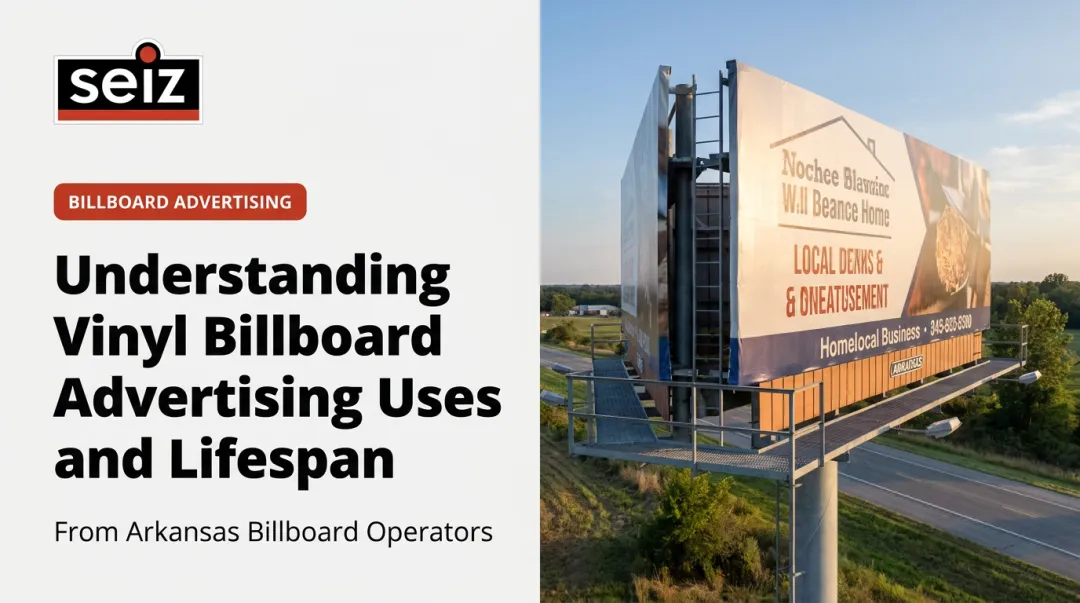
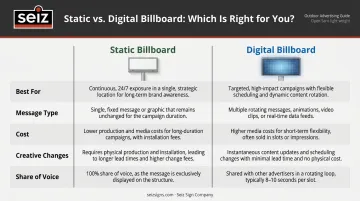
Static (traditional) billboards are printed vinyl displays that show a single, fixed message for the duration of a campaign. They run continuously — morning, night, weekends, holidays — without any rotation or interruption. For businesses that want always-on brand visibility in one specific location, static billboards deliver consistent, uninterrupted exposure that no rotation can match.
Seiz Sign Company operates over 90 billboard locations with 225 faces throughout Hot Springs and Garland County, the majority of which are traditional static faces. Their large-format vinyl printing capability (up to 16 feet wide) means production is handled entirely in-house, from design through installation.
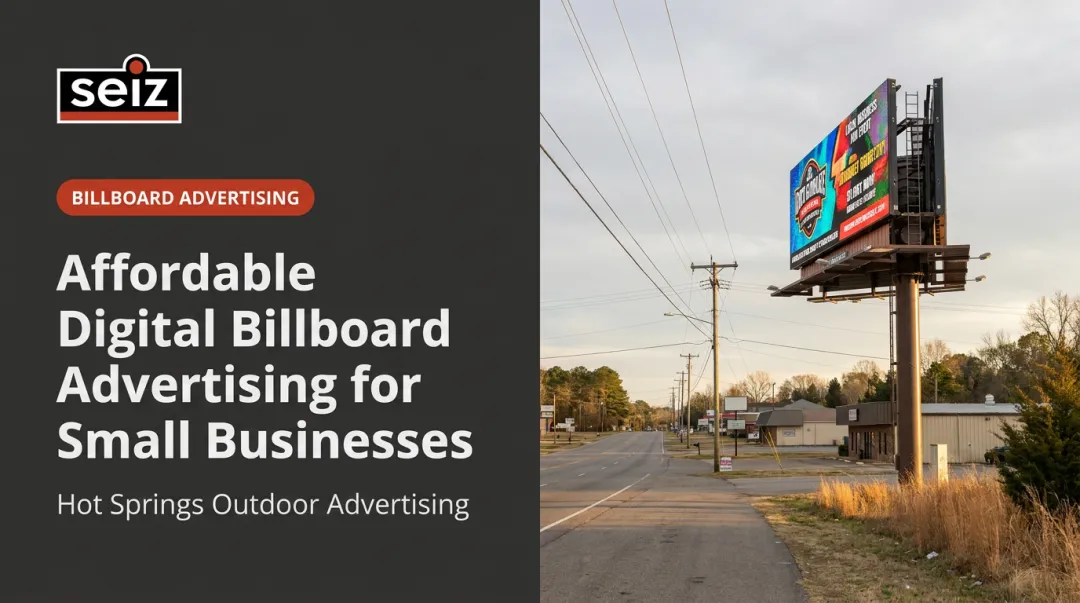
Digital billboards (DOOH) are electronic displays that rotate multiple advertisers' ads — typically every six to eight seconds, per OAAA guidance. The IAB defines DOOH as digital media used for marketing outside the home, combining dynamic screens with data-driven marketing in public spaces. Seiz also offers a large outdoor LED digital display for rotating spot messages, so Hot Springs advertisers can update messaging the same week — or same day — without reprinting.
Here's a practical way to choose:
| Static Billboard | Digital Billboard | |
|---|---|---|
| Best for | Long-term brand presence | Promotions, time-sensitive offers |
| Message | One fixed ad | Rotates with other advertisers |
| Cost | Generally lower | Typically higher |
| Creative changes | Requires reprinting | Updated quickly |
| Exclusivity | 100% share of voice | Shared rotation |
Other OOH Formats Worth Knowing
Billboards capture audiences on the move, but two additional OOH categories bring your message closer to foot traffic — useful as campaigns expand beyond roadside placements:
- Street furniture — bus shelters, benches, and kiosks positioned close to pedestrian traffic at eye level, per OAAA's format definitions
- Transit advertising — wraps or displays on buses and vehicles, or in transit stations
There's also a growing category called place-based OOH — ads appearing in malls, gyms, restaurants, and similar venues. The OAAA describes place-based media as targeting consumers in locations where they congregate, reaching them closer to purchase decisions. When a Hot Springs restaurant advertises on a gym screen or a retailer runs a bus shelter ad near their storefront, they're layering impressions on top of an existing billboard campaign — which is when these formats typically earn their cost.
Why Billboard Advertising Still Works for Local Businesses
The Unskippable Advantage
Digital ads can be blocked, muted, or scrolled past in under a second. A billboard simply exists. If someone drives past it, they see it — there's no opt-in required, no algorithm deciding whether to show it, no ad blocker to install.
That physical permanence translates directly into awareness. According to OAAA and Morning Consult research from 2023, 88% of adults had noticed an OOH ad in the past 30 days, with 69% specifically noticing a billboard. A separate 2023 Solomon Partners benchmark cited by OAAA found that OOH produces higher consumer recall than live and streaming TV, podcasts, radio, print, and online executions.
Repetition Builds Trust
For service businesses — healthcare, legal, home services, restaurants — credibility often comes before the customer ever walks in the door. Seeing the same business name on a billboard week after week, on the same road someone drives to work, builds exactly that kind of passive familiarity.
A single ad placement asks someone to remember you. A billboard on their daily commute means they already know you by the time they need what you offer — and that recognition is what converts a stranger into a first-time customer.
A Growing Channel, Not a Declining One
The "Is OOH still relevant?" question has a clear answer in the revenue data. US OOH advertising revenue surpassed $9.1 billion in 2024, up 4.5% from 2023, with digital OOH growing even faster at 7.5%. The channel is expanding — which matters to local business owners who want their media investments in formats with momentum.
Billboard Advertising Amplifies Digital Campaigns
OOH doesn't compete with digital marketing — it strengthens it. A person who has seen a local business on a billboard is more likely to recognize and click on that business's digital ad, recall the name when searching, or act on an email offer. A 2024 OAAA study found that 74% of mobile users took action after DOOH exposure, with 44% performing an online search and 38% visiting the advertiser's website.
Privacy-Safe by Design
That digital integration matters — but so does what billboard advertising doesn't require. With third-party cookies largely phased out and state-level privacy laws (CCPA, state SHIELD acts) reshaping digital targeting, OOH sidesteps the problem entirely. It reaches audiences through location and context alone — no personal data profiles, no consent banners, no tracking pixels. The OAAA notes that OOH campaigns using location, weather, or time-of-day targeting don't inherently rely on personal data, making the format more durable as digital ad infrastructure continues to shift.
The 3-Second Rule: Designing Billboard Ads That Work
Drivers and passersby have roughly 4–5 seconds to absorb a billboard message, per Lamar's design guidance — but the industry standard is tighter. The 3-second rule is the working benchmark most designers build around. Every creative choice should prioritize one thing: speed of comprehension.
Core Design Principles
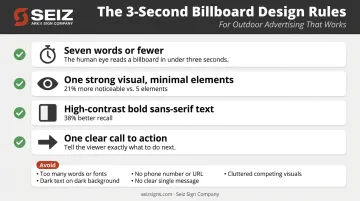
Both OAAA Creative Best Practices and Clear Channel Outdoor's design guidance align on a single benchmark: seven words or fewer. Seven words is a practical ceiling, not a stylistic preference — it reflects how little time a moving viewer actually has.
Principles that flow from that constraint:
- Pick a single idea — two offers, three services, or a paragraph of copy will all get skipped.
- Use large, high-contrast text; Lamar reports that high color contrast can improve outdoor advertising recall by 38%, and bold sans-serif fonts process faster than decorative or thin typefaces.
- Lead with one strong visual; OAAA research found ads with two message elements are 21% more likely to be noticed than ads with five elements.
- Include one call to action — a phone number, a website, or a location, but not all three.
What to Avoid
Common mistakes that cause billboard messages to be lost before the viewer passes:
- Too much copy — if you need 20 words to explain it, a billboard isn't the right format
- Small fonts that require slowing down to read
- Low color contrast between text and background
- Multiple offers or services listed on one board
- Cluttered visuals with no clear focal point
Design Meets Location
Getting the creative right is only half the equation. Before finalizing any design, consider who actually drives or walks past that specific placement. A billboard near a hospital serves a different audience than one on a highway entrance ramp, and the message, offer, and tone should reflect who's actually there.
How Much Does Out-of-Home Billboard Advertising Cost?
Billboard advertising costs vary based on several factors:
- Location and traffic volume — higher-traffic corridors command higher rates
- Market size — rural placements cost less than urban or suburban locations
- Format — static billboards are generally priced lower than digital/rotating displays
- Campaign duration — longer commitments typically affect overall pricing
Because these variables interact differently in every market, no universal price list applies — including in Hot Springs. Seiz Sign Company quotes rates on request based on specific location, format, and campaign details. Clear Channel Outdoor and OUTFRONT follow the same approach, with pricing dependent on location, availability, and campaign length.
How the Cost Model Works
Most billboard rentals are structured per four-week period, which is the standard planning and measurement cycle in OOH. The rental fee covers the display space itself — the physical placement of your ad on the structure, running 24 hours a day, 7 days a week, 365 days a year.
As Tammy Hamilton, VP of Billboard Sales at Seiz Sign Company, puts it: "Billboards work. They are promoting your brand and location 24 hours a day, 7 days a week and 365 days a year. And, no overtime charges."
That "no overtime charges" framing matters. Unlike broadcast TV or digital pay-per-click — where peak-hour placements or additional impressions generate incremental costs — a billboard rental is a flat fee for continuous exposure throughout the contract period.
Businesses typically budget separately for design and vinyl print production on static billboards. Seiz handles both in-house.
Understanding CPM
OOH is commonly evaluated using CPM (cost per thousand impressions) — a standard metric across advertising that lets you compare the cost of reaching 1,000 people across different media types. The OAAA's 2025 Value of OOH Guide notes that OOH delivers efficient CPMs with high notice and recall rates compared to other media. For local market coverage in particular, it holds up well against both broadcast and digital channels.
Getting Started with Billboard Advertising in Hot Springs
Before You Book
Three questions to answer before selecting a location:
- What's the goal? Brand awareness, foot traffic, event promotion, and directional signage all call for different placements and creative approaches.
- Who is the target customer, and where do they travel? A restaurant targeting tourists needs different placement than a law firm targeting local residents.
- What's a realistic budget? Start with one or two strategically placed boards rather than spreading a small budget thin.
Working with Seiz Sign Company's Outdoor Advertising Division
Once you've answered those questions, Seiz Sign Company's outdoor advertising division — led by VP Tammy Hamilton, who has worked the Hot Springs OOH market since 2003 — handles execution from start to finish:
- Choosing from 90+ locations across 225 faces in Hot Springs and Garland County
- Developing creative through in-house graphic artists who specialize in outdoor advertising
- Printing in-house with large-format vinyl up to 16 feet wide — no outside vendors, no delays
- Installing with licensed crews who know Hot Springs permit and zoning requirements
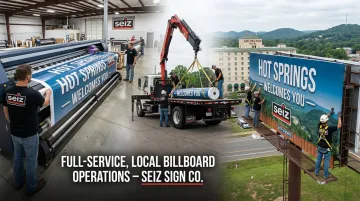
Businesses don't need existing artwork to get started — Seiz handles design through installation under one roof.
To check available inventory and discuss placement options, call (501) 623-3181 or reach Tammy Hamilton directly at tammy@seizsigns.com.
Practical Advice for First-Time Billboard Advertisers
- Pick one or two high-traffic locations rather than scattering a small budget across six mediocre placements.
- Run long enough to build frequency. Outdoor advertising works by repeated exposure — consistent presence over weeks and months is what moves people from awareness to action.
- Keep creative to seven words or fewer, one image, and one call to action — drivers will process it in under three seconds or not at all.
Frequently Asked Questions
Are billboards a form of out-of-home (OOH) advertising?
Yes. Billboards are the most common and widely recognized format within OOH advertising, accounting for nearly 74% of total OOH revenue in 2024. The terms "billboard advertising" and "OOH advertising" are often used interchangeably in everyday conversation, though OOH is technically the broader category.
Is out-of-home (OOH) advertising still relevant?
US OOH ad revenue surpassed $9.1 billion in 2024, up 4.5% year over year. The channel consistently outperforms others on consumer recall and continues to grow — particularly the digital OOH segment, which expanded 7.5% in 2024.
What is the 3-second rule for out-of-home billboard advertising?
The "3-second rule" describes the brief window drivers or passersby have to read a billboard — generally estimated at 3–5 seconds depending on speed and placement. That tight timeframe is why effective billboard ads rely on seven words or fewer, bold visuals, and a single clear call to action.
How much does out-of-home billboard advertising cost per month?
Costs vary based on market size, location, traffic volume, format, and campaign duration. In the Hot Springs market, Seiz Sign Company provides pricing on request — contact Tammy Hamilton at (501) 623-3181 or tammy@seizsigns.com for accurate local rates.
What makes an effective billboard advertisement?
A short headline (seven words or fewer), one strong visual, a single call to action, and high color contrast between text and background. Placement matters just as much as design — the right message still needs to be in front of the right audience.
How do I choose the right billboard location for my business?
Start with where your target customers already travel — then factor in traffic volume and proximity to your business or key buying moments. Seiz Sign Company maintains a map of 90+ billboard locations across Garland County, making it straightforward to match available inventory to your audience.