Key Takeaways
- Vinyl billboard panels are printed on coated PVC substrates, typically in the 13–15 oz range for standard outdoor applications
- Expect roughly 3 years of outdoor print durability for unlaminated PVC frontlit systems; actual lifespan varies with installation quality, vinyl weight, and local weather
- Standard bulletin boards measure 14' H × 48' W — drivers have only seconds to absorb your message, so keep designs simple
- Digital billboards typically rotate among six to eight advertisers every six to eight seconds; vinyl gives you that face exclusively
- Location, material specs, and campaign duration matter more than design alone
What Is a Vinyl Billboard and How Is It Made?
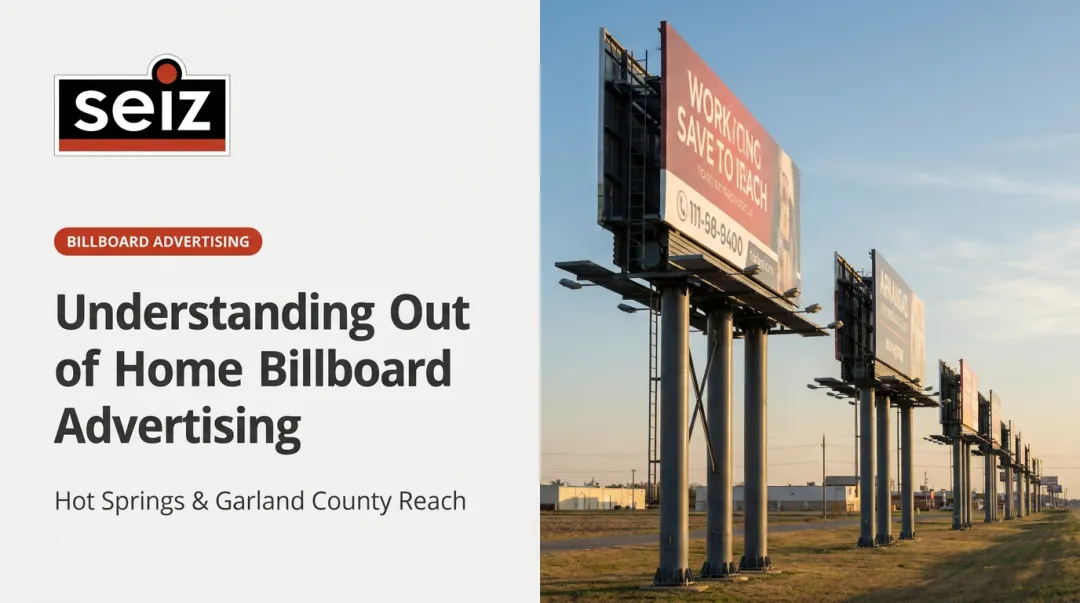
Walk past any major highway in Arkansas and the odds are high that the billboard you're looking at isn't painted — it's printed on vinyl.
Modern outdoor billboard panels are produced from coated flexible PVC (polyvinyl chloride) substrates. Weight ranges typically run from 13 oz for standard frontlit applications up to 15 oz or heavier for high-stress or exposed locations; lighter 7 oz substrates exist for certain open-frame systems. The right choice depends on the structure and site conditions, not just the panel size. Heavier-gauge, coated materials resist tearing and hold ink pigments longer under sustained UV exposure and weather stress.
How the Printing Gets Done
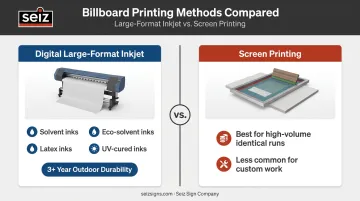
Two methods dominate large-format billboard production today:
- Digital large-format inkjet printing — the industry standard. Uses weather-resistant inks including solvent-based, eco-solvent, latex, and UV-cured systems. Roland documents 3+ years of outdoor durability for eco-solvent inks without lamination; HP reports up to 3 years for unlaminated PVC frontlit banners printed with HP Latex Inks
- Screen printing — used for high-volume runs of identical artwork, less common for custom local advertising
Hand-painted billboards still exist as a niche art form, but they're no longer the production standard. OAAA's history of OOH notes the industry evolved from hand-painted signs and paper posters to today's printed vinyl and digital formats.
Why Finishing Details Matter
The graphic itself isn't the only thing that fails in the field. Edge hemming, reinforced grommets, and pole pockets are the physical connection points between the vinyl panel and the billboard frame — and each one is a potential failure point:
- Poorly hemmed edges tear under sustained wind load
- Grommets spaced too far apart allow flutter, fatiguing the material along stress lines
- Undersized or low-gauge grommets pull through the vinyl at high-tension corners
Seiz Sign Company produces large-format vinyl graphics in-house — including design, printing up to 16 feet wide, and installation — with the same team and equipment serving their network of over 90 billboard locations and 225 faces throughout Hot Springs and Garland County.
Common Uses of Vinyl Billboard Advertising
Highway and Roadside Bulletins
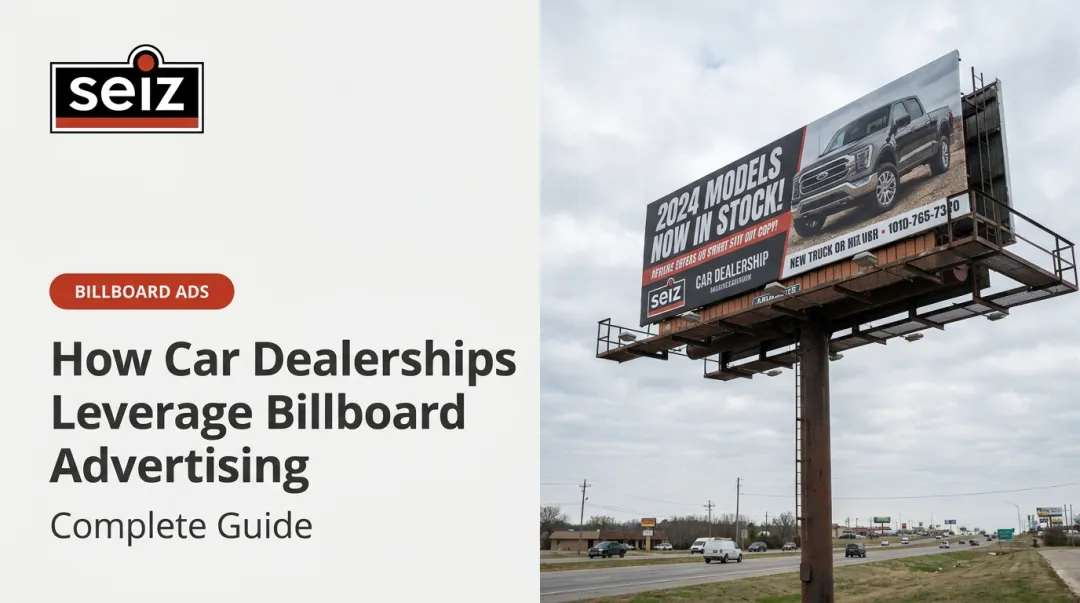
The dominant use case remains the highway corridor bulletin. OAAA identifies the bulletin as the largest standardized OOH format, typically 14' H × 48' W, with permanent contracts generally running six months or longer and rotary bulletins moving every 60 days. Placed along high-traffic roads, these panels give brands continuous, 24/7 exposure that drivers can't tune out or skip over.
For local businesses, this matters differently than it does for national brands. A restaurant on Central Avenue or a service business in Garland County benefits from the repetitive, location-specific exposure that builds recognition over weeks and months — not clicks.
Building Wraps and Oversized Installations
Vinyl's durability makes it suitable for much larger applications than a standard bulletin. Building wraps transform the exterior of a hotel, stadium, or retail center into a full-scale brand statement. These installations can run as short-term event graphics or as permanent architectural features — the material holds up in both roles because it's waterproof and built to stay taut under real-world conditions.
Transit and Public Space Advertising
Bus shelters, airport corridors, train station banners, and stadium concourses give vinyl a different kind of reach: pedestrians at close range rather than drivers at 55 mph. The viewing dynamic changes entirely, which means design can carry more detail than a highway billboard typically allows.
Temporary and Event-Based Applications
Beyond fixed locations, vinyl's portability opens up a different category of use entirely. It rolls, ships flat, and installs quickly — practical for:
- Trade show booths and event displays
- Construction site barriers and hoarding panels
- Festival signage and outdoor markets
- Pop-up retail and short-term location tests
Businesses can reuse the same panels across multiple events, which keeps costs manageable when testing a new market or campaign before committing to a longer run.
For businesses in Hot Springs and Garland County looking to move beyond temporary signage into permanent placements, Seiz Sign Company operates over 225 billboard faces across the area — already permitted, already positioned on high-traffic corridors.
How Long Does a Vinyl Billboard Last?
The honest answer: it depends on what you're measuring.
The printed graphic — the vinyl panel itself — has an outdoor print durability commonly documented by ink manufacturers at around 3 years for unlaminated PVC frontlit systems under specified ink and substrate combinations. Some sources reference a 3–5 year planning range, which is reasonable as a general guideline but not a guaranteed universal lifespan.
The steel billboard structure is an entirely different story. Structures are engineered to last decades. When advertisers talk about "billboard lifespan," they almost always mean the graphic panel, not the frame.
Factors That Shorten or Extend Panel Life
UV exposure is the primary degrader. Radiation breaks down ink pigments and causes PVC substrates to become brittle through progressive chemical breakdown. Heavier substrates with UV-protective coatings resist this significantly better than lighter, uncoated materials.
Arkansas weather is not forgiving. NWS Little Rock records show July and August average highs of 91.7°F and 91.5°F in central Arkansas. The region also faces severe thunderstorm criteria including 60 mph winds and 1-inch hail. For Hot Springs-area advertisers, these conditions are not edge cases — they're annual realities that compress the useful life of lighter-gauge vinyl.
Installation quality may be the most controllable variable. Vinyl properly tensioned across the frame — with reinforced edges and correctly placed grommets — resists wind flutter, one of the primary causes of tearing. A poor install can turn a panel rated for several years into a 12-month replacement.
Vinyl weight and ink system also determine real-world durability:
- Heavier-gauge vinyl (closer to 15 oz) outperforms lighter material under sustained UV and wind stress
- Solvent-based and eco-solvent inks generally outperform water-based inks for long-term outdoor applications
- Laminated systems extend print durability beyond unlaminated specs — worth asking about for campaigns running a year or longer
Campaign objectives often drive replacement more than material failure. Here's how typical run times break down by campaign type:
| Campaign Type | Typical Run Time | Panel Condition at End |
|---|---|---|
| Seasonal promotions / events | 4–8 weeks | Usually still serviceable |
| Product launches / short-term offers | 8–16 weeks | Minimal wear expected |
| Brand awareness / long-term | 6–12+ months | Quality substrates hold up |
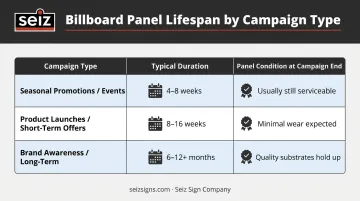
Well-produced panels on heavier-gauge vinyl can support year-long runs without replacement — making material selection a real budget consideration upfront.
Vinyl Billboards vs. Digital Billboards: Which Is Right for Your Business?
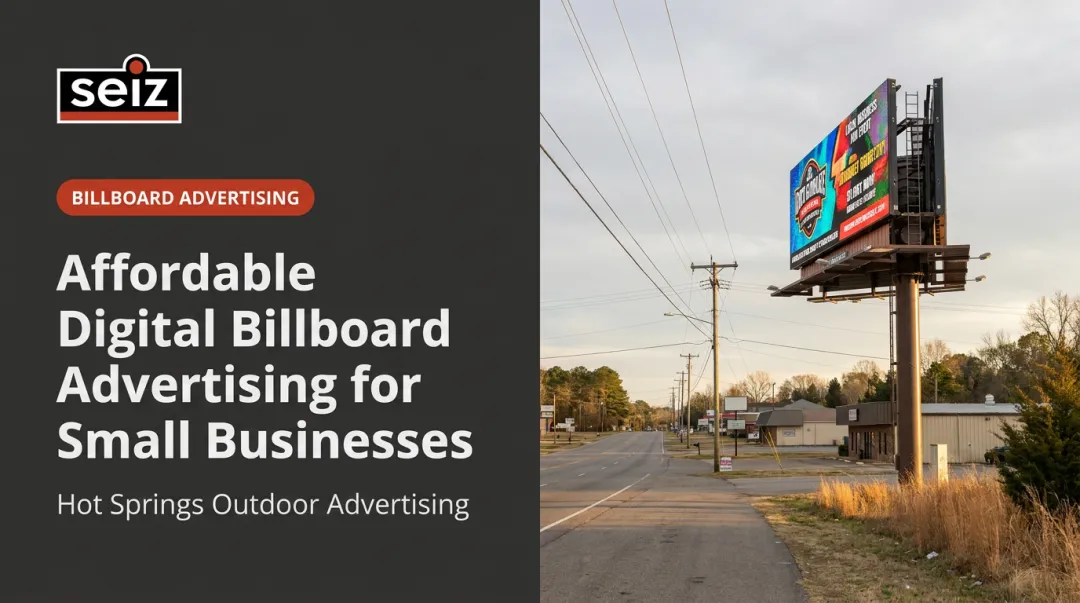
The core difference between vinyl and digital billboards is exclusivity: vinyl shows your message alone, every time — digital rotates yours alongside several others.
OAAA reports that digital billboards typically rotate among six to eight advertisers, with messages cycling every six or eight seconds. That means a driver passing a digital board in an eight-second rotation has roughly a one-in-eight chance of seeing your message on any given pass. A vinyl bulletin shows your message — and only your message — every time.
| Factor | Vinyl Billboard | Digital Billboard |
|---|---|---|
| Message exclusivity | 100% — your ad only | Shared among 6–8 advertisers |
| Message rotation | Fixed for campaign duration | Rotates every 6–8 seconds |
| Real-time updates | Requires new panel production | Immediate, no production cost |
| Budget predictability | Clear upfront cost + rental | Higher recurring fees |
| Best for | Brand awareness, location-based messaging | Time-sensitive promos, frequent updates |
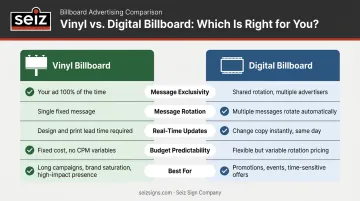
Cost structure works differently for each. Vinyl involves upfront printing and installation with a defined campaign period, making budget forecasting straightforward. Digital typically carries higher recurring fees because you're buying time slots in a rotation rather than exclusive posting rights.
Many businesses use both: vinyl for sustained brand presence in key corridors, digital for promotions that need to change weekly or respond to current events.
Tips for Maximizing Your Vinyl Billboard Investment
Design for the Speed of the Road
OAAA's creative guidance is direct: seven words or fewer. Drivers have only a few seconds of potential viewing time, so a cluttered design wastes both the creative and the placement. Seiz Sign Company's own design guidance echoes this: fewer than 7 words and 3 or fewer design elements, with one clear call to action and enough color contrast to read at speed.
Practical design rules:
- High-contrast color combinations (avoid pastels on light backgrounds)
- One primary message — brand name, offer, or directional cue
- Letter height greater than 10 inches for highway readability
- Upper and lower case text reads faster than all-caps at distance
Choose Location Before You Finalize Design
Traffic volume, sight lines, proximity to your business, and audience demographics determine whether a placement generates results. The traditional measurement metric is Daily Effective Circulation (DEC) — the average number of persons in vehicles passing and potentially exposed.
OAAA now identifies DEC as a legacy metric. Current planning increasingly uses Geopath reach and frequency data, which provides more precise audience estimates over a defined period (typically four weeks).
When evaluating locations, ask for current impressions data rather than relying solely on raw traffic counts.
Match Campaign Duration to Your Goal
- 4–8 weeks: Events, promotions, seasonal offers, location tests
- 6–12 months or longer: Brand awareness, building frequency with a local repeat-traffic audience
Frequency is outdoor advertising's real strength. OAAA frames reach and frequency as the core planning metrics — how many people in your target audience see the message, and how many times. When planning duration, work backward from your frequency goal: the more times you need to reach your audience, the longer the campaign needs to run.
Seiz Sign Company handles the full cycle — graphic design, large-format vinyl printing, installation, and ongoing maintenance — for Arkansas businesses running campaigns across their Hot Springs and Garland County network. With over 115 years serving the region, they understand what works on these specific roads.
Frequently Asked Questions
How much does vinyl billboard advertising cost?
Costs vary based on location, market size, traffic volume, and campaign duration, with pricing covering both vinyl production and billboard space rental. No universal rate applies — small-market placements in areas like Hot Springs differ significantly from major metro pricing. Contact a local outdoor advertising company for quotes specific to your market and goals.
How long does vinyl billboard advertising last?
Manufacturer evidence supports roughly 3 years of outdoor print durability for certain unlaminated PVC frontlit systems. Actual panel life in Arkansas can vary based on UV intensity, heat, severe weather, vinyl weight, and installation quality, making 3–5 years a reasonable planning range.
What is vinyl billboard material made of?
Billboard vinyl panels are typically made from coated PVC (polyvinyl chloride) substrates, commonly in the 13–15 oz weight range for frontlit outdoor applications. UV-resistant coatings and heavier-gauge construction help the material resist fading and tearing under sustained weather exposure.
Can vinyl billboards withstand severe weather?
Quality vinyl is designed to be waterproof and wind-resistant, but Arkansas's combination of summer heat, UV intensity, and severe storms — including winds of 60 mph or more and hail — can still cause wear, especially on lighter-gauge materials or poorly installed panels. Material weight and proper tensioning are the primary defenses.
How is a vinyl billboard installed and removed?
Printed vinyl is stretched across the billboard frame and secured using grommets, pole pockets, or both, with tension applied to prevent wind flutter. Removal is straightforward: release the attachment points and the panel swaps out cleanly, a practical advantage for campaigns that rotate seasonally.