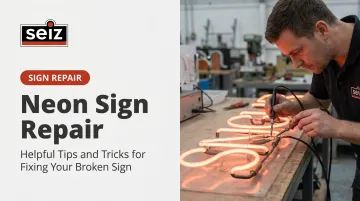
In most cases, a broken neon sign can be repaired. The solution depends on what's causing the problem. It could be a failing transformer, damaged glass tubing, or the wiring that connects the system together. Once the faulty component is identified, the right repair becomes much easier to determine.
We've been repairing and servicing neon signs across Arkansas for generations, and we've learned that many owners simply want to know whether their sign is worth fixing and what the repair will involve before making a decision.
In this guide, we'll explain the most common causes of neon sign failure, what affects repair costs, what the repair process typically involves, and when upgrading to an LED retrofit makes more sense than repairing your existing sign.
Key Takeaways
- Most neon signs can be repaired. The right solution depends on which component has failed, whether it's the transformer, glass tubing, or wiring.
- The way your sign behaves, such as flickering, dim lighting, or sections going dark, provides valuable clues about the underlying problem and the repairs required.
- Addressing problems early can help prevent additional components from failing and reduce the likelihood of more extensive repairs.
- Repair costs vary depending on the failed component, the complexity of the repair, and the overall condition of the sign.
- A professional evaluation can identify the cause of the problem and recommend the most effective repair for your sign.
How a Neon Sign Works (and Why Repairs Are Specialized)
A neon sign is a carefully engineered system made up of four main components: hand-bent glass tubing, inert gas sealed inside the tubing, electrodes at each end, and a transformer. Together, they create the distinctive glow that has made neon signs a timeless choice for businesses.
The transformer converts standard electrical current into the high voltage needed to energize the gas, while different gases and specialized coatings inside the glass produce the wide range of colors you see.
Because each component depends on the others, a problem with one part can affect how the entire sign performs. The good news is that neon signs usually don't fail without warning. Flickering, dim lighting, or sections of the sign going dark often provide clear clues about what's causing the problem. Once the issue is identified, repairs can focus on the component that needs attention, helping restore your sign efficiently and get your business back to looking its best.
Common Neon Sign Problems and What They Usually Mean
Most neon signs don't stop working all at once. They usually show clear signs that something isn't working as it should, and those symptoms often point to the component that's causing the problem. Understanding what your sign is telling you can make it easier to determine the right repair.
| Symptom | What It Usually Means |
|---|---|
| Flickering or dimming | Failing transformer, loose wiring, or gradual gas loss |
| One section is dark while the rest stays lit | Failed glass tube or electrode |
| Completely dark | Power supply, transformer, or wiring issue |
| Buzzing or a warm smell | Transformer under strain |
Flickering or Dimming
A flicker is the most common complaint we hear, and it comes down to one of three things:
- A transformer nearing the end of its life delivers erratic voltage, and the glow stutters with it.
- A loose or worn wiring connection interrupts current in the same way.
- Hairline cracks in the tubing, often too fine to see, let gas escape slowly. The results in the sign dimming over months rather than days.
Whatever the cause, flickering is usually an early warning that something needs attention. Addressing the problem sooner can often prevent additional components from being affected.
One Letter or Section Is Dark
When only one letter or section of your neon sign goes dark while the rest continues to glow, the problem is usually isolated to a section of glass tubing or one of its electrodes.
Because neon signs rely on a sealed glass tube to contain the gas, even a small crack allows the gas to escape. Once that happens, the damaged section can't simply be patched or refilled. Instead, a new piece of hand-bent glass is made to match the original and then installed in its place.
If your sign has been in service for many years, it's also worth knowing that the new section may not be a perfect color match. Older tubing naturally changes over time, so slight color variation between new and existing glass is normal.
When you call Seiz Signs, we don't jump straight to repairs. We start by evaluating your sign, explaining what's causing the issue, and helping you understand the best path forward.
Completely Dead
If your neon sign doesn't light up at all, the problem is usually related to the power supply, the transformer, or the wiring that connects them.
It's easy to assume the transformer has failed, but that's not always the case. Wiring issues can produce the same symptoms, which is why identifying the root cause is an important first step. Replacing the wrong component only adds unnecessary cost and doesn't solve the problem.
Buzzing or a Warm Smell
A low hum is normal for neon. A buzz that has grown louder, or a warm electrical smell near the sign, means the transformer is working harder than it should.
Switch the sign off and leave it off, then take it as a useful advance notice: your sign is telling you the right time for a call to us is now, while the fix is still a simple one.
What You Can Safely Check Before Calling Us
Before you pick up the phone, a few quick checks can rule out the simple stuff.
- Confirm the outlet works: Plug a lamp or phone charger into the same outlet. If it doesn't switch on, the problem may be your building’s power, not the sign.
- Check the breaker: A tripped breaker or blown fuse on the sign’s circuit is a common and easy culprit.
- Check any timer or photocell: If your sign runs on a schedule or a dusk sensor, make sure the settings have not shifted, and the sensor is not blocked or dirty.
- Look for visible damage, without touching: Note any cracked tubing, sagging sections, or discolored spots from a safe distance.
- Pay attention to when the problem occurs: Whether the sign flickers at startup, after it's been on for a while, or only in certain weather conditions can help identify the cause more quickly.
If those all check out, the problem lives past the plug, and that is high-voltage territory reserved for Licensed Sign Electricians.
Why Neon Sign Repairs Should Be Left to the Professionals
Unlike many other types of signs, neon signs should never be repaired without the right training and equipment. That's because they combine delicate hand-crafted glass with high-voltage electrical components, making specialized expertise essential.
Here are three reasons why professional repair matters:
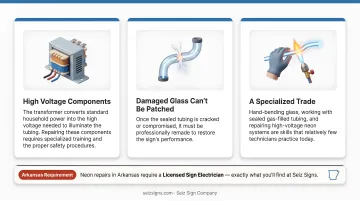
- Neon signs operate at high voltage. The transformer converts standard household power into the high voltage needed to illuminate the tubing. Repairing these components requires specialized training and the proper safety procedures.
- Damaged glass tubing can't simply be patched. Once the sealed tubing is cracked or compromised, it must be professionally remade to restore the sign's performance.
- Neon repair is a specialized trade. Hand-bending glass, working with sealed gas-filled tubing, and repairing high-voltage neon systems are skills that relatively few technicians practice today.
Not every electrical repair company is equipped to work on neon signs. In Arkansas, neon repairs require a Licensed Sign Electrician because of the specialized skills and safety requirements involved.
That's exactly what you'll find at Seiz Signs. Our team has been repairing and maintaining neon signs across Arkansas for generations, helping businesses keep their signs shining for years to come.
How We Handle Neon Sign Repair at Seiz Signs
Every repair starts with understanding what's causing the problem. We don't replace parts based on symptoms alone. Instead, we follow a step-by-step process to assess your sign, identify the source of the problem, and recommend the repair that makes the most sense.
Step 1: Perform a Thorough Inspection
We'll begin with a careful inspection of your sign, looking for visible cracks, damaged glass tubing, loose wiring, corrosion, or damage to the sign cabinet and mounting hardware. We'll also document what we observe before making any repairs, giving us a clear picture of your sign's condition before work begins.
Step 2: Diagnose the Problem
Next, we'll determine whether the issue affects the entire sign or is limited to a specific section. A sign-wide problem often points to the transformer or main power supply, while a single dark section may indicate a failed glass tube or a wiring issue within that circuit. Our team will perform the necessary testing to accurately identify the root cause before recommending any repairs.
Step 3: Recommend the Right Repair
Once we've identified the problem, we'll explain what we found and walk you through the available repair options.
- Loose wiring or electrical connections can often be repaired without replacing major components.
- A failed transformer may simply need replacement if the rest of the sign is in good condition.
- Broken or cracked glass tubing requires a professional neon replacement and gas refilling.
- Older signs with multiple issues may require a broader discussion about the most practical long-term solution.
Step 4: Test the Repair
After the repair is complete, we'll thoroughly test your sign to ensure it's operating as intended. We'll verify that every section illuminates consistently, check for unusual noise or excessive heat, and confirm the sign is performing reliably before the job is complete.
Whether your sign needs a straightforward repair or a more extensive restoration, our goal is the same: to identify the problem accurately, recommend the right solution, and get your sign back to helping your business stand out. If your neon sign is flickering, glowing dimly, or has gone dark, give Seiz Signs a call at (501) 623-3181. We'll take it from there.
How Much Does Neon Sign Repair Cost?
Neon sign repair cost depends on what failed and what it takes to fix it properly. Every sign we service is quoted individually, and four factors drive that quote:
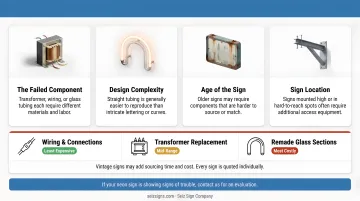
- The failed component. Replacing a transformer, repairing wiring, and remaking a section of glass tubing each require different materials and levels of labor.
- The complexity of the design. Straight tubing is generally easier to reproduce than intricate lettering, curves, or multi-colored designs.
- The age of the sign. Older signs may require components that are more difficult to source or match.
- The sign's location. Signs mounted high on a building or in hard-to-reach locations often require additional equipment and time to access safely.
As a general rule, wiring and connection repairs are typically the least expensive, transformer replacements usually fall in the middle, and remade glass sections are often the most costly. If you're repairing a vintage sign, sourcing or matching older components can also add time and cost to the project.
If your neon sign is showing signs of trouble, contact us for an evaluation.
Should You Repair or Replace Your Neon Sign?
Not every neon sign should be saved, and the honest way to decide is to look at what failed and how the rest of the sign is holding up.
| What you’re dealing with | The smarter path |
|---|---|
| Failed transformer, sign otherwise sound | Repair |
| Wiring fault, isolated | Repair |
| One or two damaged glass sections | Repair |
| Extensive glass damage | Replace |
| Wiring degraded throughout | Replace |
| Several failures at once on an older sign | Replace, or retrofit to LED |
Repair is often the better option when the problem is limited to a specific component and the rest of the sign remains in good condition. In many cases, replacing a transformer, repairing wiring, or remaking a section of glass can restore the sign for far less than the cost of a new one.
Replacement starts making sense when failures stack. Multiple problems arriving together push repair costs toward the price of starting fresh, and glass replacement carries long lead times on top. Paying repair prices repeatedly for a sign that keeps finding new ways to fail is the outcome we steer you away from.
How to Prevent Future Neon Sign Problems
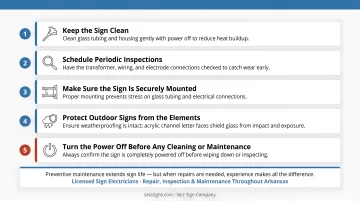
- Keep the sign clean. Dust, dirt, and debris can build up on the glass tubing and sign housing over time. Clean the exterior gently with the power turned off to help reduce heat buildup and keep the sign looking its best.
- Schedule periodic inspections. Having the transformer, wiring, and electrode connections checked every so often can help identify wear before it turns into a larger repair. This is especially valuable for older neon signs that have been in service for many years.
- Make sure the sign is securely mounted. A sign that shifts or vibrates places unnecessary stress on the glass tubing and electrical connections. Proper mounting helps protect the sign from damage over time.
- Protect outdoor signs from the elements. Weather can take a toll on any exterior sign. If your neon is installed outdoors, make sure the weatherproofing is in good condition. Acrylic channel letter faces help shield the glass tubing from physical impact and weather exposure.
- Turn the power off before any cleaning or maintenance. Whether you're wiping down the sign or performing a visual inspection, always make sure the sign is completely powered off first.
Preventive maintenance is one of the best ways to extend the life of your neon sign, but even with proper care, repairs are sometimes unavoidable. When that happens, working with an experienced sign company makes all the difference. At Seiz Sign Company, our Licensed Sign Electricians inspect, repair, and maintain neon signs throughout Arkansas, helping businesses keep their signs safe, reliable, and looking their best.
Whether you need routine maintenance or a more complex repair, our team is here to help. Contact us today.
Frequently Asked Questions
How long do neon signs last?
Well-made neon glass can glow for decades, which is why so many older signs are still in service. The electrical components age faster: transformers and wiring typically need attention long before the tubes do. A sign’s real lifespan comes down to build quality, exposure, and how early small issues get addressed.
Is it safe to leave a flickering neon sign on?
We recommend switching it off until it is looked at. A flicker usually means the transformer is delivering erratic voltage, and every hour it runs in that state adds strain to components that are still healthy. Turning it off protects the sign and keeps the eventual repair smaller.
How long does a neon sign repair take?
It depends on the fix. Electrical and wiring repairs are often resolved in a single service visit. When a glass section has to be remade, the repair takes substantially longer, since the new tube must be produced and matched to your sign, and lead times for replacement glass can be quite long. We give you a clear timeline with your quote.
Can you repair vintage or antique neon signs?
Yes. Older signs may involve sourcing or matching aged components, which we factor into the evaluation. If your sign has decades of history on your building, that is usually a reason to preserve it, and we will tell you honestly what preservation involves.
Can a Regular Electrician Repair a Neon Sign?
Not usually. Neon signs require a Licensed Sign Electrician, not a standard residential or commercial electrician. That's because they combine high-voltage electrical systems with specialized components that require specific training and experience to repair safely. At Seiz Signs, our Licensed Sign Electricians have the expertise to diagnose, repair, and maintain neon signs across the state, helping ensure the job is done safely and correctly the first time.