Introduction
Your sign is often the first thing a potential customer sees — before your website, before your storefront, before any interaction with your staff. But install that sign without the proper permits, and you could be forced to take it down before a single customer walks through the door.
Commercial sign permitting is more complex than most business owners anticipate. An illuminated channel letter sign, for example, typically requires a sign permit and a separate electrical permit, structural drawings, and a final inspection by a licensed professional. Miss one requirement, and the whole project stalls.
This guide covers what Arkansas businesses need to know:
- Which signs require permits — and which don't
- Electrical code requirements for illuminated signage
- A step-by-step walkthrough of the permit application process
- Common mistakes that consistently delay projects
Key Takeaways
- All illuminated, freestanding, and wall-mounted commercial signs require permits — exemptions are limited and city-specific
- Illuminated signs require both a sign permit and a separate electrical permit in most Arkansas jurisdictions
- Arkansas has adopted the 2020 National Electrical Code, and electric signs fall under NEC Article 600
- Overlay districts (like Hot Springs' Malvern Avenue corridor) impose stricter rules than standard zoning
- A licensed sign contractor who handles permitting is the most reliable way to avoid delays
What Is a Commercial Sign Permit and Why Do You Need One?
A commercial sign permit is the official municipal approval required before a business can legally install, modify, or replace signage on a property. These permits are issued by local planning, building, or zoning departments — Hot Springs routes sign permits through its city planning and building departments, while cities like Little Rock and Fayetteville each operate their own review processes. There is no single statewide standard; every Arkansas city or county sets its own rules.
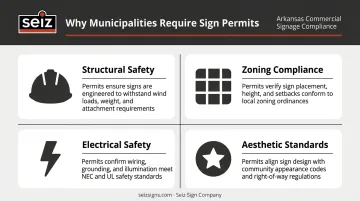
Why Municipalities Require Them
Permits exist for practical reasons that protect both the public and the business owner:
- Structural safety — signs must withstand wind loads and weather without becoming a hazard
- Zoning compliance — sign size, height, and placement must fit the property's district
- Electrical safety — illuminated signs involve wiring, circuits, and connections that create fire risk if installed incorrectly
- Aesthetic standards — many jurisdictions regulate materials and lighting to maintain neighborhood character
Consequences of Skipping the Process
Those rules carry real teeth. In Hot Springs, unpermitted signs are subject to code enforcement action and must be removed or brought into compliance before a certificate of occupancy is issued. That pattern holds across Arkansas: Centerton requires removal or compliance, Bryant includes immediate-removal language in its permit materials, and Conway allows the city to correct unresolved violations at the property owner's expense.
Beyond removal costs, unpermitted signs can delay a grand opening, complicate a lease renewal, and make retroactive permitting — which involves greater scrutiny — significantly more expensive than pulling the permit correctly from the start.
Which Types of Commercial Signs Require a Permit?
Illuminated and Electronic Signs
Channel letters, LED cabinet signs, neon signs, and digital message boards require permits in virtually every jurisdiction. In Arkansas, illuminated signs typically require both a building permit and a separate electrical permit — a standard that holds across most municipalities statewide.
Jurisdictions are particularly strict here because these signs involve electrical wiring and, in the case of LED displays, often have rules on brightness to prevent driver distraction.
Freestanding and Wall-Mounted Signs
Monument signs, pylon signs, and signs attached to building exteriors require structural review. Most Arkansas municipalities require submittal packages that include:
- Wind-load calculations for positive and negative wind pressures
- Structural calculations for footings, poles, and wall attachments
- Setback documentation confirming required distances from roads and property lines
Setback distances vary by city and sometimes by individual street corridor, so confirming local requirements before fabrication begins is essential.
Temporary Signs and Exemptions
Permanent signs aren't the only ones subject to review. Many temporary banners and grand opening signs require permits too, even for limited display periods. Some Arkansas cities do carve out narrow exemptions — but those exemptions are city-specific and can't be assumed to apply elsewhere.
The safest approach: verify with the local authority before assuming any sign is exempt. What's exempt in one Arkansas city may require a full application in the next.
Electrical Requirements for Illuminated Commercial Signs
NEC Article 600
Electric signs and outline lighting are governed by Article 600 of the National Electrical Code (NEC), which addresses wiring methods, disconnecting means, grounding, and bonding specifically for signs. Arkansas has adopted the 2020 National Electrical Code under Arkansas Board of Electrical Examiners rule 17 CAR § 210-601 — so that's the applicable edition for Arkansas projects, not the most recently published NEC revision.
Local jurisdictions may also adopt amendments, which is one reason sign code research must be done city by city.
The Separate Electrical Permit
Most municipalities require a dedicated electrical permit in addition to the standard sign permit for any illuminated installation. This permit covers the sign's wiring, circuit, and connection to the building's power supply. The city then requires a separate electrical inspection after installation before the project closes out.
UL Listing and What Inspectors Verify
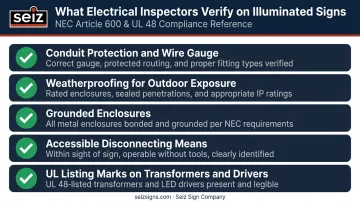
That inspection — and what passes or fails it — centers on UL-listed components. Inspectors verify compliance with UL 48, which covers electric signs, art forms, and outline lighting. For neon transformers and power supplies specifically, UL 2161 is the applicable standard.
During inspection, inspectors typically check:
- Proper conduit protection and correct wire gauge
- Weatherproofing for outdoor exposure
- Grounded enclosures
- Correct disconnecting means accessible to technicians
- UL listing marks on transformers, power supplies, and drivers
Seiz Sign Company installs UL-listed components on all electrical sign projects and has licensed sign electricians on staff to handle every phase of the electrical work.
LED vs. Traditional Lighting
LED signs draw far less power than neon or fluorescent alternatives, which often simplifies the electrical service requirements and lowers energy costs. The U.S. Department of Energy has documented LED energy savings across niche lighting applications including electric signs. Eric Schmitt at Seiz Sign Company manages the company's relationship with CleaResult through the Entergy Solutions Program, helping Arkansas clients evaluate LED conversions and applicable rebates.
One important note: LED retrofits may also require a permit if the electrical load or wiring changes from the original installation.
How to Apply for a Commercial Sign Permit: Step by Step
Step 1: Research Local Codes Before Designing
Before finalizing a sign design, verify the zoning ordinance for the property's specific district. Identify:
- Maximum allowable sign height and square footage
- Setback requirements from property lines and roads
- Restrictions on lighting type or brightness
- Whether the property falls within an overlay district
Overlay districts are where projects stall. In Hot Springs, the Malvern Avenue Overlay District (HWY 270) prohibits freestanding signs other than monument signs for commercial businesses. The same rule applies in Little Rock's Cantrell West Overlay District (HWY 10). A pylon sign that would be perfectly acceptable on a standard commercial corridor becomes a non-starter in either of those districts.
Designing a non-compliant sign wastes time and money — and restarts the clock on your opening timeline.
Step 2: Prepare Complete Documentation
A complete permit package typically includes:
- Detailed sign drawings with dimensions, materials, colors, and illumination specifications
- A site plan showing building placement and sign location relative to property lines
- Building elevation photos
- A landlord authorization letter (for leased properties)
- Structural engineering calculations for freestanding signs
- Electrical specifications for illuminated signs
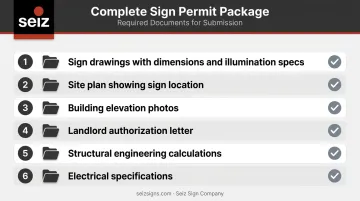
Assembling this package correctly the first time is what prevents correction cycles later. Seiz Sign Company prepares drawings, structural calculations, and UL-approved electrical permit submissions as part of its full permit service — covering channel letters, monument signs, pylon signs, and LED cabinet signs throughout Arkansas.
Step 3: Submit to the Correct Department and Pay Fees
Permit submissions may go to the planning department, building department, or zoning division — this varies by city. Misrouting an application delays the project before review even begins.
Fees vary by jurisdiction, sign type, and complexity. Review timelines also vary widely across municipalities — some list 6–10 business days for a first review; others require 20 business days for applications with plans, with accelerated options available for additional fees. In Arkansas, timelines differ between Little Rock, Hot Springs, and smaller municipalities, so confirm the current queue directly with the permit office. Illuminated signs will typically require a concurrent or follow-up electrical permit application.
Step 4: Respond Promptly to Plan Review Feedback
After submission, a plan reviewer examines the package for code compliance. Corrections are common — a mislabeled setback, an unspecified illumination type, or a dimension discrepancy between documents can all trigger a correction notice.
Respond comprehensively to avoid being pushed to the back of the review queue. Review timelines vary significantly: simple wall signs in standard commercial zones may take a few weeks; complex illuminated signs in special districts can take several months.
Step 5: Schedule the Final Inspection After Installation
Once the permit is approved and the sign is installed, a city inspector verifies that the installation matches the approved plans exactly — dimensions, placement, and electrical wiring. Passing final inspection officially closes out the permit and confirms full compliance.
Seiz Sign Company coordinates inspection scheduling directly with municipalities, handling the administrative follow-through so clients aren't left deciphering correction notices or chasing down the right contact at city hall.
Factors That Affect Sign Permit Approval
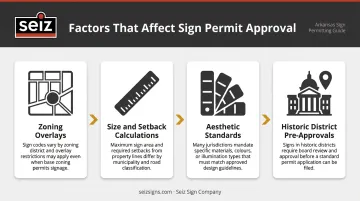
Several variables determine whether a permit application sails through review or gets bounced back:
- Zoning overlays add restrictions beyond base zoning — Historic districts, downtown design overlays, and commercial corridors often prohibit certain sign types outright. In Arkansas, overlay districts — including those in Hot Springs and Eureka Springs — restrict illumination types, materials, and mounting methods that base zoning permits freely. Assuming base zoning tells the whole story is one of the most common permitting mistakes.
- Size, height, and setback calculations must be exact — Arkansas municipalities calculate permitted sign area using factors like street frontage, right-of-way width, and road speed limits. Drawings must clearly show every dimension and setback; exceeding permitted limits by even a small margin will result in rejection.
- Aesthetic standards vary by jurisdiction — Jurisdictions with design review requirements — including several Arkansas historic districts — require sign materials, colors, and illumination styles to match neighborhood character. Submitting national brand standards without checking local requirements is a reliable way to earn a correction notice.
- Historic district pre-approvals are a separate step — Many Arkansas cities require historical commission or design review board approval before the building department will accept a sign permit application for properties in historic areas. Missing this step results in outright refusal — not just a correction request — adding weeks to the timeline.
Common Sign Permit Mistakes and How to Avoid Them
Most permit delays trace back to three recurring problems:
1. Incomplete application packages Missing a single required document — a landlord approval letter, an engineer's stamp, a jurisdiction-specific form — results in immediate rejection and resubmittal delay. Create a checklist for each jurisdiction and verify every item before submission. In Arkansas, requirements vary by municipality — Little Rock and Fayetteville each maintain their own contractor registration and submittal standards. Assuming one city's process mirrors another's is a costly mistake.
2. Inaccurate drawings and measurements Discrepancies between the application form and design drawings are among the most common triggers for correction cycles. Dimensions that don't match across documents, unlabeled setbacks, and unspecified illumination types all generate reviewer comments. Drawings are binding specifications, not rough sketches — treat them accordingly.
3. Skipping zoning verification upfront A sign design that worked at one location won't necessarily be approved at another. Sign ordinances vary dramatically by city and often by corridor within a city. Checking zoning after design work is complete leads to redesign costs and timeline setbacks that are entirely avoidable.
Frequently Asked Questions
What are the mandatory signs for construction sites?
Construction sites must post safety and regulatory signage under OSHA standard 29 CFR 1926.200, plus any signage required by local building permit conditions. Requirements vary by jurisdiction and project type, so Arkansas businesses should confirm specifics with their local building authority before work begins.
What is the electrical system in a commercial building as it relates to signs?
For illuminated signs, the central question is whether your building's existing electrical service has capacity for a dedicated sign circuit. NEC Article 600 governs how that circuit connects to sign equipment, covering disconnecting means and grounding. A licensed sign electrician can assess your service panel before installation begins.
Do I need a separate electrical permit for an illuminated sign?
In most Arkansas jurisdictions, yes. Illuminated signs require both a sign permit and a separate electrical permit. The electrical permit covers wiring, circuit connections, and grounding, and typically requires a final inspection before the sign is considered fully compliant.
How long does it take to get a commercial sign permit?
Timelines vary widely. Simple wall signs in standard commercial zones may be approved in a few weeks; complex or illuminated signs in special overlay districts can take several months. A complete, accurate application submitted upfront is the most effective way to avoid delays — something Seiz Sign Company handles directly for clients across Arkansas.
Can I install a commercial sign without a permit in Arkansas?
Installing a sign without a required permit in Arkansas risks fines, stop-work orders, and mandatory removal at the property owner's expense — as documented in municipal codes from Centerton, Bryant, and Conway. Applying for a permit after installation is possible, but it involves greater scrutiny and higher costs than permitted work from the start.
![How Much Does Commercial Sign Installation Cost? [2026 Data]](https://file-host.link/website/seizsigns-iej5ny/assets/blog-images/83c25108-8156-418f-95b0-3c6c08c2f982/1783011396512636_93394f85e0d043e48b387100828a67be/1080.webp)