![How Much Does Commercial Sign Installation Cost? [2026 Data]](https://file-host.link/website/seizsigns-iej5ny/assets/blog-images/83c25108-8156-418f-95b0-3c6c08c2f982/1783011396512636_93394f85e0d043e48b387100828a67be/1080.webp "image_id:46bbcccb-ae72-4031-977a-cafb5aca3a78")
Introduction
Your sign is ready. The design is approved. Now the quotes start arriving, and suddenly the project feels a lot less straightforward. One company's quote is several times another's, nobody explains why, and you are left wondering which one to trust.
Across the country, commercial sign installation costs for aluminum signs or letters are about $700 on average, with most small to mid-sized installations falling between $500 and $804. Small to medium size electrical signs such as wall signs (cabinet or box signs) or channel letters average $2000 per installation.
But those numbers only cover installing the sign. If you're budgeting for the entire project—from manufacturing the sign to getting a finished, illuminated sign mounted on your building—the investment can range from a few hundred dollars for a simple wall sign to significantly more for a large freestanding installation.
What causes that difference?
In this guide, we'll walk through each of these cost factors, explain why they affect your final quote, and help you understand exactly what you're paying for before you move forward with your project.
Key Takeaways
- The type of sign has the biggest impact on cost. Different signs come with different price ranges.
- Lighting costs more upfront but less to operate. LEDs typically cost only a few dollars a month to run.
- Taller signs cost more to install. They require larger equipment and more labor.
- Permits add to the total project cost. Most sign companies can handle them for you.
- National averages don't always reflect Arkansas pricing. Many local projects fall toward the lower end.
- The only way to know your exact cost is with a quote. Seiz sign provides estimates at no additional cost.
What Determines Commercial Sign Installation Cost
Every commercial sign project is priced using the same five cost factors. Understanding how each one affects your project will make it easier to compare quotes, plan your budget, and know where your money is going.
Let's look at each one.
The Type of Sign
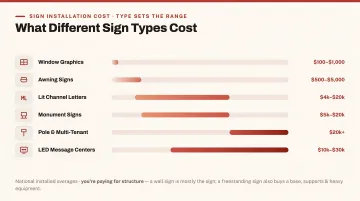
The type of sign you choose has the biggest impact on the overall cost because every sign is built differently. A simple window graphic takes far less material, fabrication, and installation than an illuminated monument sign or a multi-tenant pylon.
The table below provides a general idea of what different types of commercial signs typically cost across the country:
| Sign type | National average cost (installed) |
|---|---|
| Vinyl lettering and window graphics | $100 to $1,000 |
| Awning signs | $500 to $5,000 |
| Lit channel letters | $4,000 to $20,000 |
| Monument signs | $5,000 to $20,000 |
| Pole and multi-tenant signs | $20,000 and up |
| LED message centers | $10,000 to $30,000 |
The pattern behind the numbers is simple: you are paying for structure.
- A wall sign hangs on a building that is already there, so most of your money goes into the sign itself.
- A freestanding sign has to stand on its own, so your money also buys a concrete base, steel supports, and the heavy equipment to set it.
- An LED message center works the other way around: the structure is simple, and the screen you can change every day is what you are paying for.
The best choice isn't necessarily the most expensive one. It's the sign that fits your location, your goals, and your budget. An affordable well-placed sign may deliver better results than a $20,000 sign that's the wrong fit.
Size and Placement
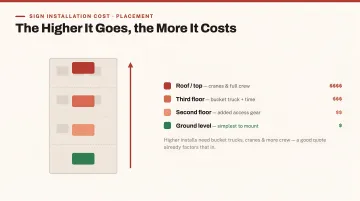
Once you've chosen the type of sign, two more factors shape the final cost: its size and where it will be installed.
Size is one of the simplest cost drivers. Larger signs generally require more materials and more installation time. But bigger isn't always better. The goal is to make your sign easy to see and read, not simply as large as possible.
Placement also affects your budget. A sign installed at ground level is usually much simpler to mount than one installed several stories above the ground. Higher installations often require bucket trucks, cranes, additional crew members, and more time on site, all of which increase installation costs.
When you receive a professional quote, these requirements should already be factored into the price, so the installation cost reflects the equipment and labor your project actually needs.
Lighting and Electrical Work
Lighting splits your quote in two, because a lit sign is really two purchases: the sign, plus the electrical work to power it. Wiring, parts, and the hookup to your building all add real cost up front.
For many businesses, though, it's worth the investment. An illuminated sign keeps your business visible after dark, making it easier for customers to find you and helping your sign continue working long after the sun goes down.
If you're investing in a new illuminated sign, LED lighting is typically the best choice. It uses very little electricity, costs only a few dollars a month to operate, and lasts for years with minimal maintenance.
Labor and Equipment
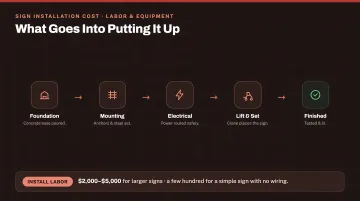
Here is the part of the quote most people never see coming: putting the sign up can cost as much as the sign itself. Across the country, installation labor runs $2,000 to $5,000 for larger signs, while a simple sign with no wiring can go up for a few hundred dollars. The final cost depends on what your project requires, including:
- Foundation work. Freestanding signs need a concrete base designed for the site and the weight of the sign.
- Mounting requirements. Brick, stucco, metal, and concrete all require different installation methods and hardware.
- Electrical work. Illuminated signs need power safely routed to the sign, whether through a wall or underground.
- Specialized equipment. Taller or heavier signs often require cranes, bucket trucks, and trained installation crews.
This is exactly why we start every pole sign installation with a free visit to your site. Everything on that list gets checked and priced before work begins, so the number you approve is the number you pay.
Permits and Code Compliance
Nearly every commercial sign needs a permit from your city, and it is a real line on your budget. Across the country, permit fees alone run from a few hundred dollars to a couple thousand, plus drawings, paperwork, and waiting in the city.
For most business owners, this is something your sign company should handle. At Seiz Signs, we handle permit issues, prepare the required paperwork, and make sure your sign complies with local sign ordinances before installation.
City rules can even decide your sign type for you. Along the Malvern Avenue Overlay District on HWY 270 in Hot Springs, commercial businesses are required to use monument signs. We catch things like that on day one, so your design is right the first time.
What a Full-Service Quote Includes
Now that you know the five factors, here is how to judge the quotes they produce. A complete quote should include one number that covers the whole job:
- A site visit to check the location, visibility, ground, and power access.
- Design built for your brand.
- Permits, handled start to finish.
- Production of the sign.
- Installation, including base, mounting, and wiring.
- A final check to ensure everything is safe, lit, and looking right.
A lower-priced quote isn't always the better value. It may simply include less. The permit may not be included. Electrical work may be priced separately. The concrete foundation for a freestanding sign may not be part of the estimate. But if your project needs those things, you'll still have to pay for them later.
So when you're comparing quotes, make sure to look at what's included. Understanding exactly what's covered upfront helps you compare proposals fairly and avoid unexpected costs later.
How to Read the Price Ranges You See Online
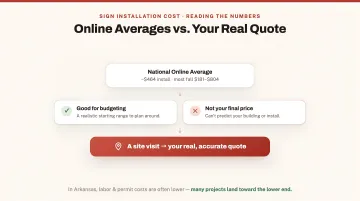
The cost ranges in this guide are a helpful starting point, but they aren't a quote for your project.
National averages combine projects of every size, from small unlit signs to large illuminated installations, across markets with very different labor, material, and permit costs. They can help you understand what commercial signs generally cost, but they can't predict what your building will cost.
They also don't always reflect local pricing. In Arkansas, labor and permit costs are often lower than they are in larger metropolitan areas, so many projects fall toward the lower end of the national price ranges.
Use these numbers to set a realistic budget and compare estimates, not to calculate your final cost. The only way to receive an accurate price is through a site visit, where a sign company evaluates your building, your installation requirements, and your project in person.
Talk to Seiz Sign Company today to get an accurate quote.
A Commercial Sign Is a Long-Term Investment
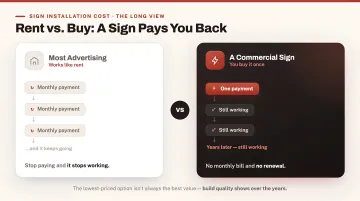
Here is the best way to think about the money you are about to spend: a sign is not an expense you keep paying. It is equipment you buy once.
Most advertising channels work like rent. You pay every month, and the day you stop paying, it stops working.
A commercial sign works the other way. You pay one time, and it advertises your business at your own address, to every car that passes, every hour of every day, for years. No monthly bill or renewal.
That's also why the lowest-priced option isn't always the best value. Two signs may look similar on the day they're installed, but over time, the difference in materials, construction, and installation quality becomes clear. A well-built sign can continue performing for years, while a lower-quality one may require more repairs, maintenance, or replacement.
Choosing the right sign isn't just about reducing your upfront cost. It's about investing in a sign that continues delivering value long after it's installed.
Let's Put Your Name in Lights
You started this guide with two quotes and no way to tell which one was real. Now you know what the honest answer looks like: a sign priced by its type, its size, its lighting, the work to put it up, and the permit to make it legal.
The final step is finding a team that can stand in front of your building and turn all of this into a quote built around your project.
That's been our job at Seiz Sign Company for 118 years.
From design and permitting to fabrication and installation, our team in Hot Springs manages every step under one roof, with licensed sign electricians on staff.
Call us at (501) 623-3181, or stop by and see us at 1231 Central Avenue in Hot Springs. We look forward to working with you.
Frequently Asked Questions
How long does commercial sign installation take?
Installation time depends on the scope of your project. A wall sign or set of channel letters goes up much faster than a freestanding pole sign that needs a concrete foundation poured and cured. Your quote includes a timeline for your specific sign, so you will know what to expect before any work begins.
Do I need a permit for a business sign in Arkansas?
In most cases, yes. Nearly all exterior commercial signs require a permit, and requirements vary by city. We handle the permitting process for you, from application to approval, and make sure your sign is fully compliant before it is installed.
Does Seiz install signs outside Hot Springs?
Yes. We design, produce, and install signs throughout the State of Arkansas, serving both local businesses and national brands. Our home base is Hot Springs, and our crews and equipment travel wherever your project is.
How do I find out what my sign will cost?
Contact Seiz Signs for a free, site-specific quote. We evaluate your location, design to your brand, and give you one accurate number covering design, permitting, production, and installation. Call us at (501) 623-3181 to get started.