The choice matters more than it might seem. It directly shapes your upfront cost, how long the investment lasts, how your brand reads from the road, and whether the numbers make sense for one vehicle or twenty.
This guide breaks down both options honestly — what they cost, how they perform, and how to decide which one is right for your business.
Key Takeaways
- Full wraps cover 100% of the vehicle; partial wraps cover roughly 25–75% of the surface
- Both use cast-grade vinyl with UV-resistant inks rated for multi-year outdoor durability
- Wrapped vehicles generate 30,000–70,000 daily impressions at as little as $0.15 CPM, per 3M fleet graphics research
- White or black vehicles can pull off a partial wrap that looks nearly identical to a full wrap from the road
- Budget, vehicle ownership, fleet size, and design complexity each point toward one option — use this guide to find yours
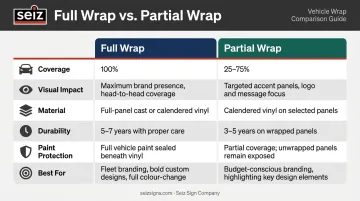
Full vs. Partial Vehicle Wraps: Quick Comparison
Here's how full and partial wraps compare across the factors that matter most to Arkansas businesses.
| Factor | Full Wrap | Partial Wrap |
|---|---|---|
| Coverage | 100% of exterior | 25–75% of exterior |
| Visual Impact | Maximum — seamless, billboard-like | Strong — especially on white/black vehicles |
| Material | Cast-grade vinyl + laminate | Same cast-grade vinyl + laminate |
| Durability | 5–7 years with proper care | Same material lifespan; exposed paint may fade differently |
| Paint Protection | Yes — covers and protects factory paint | Partial — only covered panels are protected |
| Best For | Owned vehicles, established brands, high-traffic fleets | Leased vehicles, tight budgets, white/black base color |
Cost
Wrap pricing isn't one-size-fits-all. As Graphics Pro's 2025 commercial wrap pricing guide explains, the final price depends on media grade, design complexity, coverage level, number of panels, vehicle contours, trimming, and labor time. A pickup truck and a box truck with the same "full wrap" label require very different amounts of material and installation hours.
For a custom quote based on your specific vehicle and coverage goals, contact a professional wrap provider directly. Pricing by project is always more accurate than broad national ranges.
Durability and Lifespan
Beyond cost, lifespan is where material specs matter. Avery Dennison's MPI 1105 SuperCast lists printed vertical durability up to 7 years, while 3M's IJ180mC lists expected performance life of up to 10 years for white unprinted film on vertical surfaces — with metallic finishes rating lower. Both manufacturers note that high heat, UV exposure, and humidity accelerate wear, especially relevant in Arkansas's hot, humid summers.
With partial wraps, the wrapped panels are shielded from UV while the uncovered paint is not. Over several years in direct sun, that contrast can become visible — a minor but honest trade-off to plan for.
What Is a Full Vehicle Wrap?
A full vehicle wrap is a large-format adhesive vinyl graphic applied to the entire exterior of the vehicle — every body panel, and optionally the windows, bumpers, mirrors, and roof. No original paint shows through. The vehicle becomes a mobile billboard with 360° branding coverage.
Why Businesses Use Full Wraps
Full wraps deliver four things a partial wrap simply can't match:
- Maximum surface area — more design real estate for messaging, imagery, and contact information across every panel
- Consistent fleet branding — when every vehicle looks identical from the road, it signals professionalism and scale
- Paint protection — vinyl shields factory paint from UV damage, minor scratches, and road debris, protecting resale value on owned vehicles
- Stronger visual recall — full-coverage designs register at a glance in traffic; a small door logo does not
Full wraps require cast-grade vinyl — a premium material that conforms to complex curves, deep channels, and compound body contours without shrinking back or lifting. For anything beyond a flat surface, this is the correct specification. Brands like 3M and Avery Dennison are the recognized industry standards for commercial fleet wrap film.
Full Wrap Use Cases
Full wraps deliver the strongest return when:
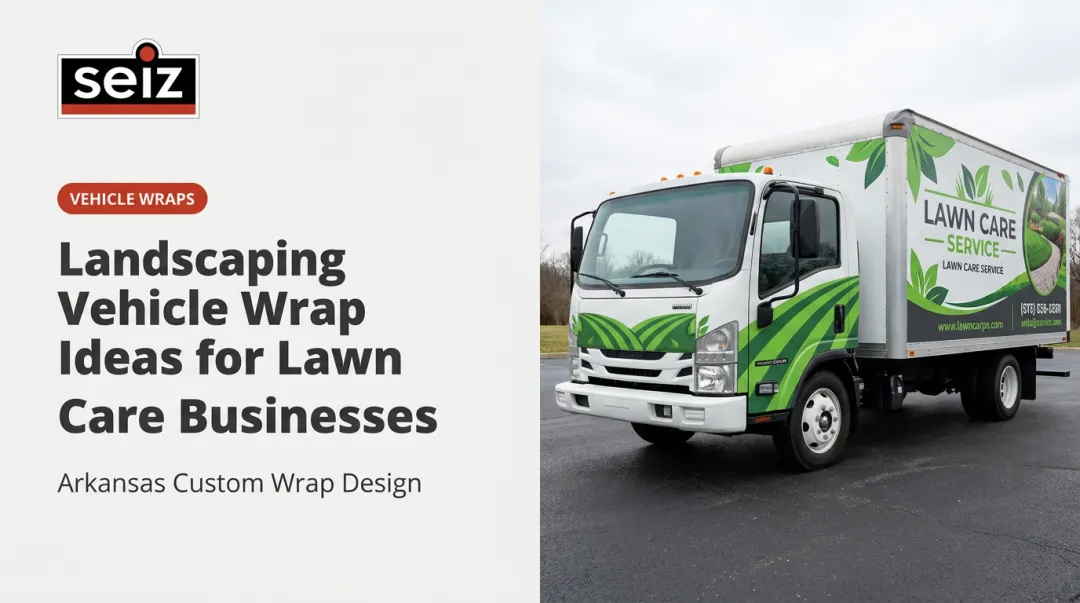
- Service fleets are in the field daily — HVAC vans, plumbing trucks, landscaping crews, and pest-control vehicles driving residential neighborhoods are rolling advertisements all day
- The vehicle IS the storefront — food trucks and mobile retail businesses where the wrap communicates the brand experience before the customer even orders
- Box trucks run high-traffic routes — side-panel coverage on a box truck is closer to a moving billboard than almost any other format
- Fleet uniformity is non-negotiable — when every vehicle needs to look like it belongs to the same professional operation
Businesses with bold visual identities — full-coverage backgrounds, photographic imagery, or complex color gradients — need the uninterrupted surface area a full wrap provides. Any design built for edge-to-edge execution loses its impact the moment it gets compressed into a partial format.
What Is a Partial Vehicle Wrap?
A partial vehicle wrap covers a portion of the vehicle's exterior — typically between 25% and 75% — while intentionally incorporating the vehicle's existing base color into the overall design. This is different from simple vinyl lettering or a small logo decal. A well-designed partial wrap is a full graphic composition; it just uses the vehicle's factory color as one of its design elements.
Why Partial Wraps Make Sense
The advantages are practical:
- Lower cost — less material and less installation labor than a full wrap
- Faster turnaround — fewer panels to print, align, and apply
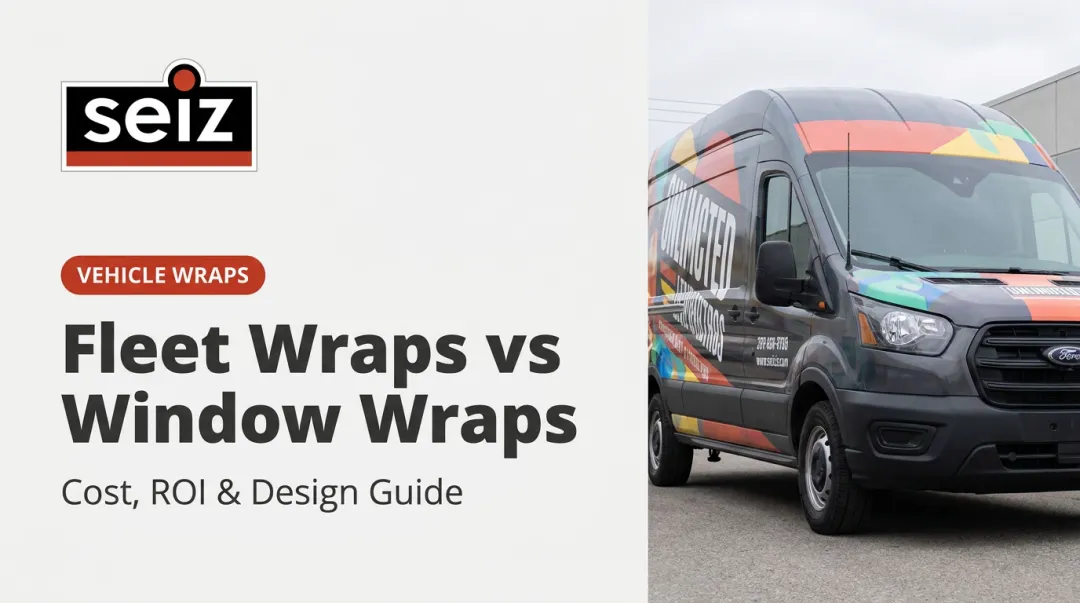
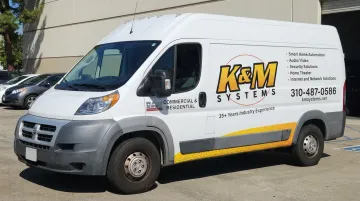
- Works with your base color — if your brand uses white or black prominently, a white van with a partial wrap can look nearly identical to a full wrap from 20 feet away. The factory paint becomes part of the design, not a gap in it
- Compatibility with leased vehicles — less coverage means less risk, and the wrap is still heat-removable without damaging factory paint when professionally installed
- Lower risk for first-time fleet branding — a well-executed partial wrap lets you test vehicle branding before committing to full coverage across multiple vehicles
A Hot Springs plumbing contractor with two white work vans, for instance, can cover the door panels with the company logo, phone number, service list, and website — plus a bold rear graphic — and produce a professional, high-visibility branded vehicle for significantly less than a full wrap. Three vans at that price point beats one van at full-wrap cost every time.
Full vs. Partial: Which Is Right for Your Business?
Neither option is universally better. The right choice depends on a handful of factors that vary by business.
Decision Framework
Choose a full wrap if:
- Brand visibility is your primary marketing driver
- The vehicle is owned long-term (not leased)
- Your design requires full-coverage imagery or a seamless background color
- You're building a fleet that needs to look uniform from every angle
- The vehicle runs high-traffic routes where maximum impressions matter
Choose a partial wrap if:
- Your per-vehicle budget is tight
- The vehicle is white or black (the base color becomes a design asset)
- The vehicle is leased and will be returned within a few years
- You're testing vehicle branding for the first time
- You need basic professional branding — logo, contact info, service callouts — without full coverage
Fleet Strategy: The Hybrid Approach
Many experienced fleet operators don't choose one or the other — they use both strategically. Full wraps on flagship vehicles that run the most visible routes. Partial wraps or spot graphics on utility vehicles, support trucks, or vehicles that spend more time parked at job sites than driving main roads. That mix gives you maximum brand impact on the assets that earn it while keeping costs manageable across the rest of the fleet.
The Advertising ROI Case
The numbers behind vehicle wraps are compelling regardless of which format you choose. Key figures make the case:
- 30,000–70,000 daily vehicular impressions per vehicle, according to 3M fleet graphics data
- $0.15 CPM for vehicle graphics, versus up to $21 CPM for online advertising
- 64% of consumers noticed vehicle graphics, per a 2019 Nielsen study
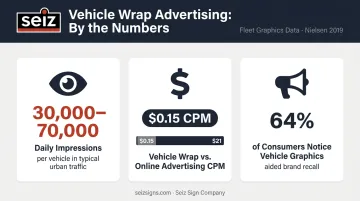
That's a one-time production cost delivering multi-year exposure — a fundamentally different investment than a recurring monthly ad buy.
For Arkansas businesses considering either route, Seiz Sign Company in Hot Springs handles vehicle wrap design, production, and installation entirely in-house. Graphics Production Manager Jorge Barboza has been leading vinyl applications since 2002, and the team serves everyone from single-vehicle small businesses to multi-vehicle commercial fleets.
Mobile installation is available throughout Arkansas for fleet projects that can't easily transport multiple vehicles to the shop.
Frequently Asked Questions
How much does it cost to wrap a car with branding?
Wrap pricing depends on vehicle size, coverage level, design complexity, and material grade — partial wraps cost less than full wraps, but ranges vary too widely to quote without specifics. Get pricing from a local provider based on your exact vehicle and coverage goals.
Is a 3M wrap worth the money?
Premium vinyl from 3M and Avery Dennison offers better conformability to complex vehicle curves, stronger UV resistance, and longer documented performance life than lower-grade alternatives. The higher upfront cost typically means fewer early failures, cleaner removal, and a longer usable lifespan — which lowers total cost over the wrap's lifetime.
How long does a vehicle wrap last?
Quality cast-grade vinyl is rated for up to 7 years of printed vertical durability per Avery Dennison's product data. Lifespan varies by sun exposure, washing frequency, and whether the vehicle is garage-kept. Hot, sunny climates like Arkansas's accelerate wear, making UV-resistant materials and proper maintenance more important than in cooler regions.
Can a vehicle wrap be removed without damaging the paint?
Professionally installed cast vinyl is designed to be heat-removable from sound factory paint, but removability depends on paint age and condition — neither 3M nor Avery Dennison warrant it universally. Avery's MPI 1105 specifically does not warrant removal on automotive paint older than 5 years.
Is a partial wrap as effective as a full wrap for advertising?
A well-designed partial wrap delivers strong brand visibility — particularly on white or black vehicles where the base color integrates naturally into the design. From a distance, a quality partial wrap on a white van can look nearly identical to a full wrap, making it a high-value option for tighter budgets.
What is the difference between a vehicle wrap and a vehicle decal?
Decals are smaller, targeted graphics — a logo on a door, a phone number on the tailgate. Wraps cover large portions of the vehicle using full-panel vinyl that incorporates design backgrounds, imagery, and multiple elements. Wraps offer more visual real estate and complexity; decals are simpler and more budget-friendly for basic identification.