Introduction
Drive through any Arkansas neighborhood on a weekday morning and you'll spot them: plain white trucks with peeling magnetic signs, or worse, no branding at all. For lawn care business owners, that blank truck isn't just a missed opportunity — it's a liability in a market where homeowners choose service providers based on who looks most established and trustworthy.
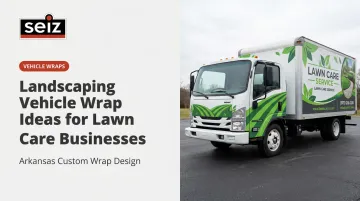
A professionally designed vehicle wrap solves that problem in one investment. Your truck becomes a moving advertisement that works every mile of every route, every day it's on the road. No monthly bill. No expiration date.
This guide walks through design styles that work for lawn care branding, coverage tiers and what each costs, what information belongs on the truck, and practical tips to protect your investment.
Key Takeaways:
- A wrapped truck can generate 30,000–70,000 daily impressions with no recurring ad spend
- Coverage options range from simple door graphics (~$250) to full wraps ($2,500–$5,000+)
- High-quality vinyl films from 3M and Avery Dennison last 7–10 years with regular care
- Your wrap needs five things: name, logo, phone number, website, and a clear call-to-action
- Working with a single in-house provider for design, print, and installation keeps the process simple and the result consistent
Why Landscaping Vehicle Wraps Are Worth the Investment
The Numbers Behind Mobile Advertising
According to 3M's fleet graphics research, a single wrapped vehicle generates 30,000–70,000 daily impressions — and **64% of US travelers notice vehicle graphics**. That same research, citing Nielsen data, reports 97% message recall for fleet graphics, a figure that outperforms television, radio, and digital ads.
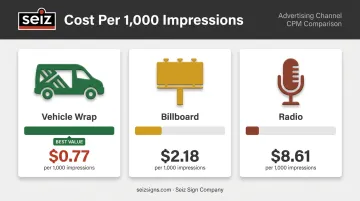
For context on cost efficiency: Heavy Duty Trucking reports a vehicle wrap CPM (cost per thousand impressions) of just $0.77, compared to $2.18 for billboards and $8.61 for radio. A full wrap paid once continues generating impressions for years.
The Trust Factor
When a crew pulls up in a fully branded truck, the message is immediate: this is a real business. No logo, no wrap, no proof. That established look matters — especially when competing against larger regional companies that already have recognizable fleets.
Brand recognition compounds over time, too. Repeated exposure in the same neighborhoods builds the kind of name recognition that no yard sign or coupon mailer can replicate:
- Homeowners remember the truck they've seen three times this week
- Familiarity drives referrals before a prospect ever contacts you
- A consistent brand signals stability, not a fly-by-night operation
Flexibility You Don't Get with Paint
Modern vinyl adhesive technology makes wraps heat-removable without damaging factory paint. For a leased truck or a business going through a rebrand, that's a meaningful advantage — you're not locked in. Wrap removal is part of the process at Seiz Sign Company, so switching designs when you're ready is straightforward — no paint damage, no downtime drama.
Types of Landscaping Vehicle Wraps by Coverage Level
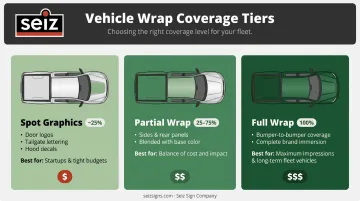
Not every truck needs a full wrap. Coverage level should match your budget, how long you plan to keep the vehicle, and how much road exposure it gets daily.
| Coverage Tier | What's Included | Best For |
|---|---|---|
| Spot graphics (~25%) | Door logos, tailgate lettering, hood decals | Startups, short-term vehicles, tight budgets |
| Partial wrap (25–75%) | Sides and rear panels, blended with base color | Balance of cost and visual impact |
| Full wrap (100%) | Bumper-to-bumper coverage | Maximum impressions, long-term fleet vehicles |
Before committing to a coverage level, consider three factors:
- How long will this vehicle stay in your fleet?
- Does it drive high-visibility routes daily, or mostly stay parked?
- Will it double as a personal vehicle after hours?
A truck that logs heavy miles through residential neighborhoods earns back a full wrap investment quickly. A spare trailer that rarely leaves the shop is a better candidate for spot graphics until you're ready to commit.
Inspiring Landscaping Vehicle Wrap Design Ideas
The best landscaping wraps share a consistent structure: clear visual hierarchy, a limited color palette (two to three colors), and imagery that communicates the service at a glance. A driver passing at 40 mph should understand who you are and what you do in under three seconds.
Before committing to a design direction, study your local competitors. Find the gap — then own it.
Every style below works. The right one depends on your market, your clients, and the identity you want on the road:
- Clean and Green — approachable, neighborhood-friendly, instantly recognizable
- Bold and Bright — maximum attention in traffic and dense suburban corridors
- Effortlessly Classy — premium positioning for upscale residential or commercial accounts
- Minimalist and Nature-Inspired — quiet confidence with high legibility at speed
- Creative and Attention-Catching — memorable, unconventional, best when the brand is already established
Clean and Green
Bright greens, crisp white fonts, leaf or grass imagery, and generous white space. This style projects professionalism and approachability without trying too hard. It's the most recognizable visual language for lawn care — familiar, trustworthy, easy to read from across a parking lot. Best for businesses that want a polished, neighborhood-friendly identity.
Bold and Bright
High-contrast combinations — neon green on black, vivid yellow on white — paired with large typography and graphic elements like mower silhouettes or turf imagery. This style commands attention in traffic and dense suburban areas. If your trucks sit at busy intersections during peak hours, bold and bright earns its keep.
Effortlessly Classy
Deep tones (dark green, charcoal, navy) with refined serif or script fonts and minimal imagery. This signals a higher price point before you say a word — and tells upscale residential and commercial clients that you belong in their spaces.
Minimalist and Nature-Inspired
Earthy palettes — olive, tan, muted green — with subtle leaf or topography motifs and generous open space. Brand identity and contact information take center stage. This style reads as quiet confidence and is easy to read at speed, making it practical for trucks constantly on the move.
Creative and Attention-Catching
Diagonal stripes, full-panel photography of finished landscapes, or distinctive mascot graphics. This breaks visual convention and sticks in memory. The catch: creative wraps work best when the business name is already strong enough to carry the design. If the visuals overshadow the brand, the truck becomes a moving art piece without telling anyone who to call.
What Information to Include on Your Lawn Care Vehicle Wrap
Keep it to what a driver or pedestrian can absorb in five seconds while moving.
Core elements — every wrap needs these:
- Company name and logo (largest, most prominent placement)
- Primary phone number
- Website URL
- Brief service description or tagline ("Lawn Care & Landscaping," "Mowing, Mulching & More")
Add a call-to-action near the phone number — most wraps leave this out.
A line like "Call for a Free Estimate" or "Book Online Today" gives viewers a reason to act rather than passively register your name. Without a CTA, a homeowner might notice your truck and still not pick up the phone.
DOT Numbers and License Identifiers
If your trucks require DOT numbers or license identifiers, include them — but place them discreetly near a wheel well or lower panel. A good wrap designer will position these so they meet compliance requirements without pulling attention away from your branding. At Seiz Sign Company, DOT lettering is built into the wrap design process so you don't have to think about it separately.
Practical Design Tips to Make Your Wrap Stand Out
File Quality Matters at Truck Scale
Any photography or graphics used in the design must be high-resolution — FESPA's vehicle wrap guidelines recommend at least 210 ppi at actual print size, with 300 DPI as the preferred target. Artwork that looks sharp on a monitor can print blurry at truck scale. Seiz Sign Company's in-house design team builds wrap files to vehicle-specific templates, catching resolution and layout issues before production begins.
Use Every Surface Strategically
- Rear panels get extended dwell time in traffic — ideal for phone number and CTA
- Side panels are visible while the truck is parked at a job site — maximize brand visibility here
- Hood or cab roof works well for a secondary logo placement visible from elevated vantage points
Every surface your truck shows to the public is real estate. Plan for all of them from the start.
Maintenance Extends Wrap Life
A few simple habits keep wraps looking sharp for years:
- Wash by hand or with touchless washes — pressure washers and stiff-bristle brushes degrade the laminate overcoat
- Avoid directing high-pressure spray at door handles and bumpers, where edges are most vulnerable
- Inspect high-wear areas periodically so a small edge lift gets caught before it becomes a damaged panel
How Much Do Landscaping Vehicle Wraps Cost?
Prices vary by coverage level, vehicle size, design complexity, and vinyl material. Use these figures as directional benchmarks, not fixed quotes — Arkansas market rates will vary by installer.
| Wrap Type | General Range |
|---|---|
| Door graphics / tailgate lettering | $250–$600 |
| Partial wrap (pickup truck) | ~$2,855 (Sign Builder Illustrated F-150 example) |
| Full wrap (pickup truck) | ~$5,705 (Sign Builder Illustrated F-150 example) |
What Drives the Cost
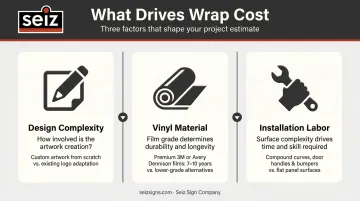
Three factors move the price significantly:
- Design complexity: Custom artwork costs more than adapting an existing logo — budget accordingly if starting from scratch
- Vinyl material: Premium films from 3M (IJ280 series: 10-year expected performance) or Avery Dennison (MPI 1105: up to 7-year vertical exposure durability) cost more upfront but last noticeably longer
- Installation labor: Compound curves, door handles, and bumpers take more time than flat surfaces — that complexity shows up in the quote
Wrap vs. Paint
According to Edmunds, a competent quality paint job with multiple coats costs roughly the same as a wrap — but a wrap is removable, updatable, and doesn't require vehicle downtime at a body shop. For a lawn care business that needs its trucks on the road, that matters.
When getting quotes, ask to see wrap jobs that are two to three years old, not fresh installs. That's the real durability test. Also ask what vinyl brand and warranty the shop uses. Seiz Sign Company's team, with Jorge Barboza leading vinyl applications since 2002, can walk you through material options and provide a project-specific quote based on your vehicles.
Frequently Asked Questions
How much does it typically cost to wrap a truck?
Simple door graphics and tailgate lettering start around $250–$600. Full wraps on pickup trucks typically run $2,500–$5,000+, with partial wraps falling in between. Final cost depends on coverage level, vehicle size, design complexity, and vinyl material.
Is it cheaper to paint or wrap a truck?
A quality multi-coat paint job costs roughly the same as a wrap, but wraps are removable, updatable, and protect the factory paint underneath. For most lawn care businesses, a wrap is the more flexible and practical choice.
What should I include on my landscaping truck wrap?
At minimum: business name, logo, phone number, website, and a brief service description or tagline. Add a call-to-action near the phone number — "Call for a Free Estimate" gives people a reason to call now.
How long do landscaping vehicle wraps last?
Premium printable vinyl films from manufacturers like 3M and Avery Dennison are rated for 7–10 years with proper care and installation. Lower-grade materials may begin fading or peeling in three to five years. Hand-washing and avoiding pressure washers extends wrap life significantly.
Can I wrap my entire lawn care fleet on a tight budget?
Start with partial wraps or door graphics on your highest-visibility trucks first, then upgrade to full wraps as budget allows. Even a logo and phone number on both doors is a clear step up from an unbranded truck — and it gets your name in front of neighborhoods you service every day.