Introduction
A potential customer decides whether to walk into your business within seconds of seeing your storefront. That judgment is instant — and your sign is what triggers it.
For small businesses working with limited marketing budgets, a storefront sign is one of the few assets that works continuously without recurring cost. Unlike a social media ad that disappears when your budget runs out, a well-made sign attracts foot traffic at 7 a.m., 7 p.m., and every hour in between.
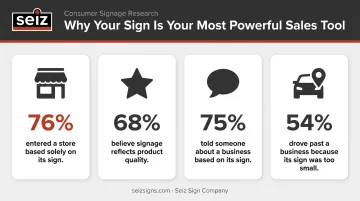
According to a FedEx Office consumer survey, 76% of consumers entered a store they'd never visited based solely on its sign — and 68% made a purchase because a sign caught their eye. For a one-time investment, that kind of consistent pull is hard to match.
This guide walks through the most effective storefront sign types for small businesses, key design and placement principles, and how to pick the right option given your location, goals, and budget.
Key Takeaways
- A storefront sign is a permanent marketing asset that works 24/7 — no recurring ad spend required
- Different sign types serve different goals: channel letters for long-term brand presence, window graphics for seasonal updates, monument signs for roadside visibility
- Placement and design matter as much as sign type — poor positioning or cluttered layouts undermine even quality signs
- Most municipalities regulate sign size, height, illumination, and placement through local sign ordinances
- A full-service sign company handles design, fabrication, permitting, and installation as one bundled process
Why Your Storefront Sign Is Your Best Marketing Tool
Most marketing requires ongoing investment. Paid ads stop running when the budget runs out. Mailers reach a limited audience once. A storefront sign requires none of that — every person who passes your location sees it, whether they're walking, driving, or stuck at a red light.
The Numbers Behind Signage
The FedEx data referenced above goes further than just foot traffic. The same survey found:
- 68% of consumers believe a store's signage reflects the quality of its products or services
- 52% were less willing to enter a store with misspelled or poorly made signs
- 75% told someone about a business based on its sign alone
The International Sign Association adds another dimension: 54% of shoppers have driven past a business and failed to find it because the sign was too small or unclear. That's not a lost customer — that's a customer who actively tried to find you and couldn't.
The Case for Illuminated Signs
A lit sign doesn't clock out. Evening commuters, late diners, and pedestrians heading out after dark all represent foot traffic that a non-illuminated sign simply misses. Illuminated signs — channel letters, LED cabinets, neon — give businesses a presence beyond business hours, prompting return visits from people who spot you on their evening commute.
That extended visibility also reinforces perceived quality. A clean, well-lit sign signals that your business is established and worth entering. A faded or generic one undermines that impression before a single customer walks through the door.
8 Storefront Sign Ideas for Small Businesses
These sign types span a range of budgets, business sizes, and goals. The best choice depends on your location, visibility needs, and how often your message needs to change.
Channel Letter Signs
Channel letters are individually fabricated three-dimensional letters — typically aluminum and acrylic — mounted directly to a building facade. They come in three primary configurations:
- Front-lit (regular): Light projects forward through a translucent face — the standard choice for retail, restaurants, and high-traffic storefronts
- Back-lit (halo): Light glows behind the letters onto the mounting surface, creating an upscale architectural effect
- Open-faced: The light source is directly visible, producing a retro, high-impact look
For small businesses seeking a permanent, professional storefront presence, channel letters are hard to beat. They're highly customizable — virtually any font, color, or size — and LED-illuminated versions offer strong night visibility with lower energy consumption than older fluorescent or neon alternatives.
Seiz Sign Company fabricates all three types with LED or neon illumination options, and every installation uses UL-approved components.
LED and Electronic Message Center Signs
LED signage spans a wide range — from static illuminated cabinet signs to fully programmable Electronic Message Centers (EMCs) that display animation, photos, and real-time promotional content.
The operational advantage for small businesses is significant. An EMC lets you promote a daily lunch special, announce a seasonal sale, or update your hours without printing or replacing physical signage. Most EMC software updates content in under five minutes from any connected device.
Important: Electrical sign installation requires a Licensed Sign Electrician. In Arkansas, the Board of Electrical Examiners administers sign specialist licensing, and all UL-compliant electrical sign installations must be performed by credentialed contractors.
Window Graphics and Vinyl Decals
Storefront windows are underused advertising space. Vinyl window graphics can display business hours, seasonal promotions, and branding without consuming sidewalk space or requiring structural changes.
Options range from:
- Full-window wraps for bold, brand-forward coverage
- Perforated vinyl that displays graphics outside while maintaining interior visibility
- Cut-vinyl lettering for clean, minimal business identification
Perforated vinyl, in particular, offers full-color exterior coverage with a built-in tint benefit — useful for sun-exposed storefronts. These are among the most budget-flexible sign options and can be updated seasonally.
A-Frame and Sandwich Board Signs
A-frames are portable, double-sided sidewalk signs that can be updated daily with specials, menus, or directional messaging. They work well for cafes, salons, boutiques, and any business that depends on pedestrian traffic.
A few practical considerations:
- They're most effective at close range — pedestrian level, not vehicle visibility
- Local sidewalk ordinances regulate placement; many require at least 36 inches of clear sidewalk passage (some municipalities require more)
- Weather-resistant materials and bold, high-contrast typography are non-negotiable for durability and legibility
Blade Signs
Blade signs mount perpendicularly from a building facade on a bracket, making them visible to pedestrians approaching from both directions along a sidewalk. On busy commercial streets, a blade sign can be spotted by pedestrians approaching from either direction — something a flat facade sign simply can't match.
Keep blade sign designs simple. The limited surface area isn't suited for detailed messaging — it's built for quick brand recognition and wayfinding. Business name, logo, and possibly a directional indicator are all you need.
Monument Signs
Monument signs are low-profile, ground-level freestanding structures placed near a business entrance or property boundary. They're typically used by businesses set back from the road where building-mounted signs aren't visible from the street.
Best use cases include:
- Office parks and professional service firms
- Medical practices and healthcare facilities
- Restaurants with parking lots
- Multi-tenant commercial plazas
- Churches and institutional buildings
In certain Arkansas locations — including the Malvern Avenue Overlay District in Hot Springs and the Cantrell West Overlay District in Little Rock — monument signs are legally required for commercial businesses. Knowing local regulations before choosing a sign type isn't optional.
Neon and LED Neon Signs
Traditional neon uses glass tubes filled with illuminated gas. Modern LED neon flex uses flexible LED strips shaped into custom designs. Both create the warm, eye-catching glow that's been a retail staple for decades — but LED neon consumes significantly less energy. Blink Signs' technical guide puts the comparison at 6–10 watts per foot for LED neon versus 60–100 watts per foot for traditional glass neon.
LED neon works well for bars, restaurants, salons, and entertainment venues that want a distinctive visual identity. These signs are also naturally shareable on social media, extending their reach well beyond the physical storefront.
Sign Placement Tips to Maximize Visibility
The Two-Sign Strategy
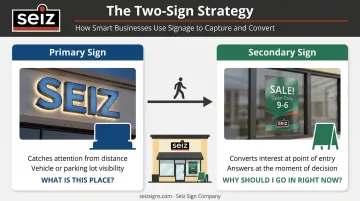
Many successful small businesses use two signs that work together at different stages of a customer's approach:
- A high-visibility primary sign (channel letters, pole sign, or monument) catches attention from a distance — from a moving vehicle or across a parking lot
- A close-range secondary sign (A-frame, window decal, or door sign) converts that passing interest into action at the point of entry
The primary sign answers "what is this place?" The secondary sign answers "why should I go in right now?"
Placement Principles
- Pedestrian-facing signs: Eye-level placement, 5–7 feet from the ground
- Vehicle-facing signs: Elevated mounting for sightline clearance over parked cars
- Legibility distance: The ISA recommends at least 1 inch of letter height for every 25 feet of viewing distance — a sign read from 100 feet needs 4-inch letters minimum
- Glare: Check sign visibility at different times of day, particularly for west-facing illuminated signs at sunset
- Obstructions: Trees, utility poles, and parked delivery vehicles can all block signage that looks perfectly placed on installation day
Those physical factors are only part of the equation — placement decisions also have to clear a regulatory hurdle. Most municipalities regulate sign size, illumination, and height through local sign ordinances, and in Arkansas those rules vary significantly, sometimes block by block. Research local requirements before installing any permanent or semi-permanent sign. Seiz Sign Company handles permit research and application as part of every project, so you're not navigating zoning codes alone.
Design Tips for a More Effective Storefront Sign
Legibility First
The most common small business sign mistake is putting too much on the sign. Crowded designs with multiple fonts, busy graphics, and dense text become unreadable at distance — especially from a moving vehicle.
Practical rules:
- Use sans-serif, bold fonts — they read fastest at distance
- Apply the 1-inch-per-25-feet letter height rule for sizing
- Maintain at least 70% contrast between text and background — dark text on light background or light text on dark background, not competing mid-tones
Brand Consistency
Your sign's colors, fonts, and logo should match your other branded materials. Cohesion builds recognition faster than any single element alone — and customers pick up on inconsistency quickly, even if they can't name it.
Keep these touchpoints aligned:
- Website and social media graphics
- Business cards and printed collateral
- Packaging and interior signage
- Vehicle lettering and fleet graphics
Materials and Durability
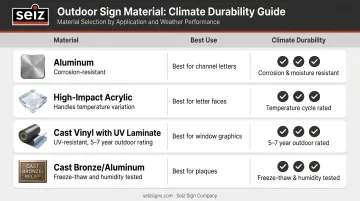
Outdoor signs in Arkansas face UV exposure, humidity, and significant temperature swings. Material choices directly affect how long a sign looks its best:
| Material | Best For | Climate Consideration |
|---|---|---|
| Aluminum | Channel letters, dimensional letters, sign faces | Corrosion-resistant, won't rust in humidity |
| High-impact acrylic | Letter faces, monument sign faces | Handles temperature variation |
| Cast vinyl with UV laminate | Window graphics, printed signs | UV-resistant inks rated for 5–7 years outdoors |
| Cast bronze / cast aluminum | Plaques, architectural signage | UV, freeze-thaw, and humidity tested |
How to Choose the Right Storefront Sign for Your Small Business
Match the sign type to your primary goal, then build from there.
Scenario 1 — Restaurant on a busy street: A restaurant needs to be found from the road and communicate its identity at close range. The right combination is typically illuminated channel letters or an LED cabinet sign for building identification, paired with a programmable electronic message center near the entrance to display daily specials. Window vinyl handles hours and seasonal promotions on the glass.
Scenario 2 — Professional office set back from the road: A medical practice or insurance agency set back from the street needs a monument sign at the property entrance for roadway visibility. Building-mounted channel letters or dimensional letters handle identification at the entrance itself.
Scenario 3 — Boutique retail shop in a walkable district: A boutique on a pedestrian street benefits from a blade sign for sidewalk visibility in both directions, window graphics for seasonal promotions and branding, and window vinyl or a programmable LED display for daily specials or event messaging.
Budget Reality
Permanent electrical signs require a higher upfront investment but deliver the best long-term ROI — no recurring spend, continuous visibility, durable materials. Portable and printed options cost less and are easier to update. For most small businesses, a layered strategy using both makes the most sense.
Cost ranges vary widely by sign type, materials, and local permitting complexity. As a general reference:
- A-frame signs: $100–$500
- Vinyl window graphics: Varies by coverage, film type, and complexity
- Channel letter signs: $2,000–$20,000+
- Monument signs: $8,000–$25,000+ depending on materials, foundation, and site work
Arkansas small businesses can work with Seiz Sign Company in Hot Springs for the full process — design, fabrication, permitting, and installation under one roof. With over 115 years of experience, Licensed Sign Electricians on staff, and direct familiarity with Arkansas sign ordinances statewide, they take the guesswork out of code compliance and installation. Reach them at (501) 623-3181 or visit seizsigns.com.
Frequently Asked Questions
How can I make my storefront stand out?
Combine a distinctive, well-lit primary sign with consistent brand colors and fonts, then add a close-range secondary sign — an A-frame or window graphic — that gives passersby a reason to stop. Good lighting and unobstructed placement do more than most design changes.
What are popular storefront sign trends right now?
LED-illuminated channel letters, programmable Electronic Message Centers for real-time promotional updates, and LED neon for social-media-friendly aesthetics are all seeing strong adoption. Energy-efficient LED lighting across all sign types is the clearest technical trend.
What should I put on a shop sign?
Business name, logo, and optionally a one-line descriptor of what you do. Keep it brief and readable from a distance. The more you try to put on a sign, the less any of it registers.
What is a storefront sign called?
Storefront signs go by several names depending on type — fascia signs, blade signs, channel letter signs, monument signs, or simply business signs. "Exterior business signage" is the umbrella term for any sign visible from outside your location.
Do I need a permit for a storefront sign?
Most U.S. cities and counties require permits for permanent exterior signs, with regulations covering size, height, illumination, and placement. Check local sign ordinances before installation. A licensed sign company can manage the permitting process on your behalf.
How much does a storefront sign cost for a small business?
Costs depend on sign type — simple window decals can run under a few hundred dollars, while illuminated channel letter signs or monument signs typically range into the thousands. Always get a quote that accounts for design, fabrication, permitting, and installation together, not just materials. A full-service sign company like Seiz Sign Company can walk you through all-in pricing before any work begins.