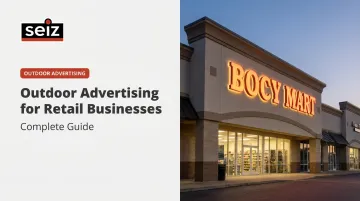
That's the cost of under-investing in outdoor advertising. It's not dramatic. It's just quiet, daily revenue walking past your door.
Out-of-home (OOH) advertising — any promotional display that reaches customers outside their homes — remains one of the most reliable tools for retail businesses. It can't be skipped, blocked, or scrolled past. It works while you sleep. And according to OAAA and Kochava research, OOH campaigns in the retail vertical deliver a 25% median in-person lift — measurable store visits, not just brand impressions.
This guide covers everything a retail business needs to build an effective outdoor advertising strategy: the formats that matter most, design principles that actually work, permit requirements you can't ignore, and how to pick the right combination for your store.
Key Takeaways
- OOH advertising reaches customers in the physical world and can't be blocked, skipped, or closed like a digital ad
- Retail OOH delivers a 25% median in-person lift, making it one of the most measurable formats for driving foot traffic
- The most retail-relevant formats are storefront signs, billboards, banners, window graphics, and vehicle wraps
- Effective ads follow OAAA's 6-second rule: one message, under 7 words, one call to action
- Most permanent signs and billboards require local permits — always work with a licensed sign contractor
Types of Outdoor Advertising for Retail Businesses
Most retail owners think of outdoor advertising as one thing: the sign above the door. In reality, there are five distinct formats worth considering — and the strongest strategies layer several of them together.
Storefront Signage: Your Most Important Asset
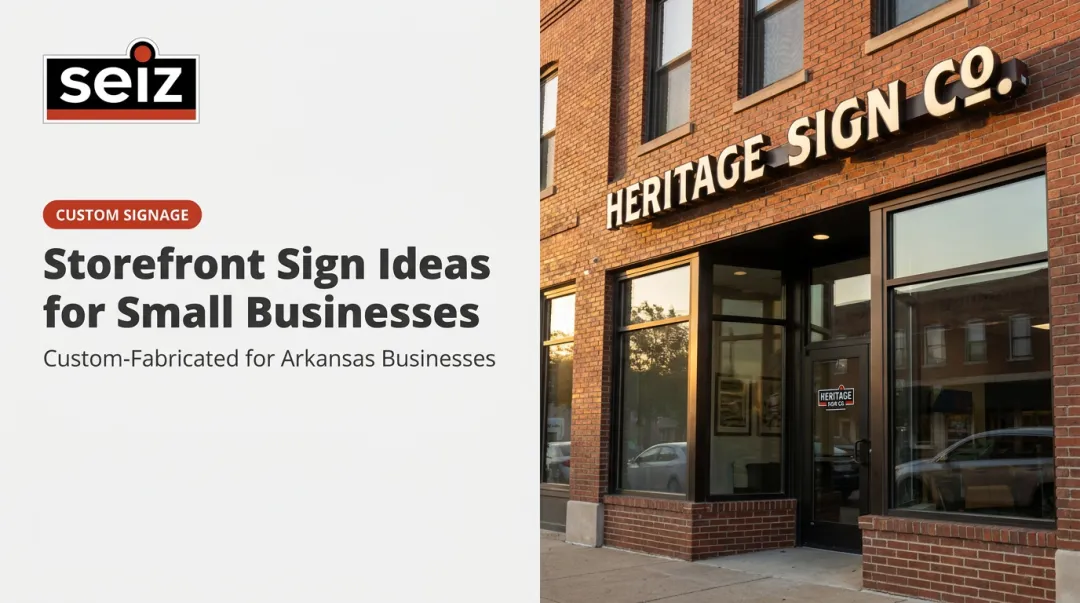
Your storefront sign is the one piece of advertising that works every single hour you're open, and many hours you're not. A 2012 FedEx Office survey found that 76% of U.S. consumers entered a store they had never visited before based on its sign, and 68% made a purchase because a sign caught their eye. More telling: 60% were deterred from entering a business with no sign at all.
For retail storefronts, illuminated signs extend that impact well beyond business hours. Sign Research Foundation data from 2014 found that 58% of businesses believed they would lose customers if prohibited from illuminating their signs, with an estimated average sales loss of 21% among that group.
Seiz Sign Company fabricates several types of illuminated storefront signs for Arkansas retailers:
- Channel letters produce individual dimensional letters in nearly any font, color, or size; front-lit, back-lit, and open-faced options are all available, and they're the go-to choice for many national retail chains
- Cabinet signs are internally lit box signs with embossed, flat, or flex faces, available with fluorescent or LED illumination
- Backlit signs deliver a clean, high-contrast storefront presence with minimal visual clutter
Today's LED illumination matches or outperforms neon in visibility, reliability, and energy efficiency. It's what Seiz most commonly installs for new retail clients.
Billboards
Billboards reach customers before they ever arrive at your block. OAAA and Solomon Partners research found OOH produces higher consumer ad recall than TV, podcasts, radio, print, and online — and nearly 90% of consumers noticed a billboard in the past month.
Two formats to understand:
| Format | Best For | Key Characteristic |
|---|---|---|
| Static billboard | Sustained local awareness | Cost-effective; long-term exposure; simple message |
| Digital/LED billboard | Promotions, events, time-sensitive offers | Rotates 6–8 advertisers; copy changes without print charges |
For retailers in Hot Springs and Garland County, Seiz Sign Company operates over 90 billboard locations with 225 faces — the largest outdoor advertising inventory in the area. That scale makes it practical to place ads near the specific routes your target customers travel most.
Banners, Flags, and Window & Vehicle Graphics
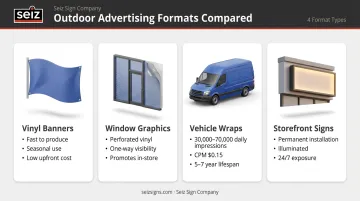
Banners and flags are the right tool for time-sensitive promotions, grand openings, and seasonal sales. They're fast to produce, easy to update, and reusable. Seiz produces custom vinyl banners engineered for Arkansas weather. Standard options include:
- 13oz and 18oz heavy-duty vinyl for durability
- Mesh vinyl for wind resistance in exposed locations
- UV-resistant inks to prevent fading
- Finishing options: grommets, hem edges, and wind slits
A step up from banners, window graphics turn unused glass storefront space into advertising real estate. Perforated vinyl is particularly effective: it displays full-color graphics to passersby while preserving one-way visibility for people inside. It also adds a tint/shade benefit, reducing glare without blocking natural light. Common retail uses include store hours, promotions, brand imagery, and seasonal messaging.
Vehicle wraps extend a retail brand's reach across an entire service area. According to 3M, fleet graphics can generate 30,000 to 70,000 daily impressions at CPMs as low as $0.15 — among the lowest cost-per-impression of any advertising format. Professionally installed wraps last 5–7 years with proper care. Seiz offers full wraps, partial wraps, and vinyl lettering for cars, vans, trucks, trailers, and fleet vehicles across Arkansas.
How to Design Outdoor Advertising That Drives Foot Traffic
Outdoor ads compete for attention in some of the most cluttered visual environments imaginable — roadsides, parking lots, shopping districts. Great design doesn't just look good. It communicates before the viewer has consciously decided to pay attention.
The 6-Second Rule and the 7-Word Limit
The popular "3-second rule" you may have heard about lacks verified sourcing. The actual OAAA standard is more nuanced — and more useful.
OAAA's creative best-practices guide establishes that:
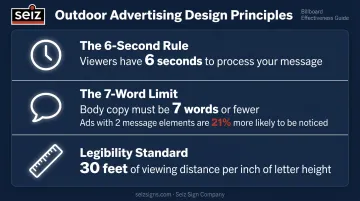
- The average viewer has 6 seconds to process an outdoor message
- 7 words or less is the proven benchmark for body copy
- Ads with 2 message elements are 21% more likely to be noticed than ads with 5
In practice: one offer, one visual, one call to action.
Keep Copy Short and Visuals Bold
The most common mistake in retail outdoor advertising is treating a sign like a brochure. Brochures invite people to linger; signs have to work in seconds. That means:
- Use high-contrast color combinations — light text on dark backgrounds or vice versa
- Avoid all-caps paragraph text; it reduces readability at speed
- Use negative space intentionally to let the key message breathe
- Make sure the headline is readable from the distance at which viewers will encounter it
FHWA research establishes a legibility standard of 30 feet of viewing distance per inch of letter height for static signs. A 4-inch letter is readable from about 120 feet. A billboard meant to be read at highway speed needs letters measured in feet, not inches.
Consistent Branding Across All Formats
A storefront sign that doesn't match the billboard that doesn't match the vehicle wrap creates visual confusion — even if each piece is well-designed on its own. Customers see your brand across multiple touchpoints in their daily movement, and inconsistency erodes recognition rather than building it.
Use the same:
- Color palette and hex values
- Logo version and placement rules
- Font family
- Tone of voice in any copy
Seiz Sign Company's in-house design team builds all formats — storefront signs, billboard artwork, banners, and vehicle wraps — from a single unified design file, so every touchpoint stays consistent without extra back-and-forth.
Include a Clear Call to Action
Every outdoor ad needs one action the viewer should take. Not two. One.
- Visit a location — include the address or a landmark reference
- Call a phone number — large enough to read from viewing distance
- Scan a QR code — increasingly common as a bridge between physical ads and digital landing pages
QR code usage on outdoor advertising has grown steadily as smartphones became universal. For static signage, OAAA recommends sizing QR codes for reliable activation at the expected viewing distance and keeping the destination simple — a promotional landing page, not a homepage.
Navigating Permits, Zoning, and Local Regulations
Skipping the permit process isn't a risk worth taking. Most permanent outdoor signs and billboards require local approval before installation — and the consequences of non-compliance include fines, forced removal at the business owner's expense, and project delays that push back your opening or campaign.
Federal law draws the outer boundary: The Highway Beautification Act of 1965 controls outdoor advertising within 660 feet of interstate and federal highway rights-of-way. Under 23 USC 131, states risk losing 10% of Federal-aid highway funds for non-enforcement — which is why state transportation departments treat billboard permits seriously.
State and local rules stack on top: State DOTs, counties, and municipalities each add their own requirements. In Illinois, a sign erected without a permit must be removed at the owner's expense. In Florida, annual outdoor advertising licenses cost $300 and expire every year. Requirements vary at least that much from state to state — often more.
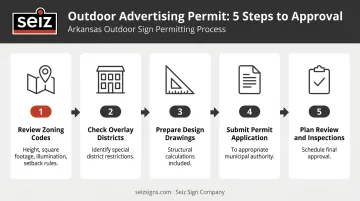
What the typical permit process looks like:
- Review local zoning codes for the specific address — height, square-footage, illumination, and setback rules can change block by block
- Identify any overlay district restrictions (in Hot Springs, the Malvern Avenue Overlay District on HWY 270 requires monument signs and prohibits other freestanding signs for commercial businesses)
- Prepare design drawings and structural calculations
- Submit permit application to the appropriate municipal authority
- Complete plan review, then schedule inspections
Temporary signage — banners and A-frames — often falls under different (and looser) rules than permanent structural signs, but it's not automatically exempt. Check local ordinances before installation.
Working with a licensed sign contractor removes most of this burden. Seiz Sign Company holds a licensed electrical contractor designation with a master electrician and licensed sign electricians on staff. The team handles the full permit process statewide across Arkansas — code research, zoning compliance review, overlay-district approvals, application submission, and inspection scheduling included.
How to Choose the Right Outdoor Advertising for Your Retail Store
There's no universal "best" format. The right outdoor advertising mix depends on your location, your goals, and how your customers move through your area.
Match Format to Goal
| Goal | Recommended Formats |
|---|---|
| Drive immediate foot traffic | Storefront signs, window decals, feather flags near the entrance |
| Build local brand awareness | Billboards, vehicle graphics — high reach, repeated exposure over time |
| Promote a time-sensitive offer | Vinyl banners, feather flags, digital billboards — fast to update |
Match Format to Location and Audience
A retailer on a high-speed arterial road benefits most from a well-positioned billboard and an illuminated storefront sign with large lettering readable at 45 mph. A boutique in a pedestrian shopping district should prioritize storefront signage, window graphics, and sidewalk-adjacent displays.
Before locking in a format for either scenario, research:
- Daily vehicle counts near your location
- Pedestrian foot traffic patterns by time of day
- Which routes your target customers actually travel
Think in Cost-Per-Impression, Not Upfront Cost
Some formats are one-time investments. Others are recurring.
- Storefront channel letters and vehicle wraps — one-time fabrication cost with 5–10 year lifespans
- Static billboard rentals — typically $1,000–$5,000/month in small to mid-size markets, per 2025 Fit Small Business data
- Vinyl banners — low upfront cost, designed to be reprinted seasonally
The most cost-efficient metric is cost-per-impression over the sign's useful life. A professionally installed channel letter sign that generates daily impressions for a decade at a fixed fabrication cost often outperforms any recurring rental on that measure.
Layer Multiple Formats for Maximum Impact
The most effective retail strategies combine formats into a layered system:
- Storefront sign anchors brand identity at the location
- Billboard builds awareness across the surrounding area
- Banner or flag captures attention at the point of decision
- Vehicle wrap extends reach across every route your vehicles travel
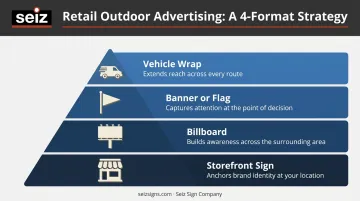
Each format hits a different moment in the customer's daily movement. Kantar research cited by OAAA found that consumers exposed to OOH 14 or more times visit physical stores nearly 4 times as often as those exposed once.
Frequently Asked Questions
What are examples of outdoor advertising?
The most common retail formats include storefront signs, billboards (static and digital), vinyl banners, window decals, monument signs, vehicle wraps, and LED displays. If it promotes your business to people outside their homes, it qualifies as OOH advertising.
What is the 6-second rule for billboards?
OAAA's creative guidelines establish that the average viewer has 6 seconds to process an outdoor message. As a result, billboard designs should use 7 words or fewer, limit the ad to 2 message elements, and include one clear call to action that registers immediately at speed.
What permits do I need for outdoor advertising signs?
Requirements vary by city, county, and state — most permanent signs and billboards require local zoning approval before installation. Temporary signage like banners may have separate rules. A licensed sign contractor can research local codes and manage the full application process on your behalf.
How much does outdoor advertising cost for a retail business?
Costs vary widely by format. Static billboard rentals in small to mid-size markets average $1,000–$5,000 per month; vinyl banners start under $100. Storefront channel letters and vehicle wraps are one-time fabrication investments with multi-year lifespans — get quotes based on your size, location, and illumination needs.
What is the most cost-effective outdoor advertising for small retailers?
Storefront signs and window graphics typically deliver the highest value for small retailers — they require a one-time investment and target customers who are already physically near the store and primed to make a purchase decision. For ongoing brand building with a small budget, partial vehicle wraps offer strong ROI.
How do I measure outdoor advertising success?
Start with foot traffic counts, unique promo codes or QR codes tied to specific ads, and changes in calls or website visits after a new sign goes up. Survey customers about how they found you. For larger campaigns, OAAA's measurement framework tracks reach, frequency, and demographic composition.