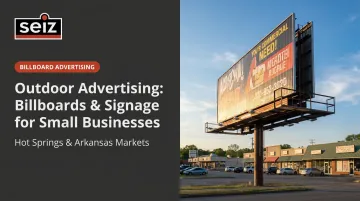
From roadside billboards to illuminated storefront signs, out-of-home (OOH) advertising puts your message directly in front of local audiences who simply can't avoid it. According to a 2023 OAAA/Morning Consult study, 88% of adults ages 18-64 noticed an OOH ad in the past 30 days — and about 69% specifically noticed a billboard.
For small businesses competing against bigger budgets, that kind of reach matters. This guide covers what outdoor advertising is, why it works, the most common formats, how to design ads that get noticed, and what costs and permits look like for Arkansas businesses.
Key Takeaways
- OOH advertising includes any promotional message in public spaces — billboards, storefront signs, banners, vehicle wraps
- It reaches a wide local audience around the clock with no per-click or per-impression ongoing cost
- Top formats for small businesses: billboards, illuminated storefront signs, vinyl banners, and vehicle graphics
- Effective outdoor ads share three traits: simple message, bold visuals, strategic placement
- In Arkansas, most commercial sign installations require local and/or state permits — a licensed sign company handles compliance
What Is Outdoor Advertising?
Outdoor advertising — also called out-of-home or OOH advertising — refers to any promotional message placed in a public or outdoor space to reach people as they go about their daily lives. Common formats include:
- Highway and roadside billboards
- Channel letter signs above storefronts
- Monument and pole signs at property entrances
- Wrapped delivery vans and fleet vehicles
- Banners, window graphics, and building identification signs
Unlike digital media, outdoor advertising exists in the physical world. There's no ad blocker for a highway, and no one scrolls past a storefront sign. For local businesses in communities like Hot Springs, Arkansas, that physical permanence is valuable — your message reaches people whether or not they're staring at a screen.
Why Outdoor Advertising Works for Small Businesses
The "Always On" Reach Advantage
A well-placed billboard or storefront sign works 24 hours a day, seven days a week, including holidays. There's no ad budget depleting per impression, no algorithm deciding who sees it, no expiration date. That's a different value proposition entirely compared to a social media post that disappears in hours.
Repeated exposure builds recognition over time. Academic research on advertising frequency — including Herbert Krugman's foundational work — supports the principle that multiple exposures to a brand message are what convert passive awareness into action.
Commuters who drive the same route daily will see your billboard dozens of times per month, compounding that familiarity with every pass.
Cost Efficiency Compared to Other Channels
OOH advertising is one of the most cost-efficient media channels available to small businesses. According to 2026 CPM benchmarks from Adsposure, the cost gap between OOH and traditional broadcast is substantial:
| Channel | Approximate CPM |
|---|---|
| Programmatic digital OOH | $8 |
| Broadcast primetime TV | $45 |
That's a meaningful difference when you're managing a limited marketing budget. Place ads near your business, along commuter routes, or in neighborhoods where your customers live and work — and every impression is someone who could realistically walk through your door.
Reinforcing Your Other Marketing Channels
Outdoor advertising doesn't work in isolation — it reinforces everything else you're doing. When a customer sees your billboard on their commute and then encounters your brand online later that day, recognition builds faster. Consistent colors, fonts, and messaging across your physical signage and digital presence create a cohesive brand experience that sticks.
Types of Outdoor Advertising for Small Businesses
Billboards
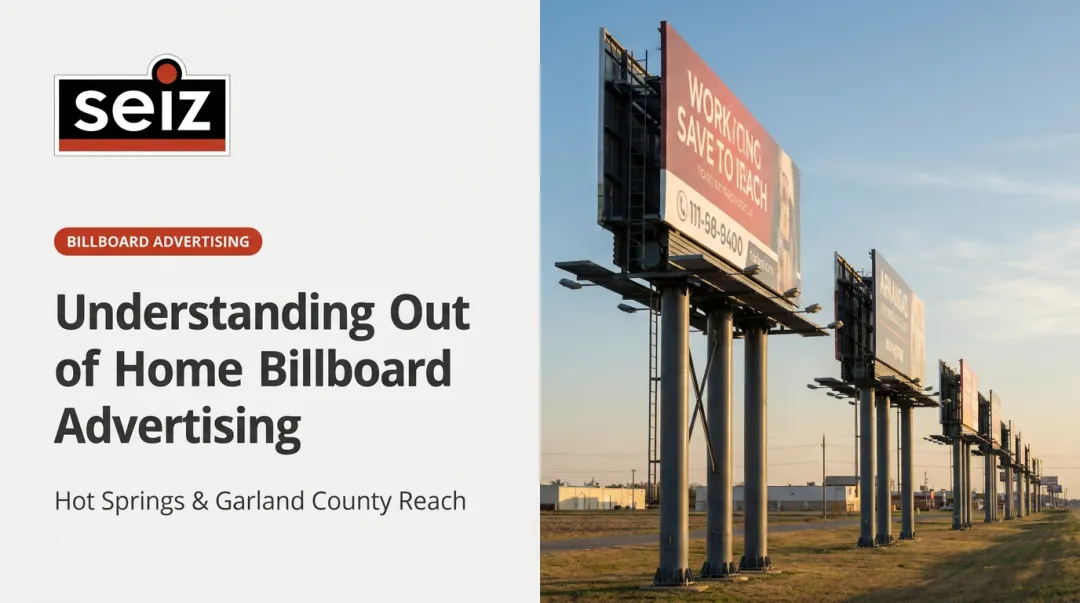
Billboards are large-format displays placed in high-traffic areas — highways, major intersections, and commercial corridors — designed to reach large audiences quickly and build top-of-mind awareness.
Two main formats small businesses will encounter:
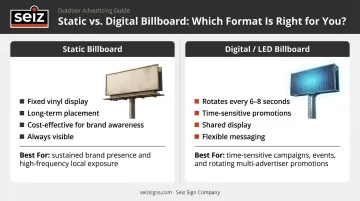
- Static billboards — vinyl-face displays that offer fixed, long-term placement. Cost-effective for ongoing brand awareness campaigns, and the most common format in most markets
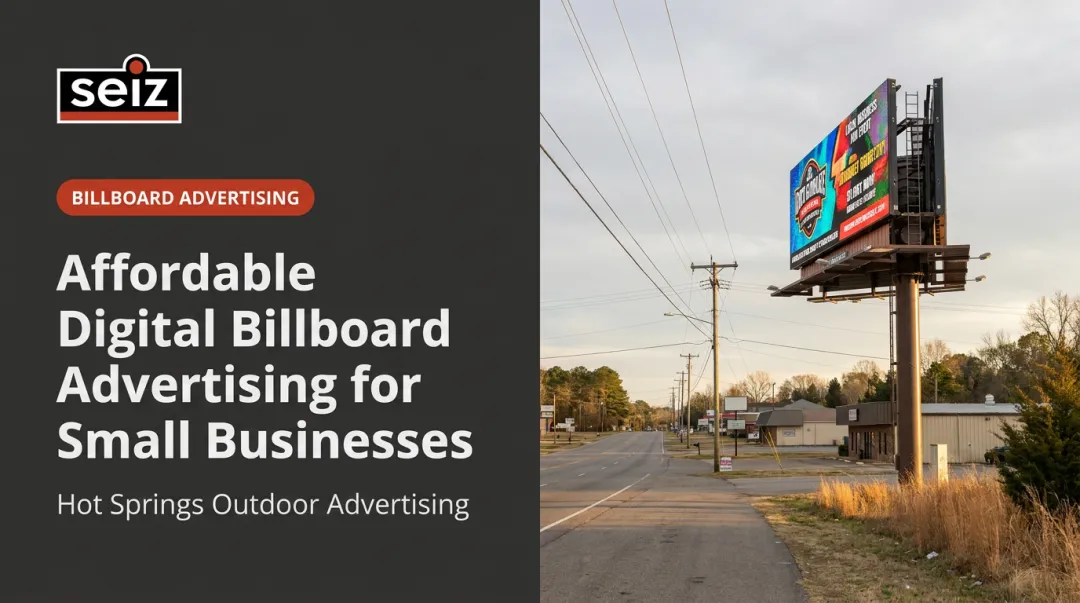
- Digital/LED billboards — rotate static messages every few seconds (typically 6-8 seconds per advertiser), allowing for time-sensitive promotions and rotating campaigns across multiple businesses sharing a display
Small businesses don't need to own billboard infrastructure. You lease space from an outdoor advertising company.
Small businesses don't need to own billboard infrastructure. You lease space from an outdoor advertising company.
Seiz Sign Company operates over 90 billboard locations with 225 advertising faces throughout Hot Springs and Garland County, making it the largest outdoor advertising network in the area. The company also offers a large outdoor LED digital display for rotational spot messages. Contact their outdoor advertising division directly to check location availability and match placement to your target audience.
Storefront and Business Signs
Your storefront sign is your permanent outdoor advertisement. It works every hour you're open — and many hours you're not — building recognition with every person who passes.
Common illuminated formats for small businesses:
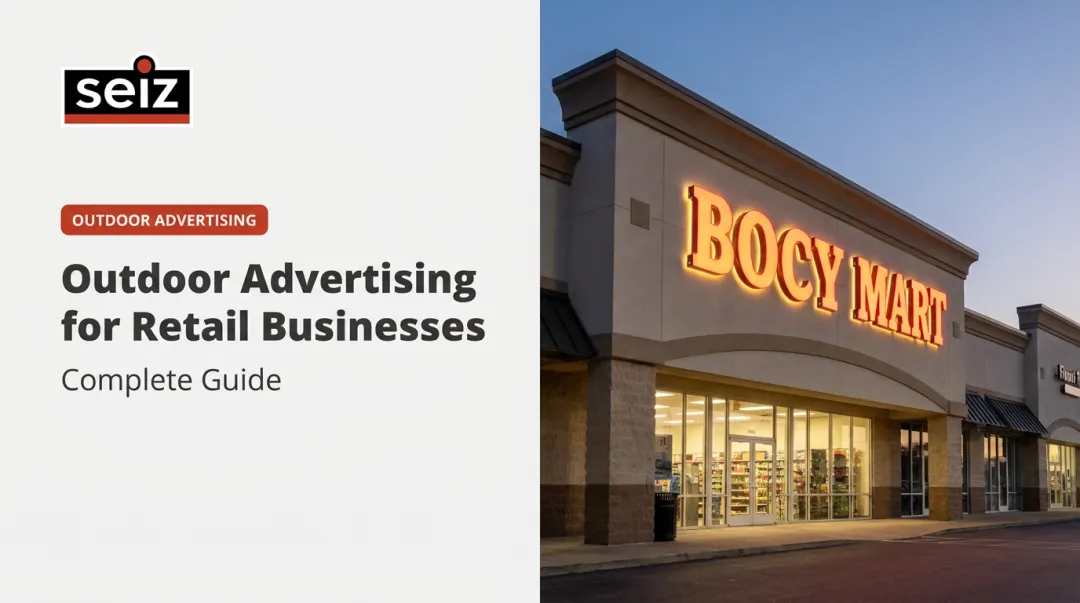
- Channel letter signs — individual dimensional letters with LED or neon illumination; high visibility on busy commercial streets, available in front-lit, back-lit (halo effect), or open-faced configurations
- Cabinet/lightbox signs — illuminated enclosures with printed or vinyl faces; common for retail, restaurants, and banks
- LED electronic message centers — programmable displays that can be updated to show rotating promotions, events, or seasonal offers
- Monument signs — low-profile freestanding signs; particularly relevant in Hot Springs, where the Malvern Avenue Overlay District (HWY 270) prohibits pole signs and requires monument signs for commercial businesses in that corridor
Banners and Portable Signage
Vinyl banners are a low-cost, flexible option for promotions, grand openings, and seasonal campaigns. Seiz Sign Company produces custom banners in multiple material options — standard 13oz vinyl, double-sided blockout vinyl, mesh vinyl for windy locations, and fabric — with large-format printing up to 16 feet wide. Display options include wall mounts, fence mounts, A-frame stands, and retractable stands.
Note that some Arkansas municipalities regulate the duration, size, and placement of temporary banners. A permit may be required before installation.
Vehicle Graphics and Wraps
A wrapped vehicle turns every work trip into continuous brand exposure across multiple neighborhoods. Service businesses get the most mileage out of this format: contractors, caterers, cleaning companies, and food trucks are already on the road daily.
Format options:
- Full vehicle wraps — maximum brand impact; built to last 5-7 years with proper care
- Partial wraps — cover specific panels or sides for a budget-conscious option
- Cut vinyl decals and lettering — company name, phone number, and basic identification
- Perforated vinyl — full-color coverage on windows with a tint benefit
How to Design Outdoor Advertising That Gets Noticed
Keep Copy Ruthlessly Short
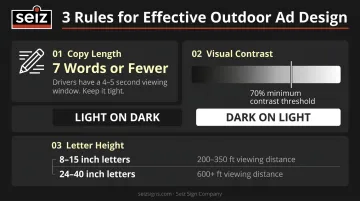
OAAA's creative best practices establish 7 words or fewer as the benchmark for billboard copy. Lamar Advertising confirms that typical OOH exposure for a mobile audience is 4 to 5 seconds — meaning your entire message needs to land in roughly the time it takes to blink twice.
Structure your outdoor ad around three elements:
- A short headline or offer
- Your brand name or logo
- One call to action (phone number, address, or URL)
That's it. Resist the urge to add more.
Prioritize Visual Contrast
Legibility at distance depends more on contrast than on color preference. Industry guidance from Signs.org notes that characters contrasting with their background by at least 70% significantly improve readability. High contrast between text and background — think dark text on light backgrounds or light text on dark — outperforms subtle, brand-palette-only choices in real-world outdoor conditions.
Font size also matters by distance. OAAA's guidelines specify letter heights of 8-15 inches for viewing distances of 200-350 feet, scaling up to 24-40 inches for distances exceeding 600 feet.
Place Ads Where Your Audience Already Travels
Strong design only works if the right eyes see it. Before committing to any outdoor ad location, consider:
- How close is it to your business or your competitors?
- Does your target customer naturally travel this route?
- What's the viewing angle and dwell time from that road?
- Is there surrounding visual clutter that will compete for attention?
In Hot Springs and Garland County, Seiz Sign Company manages 90+ billboard locations across 225 faces — and has spent over a century learning which roads, intersections, and corridors drive results for local businesses.
Keep Messaging Consistent Across Touchpoints
An outdoor ad works best when it's part of a consistent brand presence. The colors, fonts, logo, and tone on your billboard or storefront sign should match what people see on your website and social profiles. When a customer sees your billboard Monday morning and your Instagram ad Monday evening, that repetition builds recognition — and recognition drives foot traffic.
Outdoor Advertising Costs, Permits, and Local Regulations
What Billboard Advertising Costs
Billboard costs vary based on location, traffic volume, format, and lease duration. For planning purposes:
| Market Type | Static Billboard | Digital Billboard |
|---|---|---|
| Small-to-mid-size city | $1,000–$5,000/month | Typically 30-50% higher than comparable static |
| Rural/small market | $250–$1,500 per 4-week cycle | Starting around $1,000/month for shared rotations |
Source: Fit Small Business (2025) and AdQuick (2026). These are planning ranges — get local quotes before budgeting.
Production costs (design and vinyl printing) are additional. Design/print fees, lease duration, and whether you're on a static versus digital board all affect your total investment.
Permits and Regulations in Arkansas
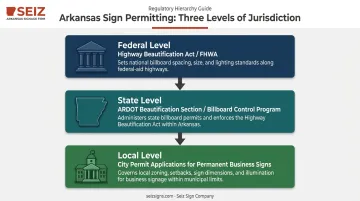
Most commercial sign installations in Arkansas require permits at more than one level of government:
- Federal level — The Highway Beautification Act (signed 1965) and FHWA regulations under 23 U.S.C. 131 control outdoor advertising adjacent to Interstate and Federal-aid primary highways within 660 feet of the right-of-way
- State level — ARDOT's Beautification Section administers Arkansas's Billboard Control Program, issuing permits for billboard construction near controlled highways
- Local level — Cities like Hot Springs require separate permit applications for permanent business signs, including wall signs, pole signs, monument signs, and illuminated signage
Hot Springs sign codes also include overlay district restrictions that aren't citywide — meaning requirements can change block by block. The Malvern Avenue Overlay District alone prohibits pole signs entirely for businesses along that corridor.
That complexity is why most Arkansas businesses work with a sign company that handles permitting directly. Seiz Sign Company manages the full process on behalf of clients, from initial code research through final inspection scheduling. President David Hamilton has served as Past Vice-Chairman of the City of Hot Springs Code Committee — meaning the team has worked inside the regulatory process, not just around it.
The full permit scope typically includes:
- Code research and zoning review
- Overlay district compliance verification
- Structural drawings for permit submission
- Application filing with city and state agencies
- Inspection coordination and sign-off
Frequently Asked Questions
What does outdoor signage mean?
Outdoor signage refers to any sign, display, or advertisement placed in an outdoor or public-facing location — including storefront signs, billboards, banners, and vehicle graphics — to attract attention and communicate a brand message to passersby.
How much does an outdoor billboard cost?
Costs vary by location, traffic volume, and format. In small-to-mid-size markets, static billboard leases typically range from $1,000 to $5,000 per month; rural placements can start as low as $250-$1,500 per 4-week cycle, with digital boards running higher. Always get local quotes — these figures are planning benchmarks, not guaranteed prices.
What are the most effective types of outdoor advertising for small businesses?
It depends on your goals. Billboards build broad brand awareness; storefront signs drive walk-in traffic; vehicle wraps create mobile exposure across your service area; banners work well for promotions and grand openings. The strongest approach typically combines formats based on what the business needs at each stage.
Do I need a permit for a billboard or business sign in Arkansas?
Yes — most commercial sign installations require permits at the state and/or local level, and requirements vary by sign type, size, and location. Billboard signs near controlled highways may involve ARDOT in addition to city permitting. A licensed sign contractor can help navigate permitting and zoning requirements before you invest in permanent signage.
What should be included in an effective outdoor advertisement?
Stick to three elements: a short headline or offer (seven words or fewer), your brand name or logo, and one clear call to action — a phone number or address. Use high-contrast colors, large readable fonts, and design for viewers who have five seconds or less.