Introduction
Many vehicle owners hesitate before committing to a wrap. The fear makes sense — you're placing an adhesive film over your car's finish, and the thought of pulling it off years later to find damaged paint underneath is genuinely concerning.
Here's the direct answer: professionally installed car wraps do not damage factory paint. The vinyl adheres with a pressure-sensitive adhesive engineered for clean removal, leaving the original finish intact.
That said, the answer isn't unconditional. Outcomes depend on three variables: vinyl quality, paint condition, and installer skill. Get those right, and a wrap actually protects your paint. Get them wrong, and problems follow.
This guide breaks down exactly when wraps are safe, when they carry risk, and what you need to know before committing. For Arkansas businesses especially, that distinction matters — intense summer UV exposure means paint protection is a practical concern, not just a cosmetic one.
Key Takeaways
- Professionally applied, high-quality vinyl wraps do not damage factory paint
- Premium vinyl shields paint from UV rays, road debris, and environmental contaminants
- Pre-existing paint problems, cheap materials, or poor removal cause almost all wrap-related damage
- Factory (OEM) paint is the safest base for wrapping — repainted panels need inspection first
- Installer experience is the biggest factor in whether a wrap protects or harms your paint
The Short Answer: Do Car Wraps Damage Paint?
No — when installed correctly using premium materials, car wraps leave factory paint completely intact.
Modern wrap films use a pressure-sensitive adhesive with air-release technology, meaning the vinyl bonds securely during use but releases cleanly when heat is applied during removal. Products like the Avery Dennison SW900 Series are specifically engineered for what Avery describes as "long term removability", with less than 20% adhesive residue when appropriate heat and chemical removal methods are used.
Where the Misconception Comes From
Most stories about wrap-related paint damage fall into one of three categories:
- Paint was already failing — peeling, oxidized, or poorly bonded before the wrap went on
- Cheap vinyl was used, with inferior adhesives that bond too aggressively and resist clean removal
- Removal was done incorrectly — no heat, wrong angle, excessive force
In every one of these cases, the wrap material and the process are not the culprits. The outcome comes down to three controllable variables.
The Three Variables That Determine Outcomes
| Variable | Good Outcome | Bad Outcome |
|---|---|---|
| Vinyl quality | Premium cast film, clean release | Cheap film, aggressive adhesive |
| Paint condition | OEM factory paint, fully cured | Peeling, oxidized, or repainted surface |
| Installer skill | Heat-assisted application and removal | DIY removal, incorrect technique |
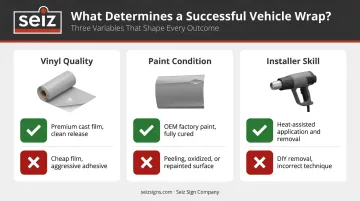
Every documented case of wrap-related paint damage traces back to at least one of these three factors — not the concept of wrapping itself.
How Car Wraps Actually Protect Your Paint
A well-installed wrap doesn't just leave paint unharmed — it actively preserves it. The protection is real, and it compounds over the life of the wrap.
UV Protection
Vinyl acts as a physical barrier between your paint and the sun. UV radiation is one of the primary causes of paint fading, and in sun-heavy climates this matters more than most vehicle owners realize. Hot Springs, Arkansas recorded a UV Index of 11 on a recent June afternoon — a level the EPA classifies as Extreme. That kind of sustained exposure degrades unprotected paint over time.
The Avery Dennison SW900 Series specifically lists excellent UV resistance as a core performance characteristic. The vinyl absorbs UV energy that would otherwise reach your paint's clear coat.
Scratch and Chip Resistance
Road gravel, parking lot contact, and everyday debris leave micro-scratches on bare paint that accumulate into visible wear. The vinyl layer absorbs these minor abrasions directly, sparing the finish underneath. When the wrap eventually comes off, that paint is as untouched as the day it was applied.
Weather and Environmental Protection
Bird droppings, tree sap, acid rain, and industrial fallout all chemically etch bare paint over time. A wrap keeps these contaminants from reaching the surface.
Resale Value
That physical protection has a direct financial payoff. Because factory paint stays shielded under the vinyl for years, it looks noticeably fresher than the paint on comparable unwrapped vehicles when the wrap eventually comes off. Avery Dennison explicitly lists resale value preservation as a documented benefit of their wrap films.
For businesses running fleet vehicles, the math scales quickly: protected paint across an entire fleet means better trade-in values on every unit at disposal time.
When Car Wraps CAN Damage Paint: 5 Situations to Know
Most wrap damage is preventable — but only if you know what to watch for. These five situations account for the majority of cases where wraps cause real paint problems.
1. Pre-Existing Paint Damage
If the paint is already peeling, cracking, oxidized, or has a failing clear coat, a wrap won't fix it — and removal can pull off loose paint that was already on its way out. Always inspect paint condition before committing to a wrap. Any surface that wouldn't survive a car wash probably won't survive wrap removal either.
2. Low-Quality Vinyl
Cheap vinyl often uses inferior adhesives that bond more aggressively than premium films. When it's time for removal, those adhesives resist and can leave stubborn residue or stress the paint surface. Don't cut costs on the vinyl film itself.
3. Leaving the Wrap On Too Long
Every wrap film has a manufacturer-rated lifespan — and it varies more than most people realize. The 3M Wrap Film Series 2080 is rated up to 8 years for vertical applications, while ORAFOL's ORACAL 970RA lists up to 10 years for non-metallic colors but only 3–5 years for certain metallic finishes. Climate, sun angle, and maintenance all affect where your wrap lands within that range. Letting a wrap degrade past its service life makes removal significantly more difficult and messy.
4. Improper or DIY Removal
Removing vinyl without heat, at the wrong angle, or too quickly puts direct stress on the paint bond — and causes more wrap-related paint damage than any other factor. Professional removal using a heat gun and correct technique is essential, especially on older wraps. The 3M Removal Instruction Bulletin explicitly states that substrates must be properly prepared and that films may leave adhesive residue without the correct removal approach.
5. Adhesive Promoters Applied Incorrectly
Some installers use adhesive promoters to force vinyl adhesion in difficult areas. While occasionally necessary, misapplication significantly increases bond strength — making removal far harder than it needs to be. Before installation, ask your installer whether promoters will be used and exactly where they plan to apply them.
Does Your Car's Paint Need to Be in Good Condition Before Wrapping?
Yes. The condition of your paint before the wrap goes on determines whether the paint stays intact when it comes off — or comes with it.
What Makes a Good Surface
OEM factory paint is the gold standard. It's fully cured, chemically stable, and bonds consistently with vinyl across the entire surface.
Repainted vehicles require more scrutiny. Avery Dennison specifies that air-dried and repair paints need at least one week of drying time before vinyl application. 3M goes further — recommending installers follow the paint manufacturer's exact cure time and test for outgassing before proceeding.
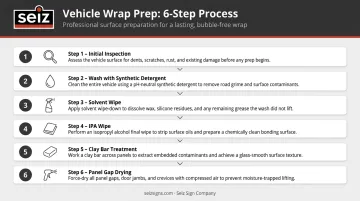
The 3M Vehicle Preparation Guide outlines the key prep steps professional installers follow:
- Initial inspection — Check for rust, paint quality issues, chips, and dents that should be repaired first
- Wash with synthetic detergent — Removes surface contamination without leaving wax or oil residue
- Solvent wipe — Eliminates tar, grease, and wax that detergent can't reach
- IPA wipe — A 70% isopropyl alcohol / 30% water solution for final surface preparation
- Clay bar treatment — Removes bonded contaminants from the clear coat
- Panel gap drying — Compressed air removes moisture from seams before vinyl is applied
The Myth Worth Addressing
Wraps cannot hide damaged paint — and attempting it causes more harm than good. Vinyl adhesive grips whatever surface it touches. If that surface is bubbling or peeling, the wrap bonds to the failing paint layer, not the car. When removal time comes, it pulls that layer off with it.
The surface needs to be clean and structurally sound before any vinyl goes on. No installer can fix bad paint with film.
Car Wrap vs. Paint Job: Which Is Better?
The right choice depends on your goals. Here's an honest comparison.
Cost Comparison
| Option | Typical Range |
|---|---|
| Professional full wrap (sedan) | $2,000–$3,000 |
| Professional full wrap (SUV) | $3,000–$5,000 |
| Premium/complex wrap | $7,000–$10,000 |
| Basic professional paint job | $1,000–$1,500 |
| Mid-tier paint job | $2,000–$5,000 |
| High-end/custom paint job | $5,000–$10,000+ |
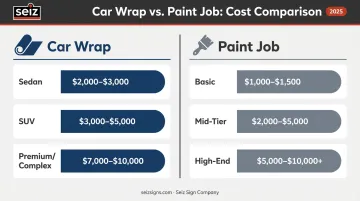
Sources: Edmunds (Oct. 2025), Kelley Blue Book (Sep. 2025)
Where Wraps Win
- Removable without damage — leased vehicles and fleet operators can return or rebrand without a repaint
- Faster turnaround than a full paint job in most cases
- Easy rebranding cycle — pull the old wrap, apply a new design, no bodywork needed
- Protects the original finish underneath for the life of the wrap
Where Paint Has the Edge
- Permanent finish goals — if you want the color to last the life of the vehicle without any maintenance cycle, paint wins
- Bodywork needs — if the vehicle already needs structural repairs, a repaint may be the more logical path
- Extreme customization — certain paint effects (true candy or chameleon finishes) still outperform vinyl aesthetically for some buyers
Fleet operators — service contractors, delivery companies, restaurant brands — tend to find wraps the more practical path. Rotating branding across multiple vehicles is straightforward: remove, reprint, reapply. Seiz Sign Company handles exactly this kind of rebranding work for Arkansas businesses across a range of industries.
How to Make Sure Your Wrap Doesn't Damage Your Paint
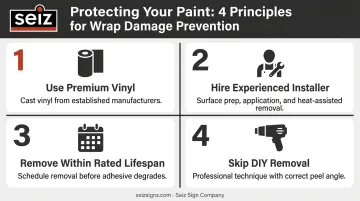
Follow these four principles and the risk of paint damage drops to near zero.
Use premium vinyl materials — Cast vinyl from established manufacturers uses adhesives specifically engineered for clean removal
Hire an experienced installer — Surface prep, tension-free application, and heat-assisted removal are skills that take years to develop
Remove within the film's rated lifespan — Don't let the wrap degrade past its service life. Schedule removal before the adhesive becomes a problem
Skip DIY removal — Professional technique with a heat gun and the correct peel angle matters as much as professional installation
Hire an experienced installer — Surface prep, tension-free application, and heat-assisted removal are skills that take years to develop
Remove within the film's rated lifespan — Don't let the wrap degrade past its service life. Schedule removal before the adhesive becomes a problem
Skip DIY removal — Professional technique with a heat gun and the correct peel angle matters as much as professional installation
At Seiz Sign Company, Graphics Production Manager Jorge Barboza has handled vinyl applications since 2002 — and offers heat-assisted wrap removal as a service alongside installation, covering the full lifecycle of your wrap.
Frequently Asked Questions
Do car wraps damage paint?
No, professionally applied car wraps do not damage factory paint. The adhesive is designed to release cleanly with heat. Any damage that does occur is almost always linked to pre-existing paint issues, inferior vinyl materials, or improper removal technique rather than the wrap itself.
How much does it cost to wrap a car?
Most professional full wraps fall between $2,000 and $5,000, with larger or more complex projects reaching $7,000–$10,000. Partial wraps, such as door logos or tailgate graphics, offer a lower-cost entry point. Contact Seiz Sign Company at (501) 623-3181 for a project-specific quote.
How long does a car wrap last compared to paint?
Lifespan depends on product and conditions: 3M's Series 2080 is rated up to 8 years for vertical applications, and ORAFOL's 970RA up to 10 years for non-metallic colors. Climate, UV exposure, and maintenance all affect real-world durability. Seiz Sign Company advises clients to expect 5–7 years with proper care under Arkansas conditions.
Can car washes damage car wraps?
Hand washing is always the safest option. Brushless automatic spray washes are generally acceptable. Brush car washes can scratch the vinyl, dull the finish, and lift edges over time. 3M's guidance is clear: if you use an automated wash, choose touchless only.
Can I wrap a car that already has paint damage?
Wrapping over damaged, peeling, or poorly bonded paint is not recommended. The surface must be repaired and properly prepped before vinyl is applied ; otherwise, removal can worsen the existing damage. A professional installer will inspect your paint before proceeding.
Does wrapping a car affect its resale value?
Wraps typically protect and preserve resale value rather than hurt it. The original factory paint stays in like-new condition underneath for the duration of the wrap. When the wrap is removed before sale, the paint usually looks significantly fresher than that of a comparable unwrapped vehicle of the same age.