Car buying isn't an impulse decision. According to Cox Automotive's Car Buyer Journey Study, buyers spend an average of 96 days in the market before making a purchase — roughly 14 weeks of consideration. A billboard on the route they drive every day doesn't just generate one impression. It generates dozens, building familiarity over the entire decision window.
This guide covers why billboards are a natural fit for dealerships, how to choose the right format and location, what to put on your creative, when to run campaigns, and how to think about ROI in real dealership terms.
Key Takeaways
- Drivers spend over 7 hours per week behind the wheel — a built-in audience that can't skip your ad
- Static billboards build long-term brand presence; digital formats handle time-sensitive deals and seasonal promotions
- Target commuter routes and competitor dealerships to intercept buyers at the right moment
- Keep copy to 7 words or fewer — one image, one message, one call to action
- A single vehicle sale typically covers an entire month of billboard rental costs
Why Billboards Are a Natural Fit for Car Dealerships
Drivers Are Already Your Audience
The AAA Foundation's 2024 American Driving Survey found that U.S. drivers spend 60.4 minutes behind the wheel each day — roughly 7 hours per week, totaling 96 billion collective driving hours annually. Every one of those hours is time spent in proximity to roadside advertising. Unlike a social media post or pre-roll video, a billboard doesn't require a click, an app, or an internet connection — it reaches drivers without asking anything of them.
For dealerships, that passive reach is especially valuable. Car buyers are often in research mode during their commute — noticing vehicles on the road, weighing options, mentally shortlisting brands. A billboard that appears consistently on their daily route keeps your name in that mental conversation.
Frequency Beats a Single Impression Every Time
The 96-day buying cycle means most car shoppers are in consideration for weeks before they set foot in a showroom. Repeated billboard exposure builds the kind of familiarity that makes a dealership feel like the obvious choice when a buyer is finally ready.
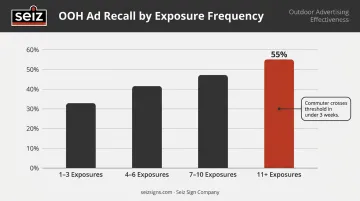
Research from a Nielsen/OAAA poster study found that campaigns with 11 or more exposures yielded 55% average ad recall — a sharp increase over lower-frequency campaigns. A commuter who passes your billboard five days a week crosses that threshold in under three weeks.
OOH Advertising Drives Real-World Action
Billboard visibility isn't passive. According to OAAA/Morning Consult research, 78% of consumers who noticed an OOH ad engaged with it in the prior 60 days, and 43% visited a business within 30 minutes of seeing a directional outdoor ad. For dealerships running a "Exit 4 — Turn Right" style placement, that conversion window is direct and measurable.
Billboards Amplify Your Other Advertising
OOH advertising doesn't compete with digital — it multiplies it. For dealerships already running Google or Facebook campaigns, a billboard acts as the offline trigger that sends buyers to their phones.
The numbers back this up:
- Nielsen/OAAA data shows OOH generates 26% of gross search activations while accounting for just 7% of combined offline ad spend
- That search activation index of 381 means every dollar in billboard spend punches well above its weight in driving online research
- OAAA's 2024 Facts & Figures places the automotive category at $106.5 million in OOH spend — one of the top-spending product categories in outdoor advertising
Types of Billboards Car Dealerships Use
Static Billboards
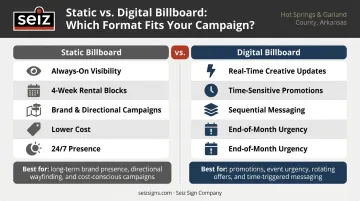
Static billboards are fixed vinyl or printed displays, typically rented in 4-week blocks as the industry standard. They're best suited for campaigns where the message stays consistent — dealership name, location, brand identity, or a long-running offer.
Best for:
- Brand awareness and dealership name recognition
- Directional advertising ("2 miles ahead on the left")
- Service department presence campaigns
- Markets where you want continuous 24/7 visibility without frequent creative updates
The strength of static is simplicity. One design, always visible, reinforcing the same message day after day.
Digital Billboards
Where static holds firm, digital flexes. Digital out-of-home (DOOH) boards rotate multiple advertisers on LED screens and can update creative without print production delays. DOOH now accounts for 36.3% of total OOH revenue and grew 10.5% year over year according to OAAA's 2025 revenue release.
Best for:
- End-of-month financing specials ("0% APR — Ends Sunday")
- New model year arrivals
- Weekend sales events
- Urgent inventory clearance campaigns
When a rate drops, a sale extends, or a last-minute event gets added, the creative updates in hours — not days. That responsiveness is what makes digital formats so useful for dealerships with fast-moving promotional calendars.
Choosing Between the Two
Many dealerships use both formats for different roles. Static handles the "always-on" brand presence. Digital drives the promotional calendar. Running both simultaneously means a commuter sees your dealership name every day on a static board — and your weekend sale on a digital one the morning it starts.
How to Choose the Right Location for Your Dealership Billboard
Placement matters more than design. A straightforward message on a high-traffic corridor outperforms a polished ad that few people see.
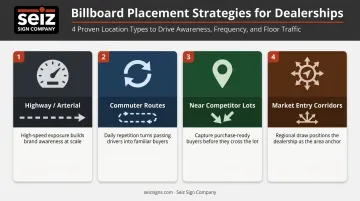
Highway and Major Arterial Roads
High-speed, high-volume routes generate the most impressions but give drivers the least time to process your message. Lamar Advertising notes that exposure time on OOH is typically 4–5 seconds, while Clear Channel cites roughly 6 seconds. At highway speeds, your billboard needs to communicate in one glance.
These placements work best for:
- Simple brand awareness ("Smith Ford — Exit 12")
- Directional instructions
- Dealership name reinforcement for buyers already researching
Commuter Routes
Local surface roads and arterials traveled by daily commuters are where repetition does the work. A buyer who passes your billboard every workday builds recognition over weeks — before they've ever searched for your dealership online. In a market like Hot Springs, where the same drivers travel the same routes daily, that consistency compounds fast.
Near Competitor Dealerships
Placing a billboard on the approach to a competing lot intercepts shoppers already in purchase mode. If a buyer is heading to an auto row and passes your message first, you've inserted your dealership into a decision they've nearly made. In that moment, your billboard doesn't need to sell — it just needs to create enough doubt to earn a detour. That's what makes "conquesting" one of the more efficient spends in a dealership's outdoor budget.
Regional Market Strategy
In smaller markets, entry-corridor placements capture regional buyers driving in from surrounding areas. Dealerships in Hot Springs, for example, routinely draw customers from 30–60 miles away. Seiz Sign Company operates over 90 billboard locations and 225 faces throughout Hot Springs and Garland County — giving local dealerships access to placements already positioned across the area's primary traffic corridors. Their team can walk you through current availability by location.
What to Put on Your Car Dealership Billboard: Creative Tips
The Short-Copy Rule
Both Lamar and the OAAA Creative Best Practices guidelines are clear: 7 words or fewer is the proven benchmark for billboard copy. At 4–6 seconds of exposure time, anything more becomes a blur. The temptation to list inventory, stack multiple offers, and include fine print is real — resist it entirely.
A billboard has one job. Give it one job.
Essential Elements for a Dealership Billboard
Every effective car dealership billboard includes:
- One strong visual — a single vehicle image or bold brand color (not a collage)
- One clear message — a financing rate, a sale event name, or a new model
- Dealership name — prominent enough to read at a glance
- One call to action — a phone number, a website, or a directional instruction
That's it. Four elements. Adding a fifth usually means one of the others stops working.
Message Examples by Goal
| Campaign Goal | Example Copy |
|---|---|
| New model launch | "2025 [Model] — Now at [Dealer Name]" |
| End-of-month financing | "0% APR Through Month-End" |
| Service department | "Oil Change $29.99 — [Dealer Name] Service" |
| Used vehicle clearance | "200+ Pre-Owned Vehicles — Drive Today" |
Each example carries a single message — nothing competing for the driver's attention.
Digital Billboard Creative Considerations
Digital boards rotate with other advertisers, so your slot may display for 6–8 seconds. Animation is an option, but keep it minimal — a slow fade or a single transition at most. The message still needs to land in under 5 seconds.
A smart approach for digital: run two or three sequential creatives that tell a short story. "New Models Arriving" → "0% APR This Month" → "[Dealership Name] — Exit 4." Different messages, same brand, building context across multiple impressions.
If you're working with a billboard operator that also handles design in-house — as Seiz Sign Company does — you skip the back-and-forth of coordinating between a separate agency and your outdoor vendor. Creative gets done faster, and it's built by people who know what actually reads at 65 mph.
Timing Your Billboard Campaign for Maximum Impact
Seasonal Windows That Move Vehicles
Not all months perform equally. The highest-converting windows for automotive advertising:
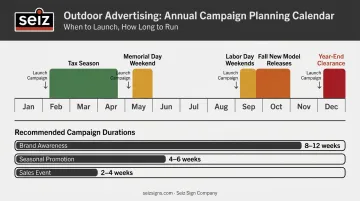
- Tax season (February–April): Cox Automotive data shows used-vehicle retail sales run 20–30% above average pace during the 6–7 week tax refund season, with dealers often seeing $90–$150 additional gross per vehicle during peak weeks
- Memorial Day and Labor Day weekends: Both are established automotive shopping events — Memorial Day for deal-shopping, Labor Day for clearing prior-model-year inventory ahead of new arrivals
- Year-end (December): Cox forecast December 2025 new-vehicle sales to rise 12.7% from November, driven by quota pressure and year-end incentives
- Fall new model year releases: The transition from outgoing to incoming model years creates natural urgency for both clearance and launch campaigns
Billboard campaigns should ramp up 2–4 weeks before these peak windows, not on the first day of a sale.
End-of-Cycle Urgency
Month-end, quarter-end, and year-end are when dealerships need to close volume. Digital billboards are particularly effective here because the message can be updated in real time: a message like "Ends Sunday — Finance from 1.9%" can go live Thursday and come down Monday morning.
Campaign Duration Guidelines
| Campaign Type | Recommended Duration |
|---|---|
| Brand awareness | 8–12 weeks (build frequency) |
| Seasonal promotion | 4–6 weeks (leading into peak) |
| Specific sales event | 2–4 weeks (tight urgency window) |
The most effective dealership strategy pairs a continuous brand awareness placement with shorter promotional bursts tied to the calendar above. The always-on board builds familiarity over time; when a promotion drops, that familiarity is what turns exposure into showroom visits.
Billboard Costs and ROI for Car Dealerships
Understanding Billboard CPM
The most useful metric for comparing billboard costs against other media is CPM — cost per thousand impressions. Solomon Partners/OAAA estimates OOH bulletin CPM at a $5.00 median, with a range of roughly $3–$9 depending on market and location.
For context, WordStream's 2024 benchmarks put the average Google Ads cost-per-click for the Automotive - For Sale category at $2.34. At highway traffic volumes, a well-placed billboard can deliver thousands of impressions per day at a fraction of the per-impression cost of paid search.
Actual monthly rental costs vary significantly by market size, traffic volume, and location type — Seiz Sign Company's team can provide current rate information for Hot Springs and Garland County placements.
Thinking in Dealership Terms
Once you understand CPM, the practical question becomes: how many sales does this campaign need to generate to break even?
For most dealerships, the math is straightforward:
- Gross profit on a single financed vehicle sale typically exceeds one month of billboard rental costs in a regional market
- A full-service appointment package often comes close on its own
- Converting one or two additional customers per month can cover the spend entirely
OAAA and Analytic Partners found that increasing automotive OOH allocation from 1% to 2% of media spend would generate an estimated $52.1 million in revenue gains across the industry — a clear signal that most automotive advertisers are leaving OOH budget on the table.
Frequently Asked Questions
How much does a billboard cost to advertise?
Billboard costs vary by market size, location, traffic volume, and format. In regional markets like Hot Springs, costs are significantly lower than major metros. Contact operators like Seiz Sign Company directly for current rates — pricing is available on request and depends on specific placement availability.
How do you advertise your car dealership?
Effective dealership marketing starts with local visibility. Billboards build name recognition in your specific market, driving buyers to seek out your dealership when they're ready to purchase. Pair outdoor advertising with consistent signage at your location to reinforce the brand at every touchpoint.
What should a car dealership put on a billboard?
Keep it to one vehicle image or brand visual, one clear message (a financing rate, sale name, or new model), the dealership name, and one call to action — phone number, website, or directional. Total copy should stay at 7 words or fewer.
Are digital or static billboards better for car dealerships?
Static billboards are better for ongoing brand awareness, while digital boards excel at time-sensitive promotions that need to change quickly. Most dealerships benefit from using both — static for sustained awareness, digital for end-of-month and seasonal campaigns.
How long should a car dealership run a billboard campaign?
Brand awareness campaigns work best at 8–12 weeks to build sufficient frequency. Promotional campaigns tied to a specific event or financing offer can run as short as 2–4 weeks, timed to peak just before the offer window closes.
How do billboards help car dealerships compete with larger brands?
Local billboards give independent and franchise dealerships dominant physical visibility in their specific market. National advertising budgets can't replicate the hyper-local, high-frequency presence of a billboard on the road your buyers drive every day — that's a competitive advantage only local operators can access.