The stakes are real. A well-placed billboard builds brand recognition through repeated exposure to the right audience. A poorly placed one sits unnoticed, collecting impressions that never convert to awareness or action.
This guide covers six data-backed tips for evaluating and selecting billboard locations that actually perform — with specific context for businesses in markets like Hot Springs, Arkansas, where local market knowledge makes all the difference.
Key Takeaways
- Premium locations balance traffic volume, audience fit, sight lines, and proximity to relevant destinations, not price alone
- Matching placement to your campaign objective (awareness vs. foot traffic) is the single most overlooked factor
- Traffic counts measure raw volume — visibility factors determine how many drivers actually see your message
- Arkansas billboard advertising is regulated at both the state and local level — skipping compliance checks can derail a campaign
- A local outdoor advertising partner with pre-vetted inventory cuts months of research
What Makes a Billboard Location "Premium"?
"Premium" doesn't mean most expensive or most visible. It means the placement that most efficiently reaches your target audience at the moment they're most receptive — balancing traffic volume, audience fit, and message context.
The outdoor advertising industry measures location value using two core metrics:
- Traffic count — the recorded number of vehicles and pedestrians passing a location, used to establish baseline circulation for an out-of-home (OOH) display (OAAA Glossary)
- Geopath Impressions (Eyes-On) — estimates actual eye contacts with a display by factoring in sight lines, approach angles, and viewing conditions, going beyond raw traffic counts
Geopath's methodology draws on data from more than 150 million mobile devices and connected cars to model real audience exposure. The goal is accuracy: measuring who genuinely had the opportunity to see the board, not just who drove past it.
Billboard format also shapes what "premium" looks like in practice. Each format suits a different placement context:
| Format | Best Location Context | Key Advantage |
|---|---|---|
| Static Vinyl Bulletin | Highways, high-speed corridors | 100% share-of-voice at the location |
| Digital/LED | Intersections, slower arterials | Rotating messages, flexible content |
| Poster | Local commercial corridors | Neighborhood reach, proximity targeting |
Each format serves a different placement strategy. The tips below apply across all three.
6 Data-Backed Tips for Choosing Premium Billboard Locations
Tip 1: Know Your Audience Before You Pick a Location
Traffic count means nothing if the wrong people are driving past. Location selection has to start with a clear audience profile — demographics, daily travel patterns, and behavioral habits.
A targeted OOH approach makes a measurable difference. A Clear Channel Outdoor case study for a beer brand using audience-targeted billboard placements reported a 20% increase in purchase intent and 6.7% higher average household sales lift among exposed audiences — outcomes that generic placement wouldn't reliably produce.
To map your audience to locations:
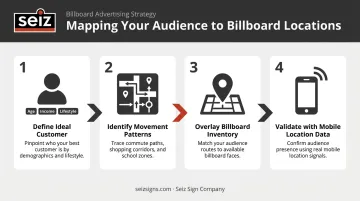
- Define your ideal customer — age, income, lifestyle, and what they do during a typical day
- Identify their daily movement patterns — commute routes, shopping corridors, school zones, workplace areas
- Overlay that map against available billboard inventory
- Use mobile location data (now standard in OOH planning) to validate that your target audience actually passes those locations
Local market knowledge often does the heavy lifting here. Seiz Sign Company's team in Hot Springs identifies the right corridors based on years of firsthand observation and client experience across different business categories — no enterprise analytics platform required.
Tip 2: Follow High-Traffic Corridors and Commuter Routes
Highways, arterials, and commuter routes are premium for one specific reason: frequency. The same driver passes the same board multiple times per week, which builds brand recall in a way that a single ad impression never can.
OAAA data shows that consumers exposed to OOH ads 14 or more times visited stores nearly four times as often as those exposed once — a compounding return that only happens on routes people travel repeatedly. In the U.S., 77.3% of workers commute by car (U.S. Census Bureau, 2022), making commuter routes one of the most reliable channels for reaching working-age audiences at scale.
One important nuance: not all high-traffic roads perform equally.
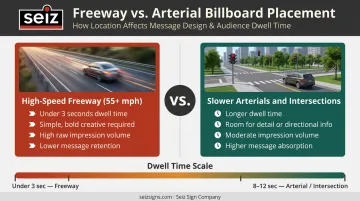
- Fast freeway traffic (55+ mph) means less dwell time — creative needs to be simple, bold, and readable in under three seconds
- Slower arterials and intersections give drivers more time to absorb the message, making them better suited for slightly more detailed content or directional information
Volume and dwell time together determine the real opportunity. A road with moderate traffic but slow-moving vehicles can outperform a high-speed highway with twice the count.
Tip 3: Match Placement to Your Campaign Objective
This is the tip most advertisers skip — and it's the one that causes the most expensive mistakes.
The right placement depends entirely on what you're trying to accomplish.
Brand awareness campaigns benefit from bulletin boards on major highways and freeways. The goal is broad reach and repeated exposure across a wide audience. Share-of-voice matters here, which is why static boards — where your message runs 100% of the time — often outperform digital rotations for pure awareness plays.
Drive-to-location campaigns perform better with poster-sized or neighborhood boards near the business or along the final approach route. OAAA's 2024 Value of OOH Guide reports that 68% of shoppers notice ads on their way to retail stores, and 42% say those ads affect in-store purchase decisions.
A practical example: A restaurant targeting lunchtime foot traffic should prioritize boards within 1–2 miles on the inbound side of the morning commute route — not a freeway board several miles away. That "last-mile" placement reaches consumers when they're already close and actively making decisions about where to eat.
A freeway board builds awareness. A neighborhood board builds foot traffic. Choosing the wrong one for your objective wastes the budget on impressions that can't convert.
Tip 4: Prioritize Proximity to Relevant Points of Interest
Placing a billboard near points of interest (POIs) relevant to your business shortens the gap between awareness and action. The audience is already in the right mindset.
- A restaurant near an entertainment venue reaches people who are deciding where to eat that evening
- A healthcare provider near a residential neighborhood reaches families making preventative care decisions
- A retail store near a shopping district reinforces the brand just before a purchase moment
Research from JCDecaux found that 77% of consumers want ads relevant to their location and that contextual OOH campaigns can drive a 60% increase in spontaneous ad awareness.
A billboard near a sports facility reaches sports fans. One near a hospital attracts healthcare consumers. Proximity to the right POI — not just any high-traffic destination — is what drives contextual relevance.
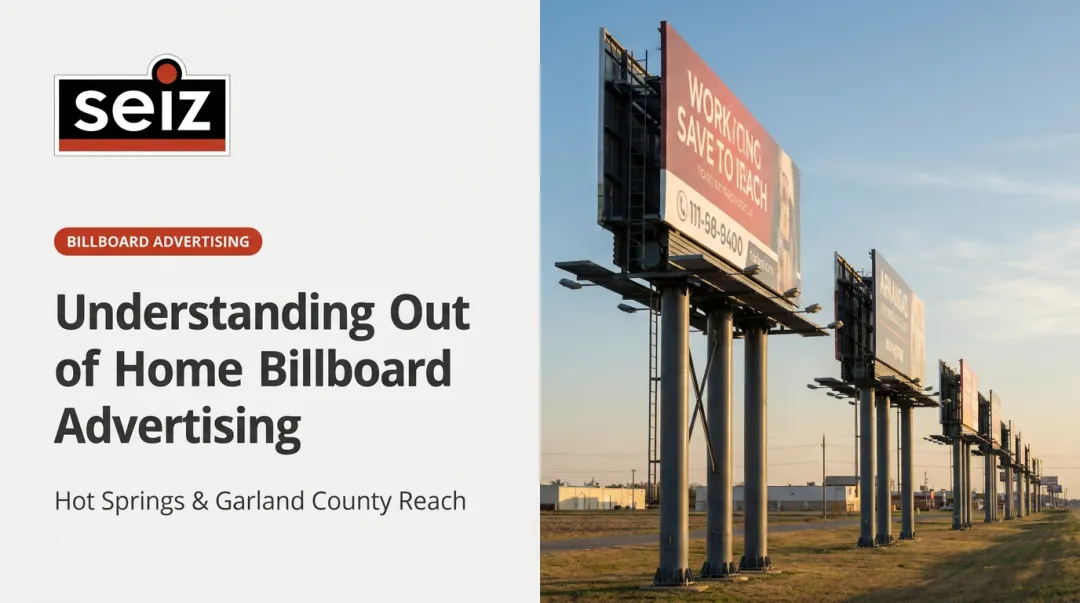
In Hot Springs specifically, POIs like Oaklawn Racing Casino Resort, Lake Hamilton, the Hot Springs Convention Center, and the area's hospital campuses each attract distinct audience segments. Businesses targeting visitors, locals, or specific demographic groups should identify which POIs their customers frequent and prioritize inventory near those locations.
Tip 5: Evaluate Visibility Factors — Angle, Approach Distance, and Sight Lines
A high traffic count doesn't guarantee that drivers actually see the board. Physical visibility factors determine how many of those counted vehicles produce a real impression.
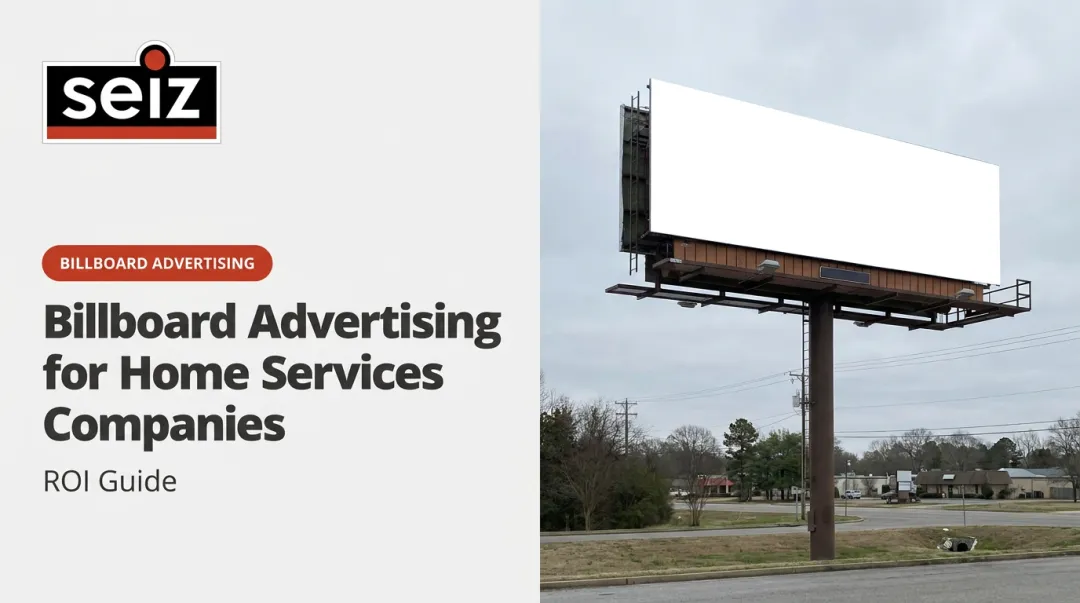
Right-hand reads vs. cross-reads: A right-hand read is a board on the same side of traffic as the viewer — no head-turning required. A cross-read sits on the opposite side, across multiple lanes. Industry measurement data consistently shows that right-hand reads generate around 31% more impressions than comparable cross-reads — a difference that reflects the basic physics of how drivers process their forward field of view.
Approach distance is how far away a driver can first see the board clearly. Longer approach time means more seconds to read and absorb the message — critical for boards where the creative has more than four or five words.
Additional visibility factors to evaluate:
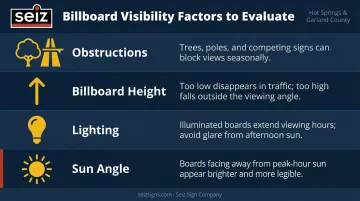
- Obstructions — trees, overpasses, utility poles, and competing signs can block visibility seasonally or permanently
- Billboard height — too low and it disappears behind traffic; too high and it falls outside comfortable viewing angles
- Lighting — illuminated boards extend effective viewing hours; boards facing into the afternoon sun create glare that reduces readability
- Sun angle — a board that faces away from the sun during peak traffic hours will appear brighter and more legible
OAAA's creative guidelines recommend 7 words or less for highway boards, with font sizing calibrated for readability at 350–500 feet. Visibility factors and creative simplicity work together — the best placement in the world underperforms if the message can't be read in the available approach distance.
Tip 6: Verify Zoning, Permits, and Local Regulations Before Committing
Skipping this step is how campaigns get derailed. Billboard placement is regulated at multiple levels simultaneously, and the rules vary significantly by city, county, and road classification.
At the federal level: The Highway Beautification Act of 1965 governs outdoor advertising along approximately 306,000 miles of Interstate and Federal-Aid Primary highways, establishing size, spacing, and lighting controls for signs near those corridors.
In Arkansas specifically: Billboard construction and placement are administered through ARDOT's Billboard Control Program, established under Arkansas Act 640 of 1967. ARDOT's Beautification Section issues permits, monitors routes, and coordinates removal of non-compliant signs. Advertising on regulated highway corridors requires a valid permit — and operating without one can result in forced removal.
Before committing to any location, confirm:
- Zoning classification — most billboard permits require the parcel to be commercially or industrially zoned
- Scenic and historic restrictions — locations within regulated scenic corridors or historic districts face additional or absolute restrictions
- Digital/LED permissibility — not every jurisdiction permits digital displays, and some that do impose specific brightness, animation, or spacing rules
- Local overlay districts — in Hot Springs, for example, specific corridors like the Malvern Avenue Overlay District (Highway 270) carry their own sign restrictions that can change block by block
Working with a licensed outdoor advertising company that knows Arkansas regulations firsthand avoids costly surprises. Seiz Sign Company's president, David Hamilton, has served as Past President of the Arkansas Outdoor Advertising Association — meaning their team navigates these requirements as a core part of every project.
How Seiz Sign Company Helps You Choose the Right Billboard Location
Seiz Sign Company is the largest outdoor advertising company in the Hot Springs area, with over 90 billboard locations and 225 faces throughout Hot Springs and Garland County. For local businesses, that means access to a pre-vetted, permit-compliant inventory — no scouting unknown corridors or navigating zoning issues from square one.
Their outdoor advertising division is led by Tammy Hamilton, Vice President and billboard sales lead since 2003. That's over two decades matching Hot Springs businesses to the right locations. She knows this market at the route level: which corridors carry which audiences, which placements deliver the strongest visibility, and how to move through Arkansas permit requirements without delays.
Seiz Sign offers:
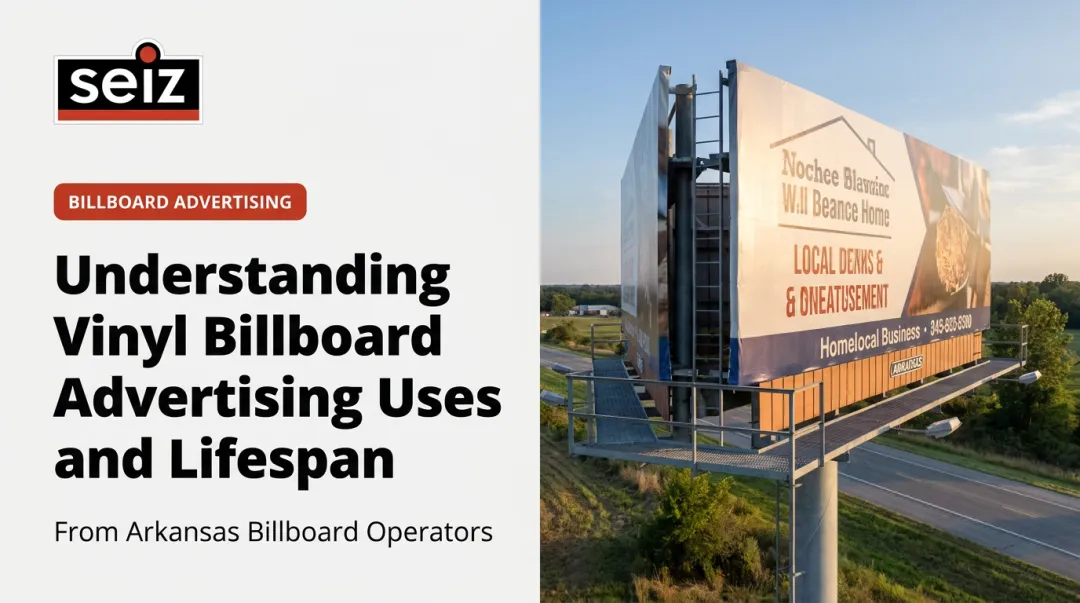
- Static vinyl and LED digital display options across their inventory
- 24/7/365 billboard advertising with no overtime charges — evenings, weekends, and holidays included
- Full-service support from creative design through installation and permit compliance
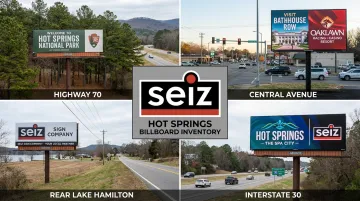
To evaluate locations for your next campaign, contact Seiz Sign Company at (501) 623-3181 or visit their office at 1231 Central Avenue, Hot Springs.
Conclusion
Choosing a premium billboard location means balancing six factors simultaneously: audience alignment, traffic patterns, campaign objective, POI context, physical visibility, and regulatory compliance. Optimizing for just one — like raw traffic count or price — consistently underperforms against a placement that scores well across all six.
That multi-factor discipline doesn't end at the signing of a contract. Road patterns shift, audience behaviors evolve, and a placement that performed well two years ago may need reassessment today. Businesses that revisit their billboard locations periodically — adjusting for new traffic data, changed demographics, or updated campaign goals — tend to see stronger returns over time.
If you're advertising in Hot Springs or Garland County, Seiz Sign Company manages 90+ billboard locations across the area and can help match your campaign objectives to the right placement from the start.
Frequently Asked Questions
How much does an outdoor billboard cost?
Billboard costs vary based on market size, traffic volume, format (static vs. digital), and contract length. Industry estimates put static billboards at roughly $1,500–$30,000 per four-week cycle in larger markets, while smaller regional markets like Hot Springs are generally more affordable. Contact a local provider for market-specific rates.
Where is the best place to put a billboard?
It depends on your objective and target audience. High-traffic commuter corridors work best for awareness campaigns, while placements near points of interest or close to your business location are more effective for driving foot traffic and conversions.
How do traffic counts affect billboard location selection?
Traffic counts measure raw vehicle or pedestrian volume past a location. Higher counts mean more potential impressions, but visibility factors — approach distance, sight line angle, and obstructions — determine how many of those vehicles actually see your message. Traffic count is the starting point, not the final answer.
What is the difference between a static and a digital billboard, and does it affect location choice?
Static billboards give you 100% share-of-voice at a location, while digital boards rotate multiple advertisers' messages. For location choice, digital boards work better near slower-traffic intersections where dwell time allows rotating content to be read. Static boards on highways provide uninterrupted solo visibility that compounds over repeated exposures.
Do I need a permit to advertise on a billboard in Arkansas?
Yes. Billboard advertising in Arkansas is regulated under state outdoor advertising law administered by ARDOT, as well as local zoning ordinances. Working with a licensed local outdoor advertising company — such as Seiz Sign Company in Hot Springs — ensures all permit requirements are verified and met before your campaign launches.