Introduction
Hospitals are among the most disorienting environments most people will ever navigate. Add physical discomfort, health anxiety, or an unfamiliar campus layout into the equation, and even a straightforward appointment can become a stressful ordeal before a patient ever reaches the waiting room.
Poor navigation creates real operational problems too: staff pulled away from patient care to give directions, appointments missed or delayed, and scheduling disruptions that ripple through entire departments.
Static signs and printed maps have long been the default answer — but they break down when layouts change, when a patient speaks a different language, or when a building has 12 floors and 40 departments.
Digital wayfinding systems — interactive kiosks, mobile apps, digital directories, and voice-activated screens — have emerged as a practical, measurable solution that hospitals are actively deploying.
This article breaks down what those systems actually do and the specific operational benefits they deliver.
Key Takeaways
- Digital wayfinding includes interactive kiosks, mobile apps, digital directories, and voice-activated screens that guide patients, visitors, and staff through complex facilities
- Wayfinding problems cost hospitals an estimated $220,000 annually in labor costs at some institutions
- A 2025 survey of 301 U.S. hospital staff found each staff member spends roughly 30 minutes per week helping people with directions
- Key benefits: reduced patient stress, measurable efficiency gains, improved accessibility for diverse populations, and stronger emergency communication
- Systems work best when content stays current, placement is deliberate, and digital tools complement physical signage
What Is Digital Wayfinding in Hospitals?
Digital wayfinding is the use of electronic tools to guide patients, visitors, and staff through hospital facilities — from the parking garage entrance to the specific room, lab, or clinic they need to reach.
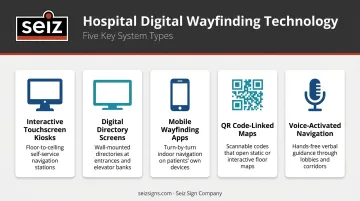
The technology takes several forms:
- Interactive touchscreen kiosks positioned at building entrances and lobby areas
- Digital directory screens at elevator banks and corridor decision points
- Mobile wayfinding apps that use Bluetooth and Wi-Fi for real-time indoor navigation
- QR code-linked maps embedded in printed admission materials or posted at key locations
- Voice-activated navigation for hands-free or accessibility-focused use
Brigham and Women's Hospital's BWH Maps app is one documented example — it provides real-time indoor navigation to more than 300 destinations on the main campus, including offline functionality for areas with limited connectivity.
Where These Systems Are Deployed
That kind of coverage requires placement throughout the entire facility. Hospitals deploy these tools at every point where someone must choose a direction:
- Main building entrances and parking structures
- Lobby reception areas
- Elevator lobbies on each floor
- Corridor intersections leading to major departments
- Off-campus clinics and satellite facilities
What these systems actually prevent is where their value shows up: missed appointments, frustrated patients, and nurses pulled away from clinical work to answer the same directional questions over and over.
Key Benefits of Digital Wayfinding in Hospitals
Benefit 1: Reduced Patient Stress and Improved Experience
Navigating a large, multi-floor hospital is stressful under any circumstances. Research from Vanderbilt University Medical Center describes the journey through parking lots, public areas, and hallways as genuinely stressful for patients visiting large medical centers — and that stress doesn't disappear once they sit down with a provider.
High anxiety before an appointment has documented downstream effects. Research published in the Journal of General Internal Medicine found that patients retain only 40–80% of medical information — and anxiety compounds that by narrowing attention during clinical interactions. Patients who arrive flustered and late are less prepared to communicate clearly or follow through on care instructions.
Digital wayfinding addresses this at the source. Step-by-step directions from current location to named destination — a specific lab, a doctor's suite, an outpatient clinic — remove the uncertainty that triggers anxiety and delays.
Where this matters most:
- Large multi-building campuses with complex floor plans
- High-traffic facilities during peak appointment periods
- Facilities serving aging populations or patients with cognitive or sensory impairments
- During construction phases when corridors and departments are temporarily relocated
KPIs affected: HCAHPS patient satisfaction scores, appointment punctuality rates, no-show rates, and overall patient experience ratings.
HCAHPS scores carry direct financial weight. Under CMS's Hospital Value-Based Purchasing program, patient experience is one of four equally weighted domains — meaning wayfinding-related friction that drags down satisfaction scores can have real reimbursement consequences.
Benefit 2: Operational Efficiency and Cost Savings
The staff-interruption problem is well-documented. A 2025 U.S. survey of 301 hospital staff found that each staff member spends approximately 30 minutes per week helping patients and visitors with wayfinding — and nearly 44% reported experiencing incivility from users frustrated by navigation difficulties.
Across a hospital with hundreds of staff, that adds up to thousands of hours annually redirected from care tasks to giving directions.
The cost benchmark most often cited in healthcare facility literature comes from a foundational study of Emory University Hospital, later cited in a 2018 Vanderbilt University Medical Center wayfinding analytics study: wayfinding problems cost a 604-bed hospital approximately $220,000 per year in labor costs alone.
Digital wayfinding reduces this burden by putting accurate, real-time navigation tools directly in the hands of patients and visitors — before they reach the front desk.
The efficiency gains come from multiple directions:
- Fewer directional questions reaching nursing stations, security desks, and reception staff
- Elimination of recurring print costs for static maps and paper directories when departments change
- Faster routing during high-demand periods without adding staff resources
- Consistent navigation information across multi-campus health systems, updated centrally
Where this matters most: High-volume hospitals with heavy visitor traffic, facilities undergoing construction or department reorganization, and multi-campus systems where navigation content must stay synchronized across locations.
KPIs affected: Staff hours redirected to care tasks, reduction in front desk inquiries, print and signage update costs, missed appointment rates, and scheduling efficiency.
Benefit 3: Accessibility, Inclusivity, and Emergency Readiness
Digital wayfinding's accessibility capabilities are where it outperform static signage. A well-configured system can serve patients who would otherwise struggle with conventional hospital navigation.
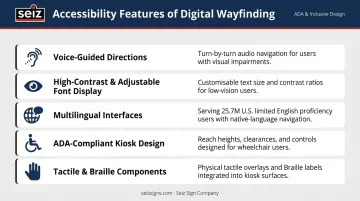
Accessibility features that well-designed systems support:
- Voice-guided directions for visually impaired users
- High-contrast display modes and adjustable font sizes for low-vision patients
- Multilingual interfaces — a meaningful need given that 25.7 million people in the U.S. have limited English proficiency, representing 8% of the population age 5 and older
- ADA-compliant kiosk heights and reach ranges for wheelchair users
- Tactile and Braille options on physical kiosk components
Spanish is the most common language among LEP adults in the U.S. (62%), followed by Chinese (7%), Vietnamese (3%), Arabic (2%), and Tagalog (2%) — meaning multilingual wayfinding isn't a niche feature at most urban hospitals. It's a baseline equity requirement.
These same systems also provide a critical emergency communication layer that static signage cannot match. During a fire alarm, security event, or public health alert, digital wayfinding can be updated in real time to override standard navigation and display emergency routing to safe exits or designated assembly areas.
The U.S. Access Board's ongoing work on self-service kiosk standards — covering speech output, display screens, reach range, and operable parts — reflects the regulatory direction of travel for these systems.
Where this matters most: Urban hospitals serving linguistically diverse populations, facilities with complex multi-floor layouts, and any campus where emergency communication protocols require real-time coordination.
KPIs affected: ADA compliance scores, patient satisfaction across demographic groups, language-barrier-related complaints, and emergency response coordination.
What Happens When Hospitals Lack Effective Wayfinding
The absence of a working navigation system has compounding effects that most facility administrators underestimate until they're looking at data.
The consequences show up in three distinct areas:
- Staff productivity: Directional interruptions pull clinical personnel away from higher-priority tasks throughout the day. The 2025 survey data makes clear this isn't occasional — it's a consistent weekly drain. Nearly half of surveyed staff reported frustration from visitors who had already been lost for some time before asking for help.
- Patient outcomes: A 2024 narrative review found global hospital nonattendance rates ranging from 5% to 30%, with missed appointments linked to delayed diagnosis, disrupted care continuity, and longer wait times for other patients. Poor wayfinding contributes directly to late arrivals and no-shows, particularly among first-time visitors to complex campuses.
- Reimbursement risk: Poor navigation appears consistently as a frustration point in patient experience feedback. HCAHPS-driven satisfaction scores affect Hospital VBP payment adjustments, and Medicare payments are reduced by 2% to fund the VBP incentive pool. Facilities with wayfinding gaps face a structural reimbursement risk that's hard to trace back to its source.
How to Get the Most Value from Digital Wayfinding
Digital wayfinding delivers its full value only when treated as a system, not a single installation. A mobile app that doesn't align with physical corridor signage, or a kiosk showing an outdated department map, creates confusion rather than relieving it.
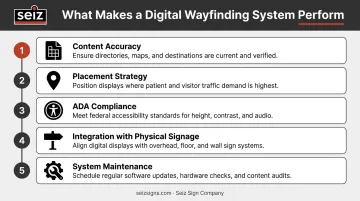
The elements that determine whether a system actually performs:
- Content accuracy — Outdated maps and incorrect department names undermine patient trust. Assign clear content ownership and schedule regular audits, especially after construction or departmental changes.
- Placement strategy — Kiosks and screens placed at genuine decision points (entrances, elevator lobbies, corridor intersections) intercept users before they become lost. Poor placement means low utilization.
- ADA compliance — Kiosk heights, speech output, and display contrast must meet accessibility requirements, not just pass a visual inspection.
- Integration with physical signage — Digital tools and well-maintained traditional signs work together. Patients moving through a corridor between kiosks still need physical markers to confirm they're on the right path.
- System maintenance — A broken kiosk or offline screen in a high-traffic area is worse than having nothing there at all.
For Arkansas healthcare facilities, the physical layer of a wayfinding system requires the same attention as the digital one. Seiz Sign Company designs, fabricates, and installs ADA-compliant room identification signs, directional signs, building directories, and corridor markers — and manages sign permits and installation coordination statewide. That means hospitals work with one team for everything from code compliance to final installation, rather than juggling multiple vendors across a multi-phase project.
Conclusion
Digital wayfinding isn't a technology upgrade for its own sake. It's an operational tool with measurable impact on patient satisfaction, staff productivity, appointment adherence, accessibility, and emergency communication — each tied to metrics that hospital administrators can track and act on.
The case for investment is straightforward: poor wayfinding costs hospitals in staff hours, missed appointments, satisfaction scores, and reimbursement. Digital systems address all of those friction points. The return grows as content stays current and maintenance stays consistent — update costs drop while the system keeps delivering.
As hospital campuses grow more complex and patient expectations continue to rise, effective wayfinding will be a standard requirement, not a differentiator. The facilities that invest now won't just improve navigation — they'll see it reflected in satisfaction scores, staff time, and appointment rates.
Frequently Asked Questions
What is digital wayfinding in a hospital?
Digital wayfinding refers to electronic navigation tools — interactive kiosks, mobile apps, digital signage displays, and voice-activated systems — that guide patients, visitors, and staff through hospital facilities in real time. These systems replace or supplement static maps and printed directories with dynamic, step-by-step directions.
How does digital wayfinding reduce missed appointments?
By giving patients clear directions from arrival to their specific destination, digital wayfinding eliminates the confusion that causes wandering, late arrivals, and patients who give up and leave. Fewer people getting lost means fewer disrupted appointment slots and improved scheduling efficiency.
What types of digital wayfinding technology are used in hospitals?
The main types include touchscreen interactive kiosks, mobile wayfinding apps, digital directory screens, QR code-linked maps, and voice-activated or AR-assisted navigation systems. Most hospitals deploy a combination of these rather than relying on a single format.
Is hospital digital wayfinding ADA compliant?
Well-designed systems can meet ADA requirements, including accessible kiosk heights for wheelchair users, voice guidance for visually impaired patients, and multilingual interfaces. Meeting those standards is a matter of intentional design — not a given with every system.
How does digital wayfinding compare to traditional hospital signage?
Static signage is fixed and requires physical replacement when layouts change, while digital wayfinding updates instantly and provides personalized step-by-step directions. Both work best together — digital tools handle personalization and real-time updates, while physical signs provide consistent orientation between decision points.
What is the ROI of digital wayfinding for hospitals?
ROI comes from multiple inputs: reduced staff time spent giving directions, lower costs for updating printed maps, fewer missed appointments, and improved patient satisfaction scores. One widely cited figure puts wayfinding-related labor costs at approximately $220,000 per year for a 604-bed hospital — a number that makes the case for digital systems on its own.