This scenario plays out regularly across Arkansas and the rest of the country. The ADA mandates specific height, content, and placement rules for accessible parking signs, and violations can trigger Department of Justice complaints, civil lawsuits, and penalties that climb into the six figures. This guide covers every key requirement so you get it right from the start.
TLDR: Key ADA Parking Sign Requirements at a Glance
- Signs must be mounted with the bottom edge at least 60 inches above the ground surface
- Every accessible space requires the International Symbol of Accessibility (ISA); van spaces need an additional "Van Accessible" designation
- Post or wall mounting is required — pavement markings alone do not satisfy ADA standards
- Arkansas fines start at $250–$500 (first offense) and rise to $500–$1,000 for repeat violations
- Lots with four or fewer total spaces and assigned residential spaces have limited sign exceptions
What Are ADA Parking Signs and Why Do They Matter?
ADA parking signs are federally mandated markers identifying reserved accessible parking spaces under the Americans with Disabilities Act, enacted in 1990 and updated by the 2010 ADA Standards for Accessible Design, which became mandatory for new construction and alterations beginning March 15, 2012.
These requirements apply broadly. Any facility open to the public must comply, including:
- Businesses and retail stores
- Restaurants and hotels
- Medical offices and healthcare facilities
- Non-profit organizations
- Parking garages and surface lots
Proper signage does more than mark a spot. It legally reserves the space, makes it enforceable by law enforcement, and ensures people who depend on accessible parking can reliably find and use these spaces. Without a compliant above-ground sign, the space has no legal enforceability — and that's where the specifics of sign placement, height, and content become critical.
The 60-Inch Height Requirement: The Core Federal Rule
What the Standard Actually Says
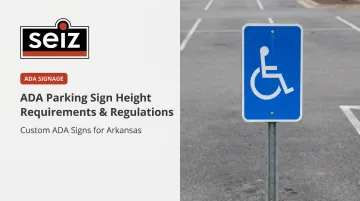
Under ADA Standards §502.6, accessible parking signs must be mounted so the bottom edge of the sign is at least 60 inches (5 feet) above the finish floor or ground surface. That measurement is taken to the bottom of the sign — not the center, not the top edge.
This is a minimum, not a target. If your sign's bottom edge sits at 58 inches, you're non-compliant regardless of how good the sign looks.
Why 60 Inches?
The reasoning is practical: when a car, truck, or van parks in the space, any sign mounted below 60 inches gets blocked from view by the vehicle. The height requirement keeps the sign visible to drivers scanning the lot and to enforcement officers confirming a violation.
Signs mounted too high introduce a different problem — they become hard to read from inside a parked vehicle. A practical target for most installations is 60–66 inches from bottom edge to grade, keeping the sign visible from both the driver's seat and the sidewalk.
Acceptable Mounting Methods
Signs can be installed in three ways:
- Post-mounted at the head of the parking space
- Wall-mounted on an adjacent structure, measured from the ground up
- Ceiling-suspended over the space, provided a minimum 80-inch headroom clearance is maintained along circulation paths (§307.4)
One critical point: pavement decals do not substitute for above-ground signs. Per the U.S. Access Board's parking guidance, required accessible parking signs must be provided even where spaces are identified by pavement markings.
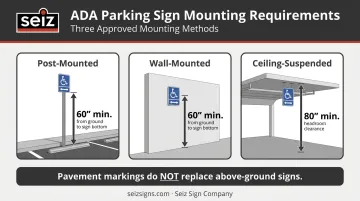
A painted ISA symbol on the asphalt may be required by some local codes, but it supplements — never replaces — the post or wall-mounted sign.
What ADA Parking Signs Must Display
Required Content Under Federal Standards
Every accessible parking sign must prominently display the International Symbol of Accessibility — the white stylized wheelchair figure on a blue background, complying with ADA Standards §703.7.2.1. No substitute symbol or custom design is permitted.
Van-accessible spaces require an additional "Van Accessible" designation on the sign or a separate panel mounted directly below the main ISA sign.
Federal standards set the baseline — but states can layer additional requirements on top. Arkansas does exactly that.
Arkansas-Specific Requirements
Arkansas Code §27-15-315 adds state-level specificity. A sign is considered regulatory in Arkansas when it:
- Is visible at the driver's eye level
- Displays the blue and white international symbol of access
- Includes one or more approved phrases: "Disabled Parking," "Van Accessible," "Handicapped Parking," "Reserved for Handicapped," or "Reserved Parking"
- Or materially conforms to MUTCD standards R7-8, R7-8a, or R7-8b
Arkansas penalties under §27-15-305 are significant: $250 to $500 for a first offense and $500 to $1,000 for a second or subsequent offense.
The ADA Standards don't mandate sign color beyond the ISA symbol, nor do they require specific text like "Reserved Parking." For Arkansas property owners, that means state law governs the details — and non-compliant signs carry real financial exposure.
Van-Accessible Parking: Space Requirements and Sign Rules
The Physical Space Standards
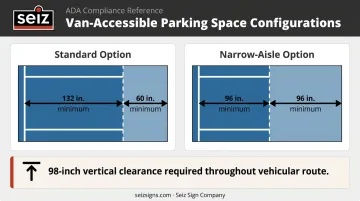
Van-accessible spaces have stricter dimensional requirements than standard accessible spaces:
| Configuration | Parking Space Width | Access Aisle Width |
|---|---|---|
| Standard option | 132 inches minimum | 60 inches minimum |
| Narrow-aisle option | 96 inches minimum | 96 inches minimum |
Both configurations require a minimum 98-inch vertical clearance throughout the vehicular route to the space (§502.5), a detail that catches many parking garage owners off guard when low-hanging structures fall short of that threshold.
The 1-in-6 Ratio Rule
Per ADA Standards §208.2.4, at least one of every six accessible spaces — or fraction of six — must be van-accessible. A parking lot with 100 total spaces, for instance, requires 4 accessible spaces, at least one of which must be van-accessible.
Sign Format Options
The "Van Accessible" designation can appear as:
- A separate panel mounted below the main ISA sign
- Combined on a single sign that includes both the ISA and the van-accessible text
Both formats satisfy federal requirements. Arkansas's regulatory recognition of MUTCD-conforming signs means the standard R7-8a supplemental plaque format satisfies Arkansas requirements.
Federal standards govern what the sign says; Arkansas law governs who can use the space. Arkansas Act 799 establishes a state-specific van-accessible parking decal system with its own enforcement rules — separate from the federal signage requirement. Arkansas DWS guidance covers current decal eligibility and enforcement details for van-accessible spaces.
Sign Size, Materials, and Placement
Recommended Dimensions
The ADA Standards do not specify a minimum sign size beyond the height requirement. However, the MUTCD recommends a minimum of 12 inches wide by 18 inches tall for accessible parking signs (R7-8), with the van-accessible supplemental plaque at 12 inches by 6 inches. Larger signs improve visibility in high-traffic lots.
Material Standards
For outdoor durability, industry benchmarks point to:
- Aluminum at 0.063 inches thick or greater, which holds up against weather, UV exposure, and Arkansas temperature swings
- Reflective sheeting rated Engineer Grade (ASTM Type I) or High Intensity Prismatic (ASTM Type III) for reliable nighttime visibility
These are real-world performance standards, not legal mandates under Arkansas law. A sign that degrades within a few years puts your property back at compliance risk — investing in the right materials upfront avoids that problem entirely.
Placement Rules
- Position signs at the head of the parking space so drivers see them before pulling in
- Signs must not be placed within the access aisle or in any position that reduces required clear width on accessible routes
- Bollards, sign poles, and other elements in the access aisle are prohibited
Compliance Risks, Common Mistakes, and Getting It Right
The Most Frequent Violations
ADA compliance reviews consistently flag these issues:
- Signs mounted below 60 inches (the single most common error)
- Missing or faded ISA symbols on existing signs
- Absent "Van Accessible" designation on qualifying spaces
- Pavement-only markings without any above-ground sign
- Insufficient number of accessible or van-accessible spaces for lot size
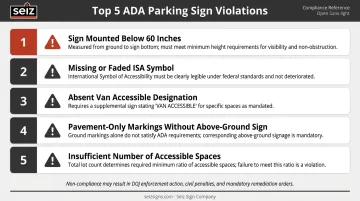
DOJ enforcement settlements have required businesses in multiple states to remount signs that were obscured by parked vehicles or missing van-accessible designations entirely — the same mistakes Arkansas businesses make today.
What Non-Compliance Actually Costs
The numbers are not trivial. Under DOJ's 2025 inflation-adjusted civil penalty schedule, ADA Title III violations can reach:
- $118,225 for a first violation
- $236,451 for a subsequent violation
Those are federal maximums for Attorney General-initiated actions, but individuals can also file DOJ complaints or pursue civil litigation. Remediation costs — new signs, restriping, post installation, legal fees — stack on top of those penalties fast. Fixing violations after the fact routinely costs more than getting the installation right the first time.
Annual Maintenance Matters
Signs should be inspected at least once a year for fading, physical damage, and illegibility. Reflective sheeting degrades over time, especially in Arkansas's heat and sun exposure. A sign that passed inspection in 2020 may no longer meet standards in 2025.
Arkansas businesses can work with Seiz Sign Company for compliant ADA sign fabrication and installation statewide. Founded in Hot Springs in 1908, the company handles the full process in-house: design, fabrication, post or wall mounting, and installation by licensed contractors.
Sign code and permit assistance are included as part of the project. The team includes Robert Manning, a Licensed Sign Electrician and Parking Lot Tech with 42 years of industry experience — the kind of specific expertise ADA parking sign compliance actually demands.
Frequently Asked Questions
What is the height requirement for ADA parking signs?
ADA Standards §502.6 requires the bottom edge of accessible parking signs to be mounted at least 60 inches above the ground surface. This ensures the sign remains visible when a vehicle occupies the space. Pavement markings alone do not satisfy this requirement.
Can a pavement decal or painted ISA symbol replace a post-mounted ADA parking sign?
No. Surface decals cannot substitute for above-ground signs. The ADA requires signs mounted at least 60 inches high that stay visible at all times. Pavement markings may be required by local codes but must supplement — not replace — the post or wall-mounted sign.
Do van-accessible spaces need a different sign than standard accessible spaces?
Yes. Van-accessible spaces require the standard ISA sign plus a "Van Accessible" designation, either as a separate panel or combined on one sign. That label doesn't restrict use to vans only — though Arkansas adds its own van-accessible decal requirements at the state level.
Are there any exceptions to the ADA parking sign requirement?
Two federal exceptions exist under §216.5. First, parking lots with four or fewer total spaces do not require signs, though accessible spaces are still required. Second, residential facilities where parking spaces are assigned to specific dwelling units are exempt from the sign requirement.
What happens if a business doesn't have proper ADA parking signs?
Non-compliant signage can lead to DOJ complaints, civil lawsuits, and significant financial penalties. The accessible space also becomes legally unenforceable without proper signage — meaning it can be occupied by anyone without consequence.
Do state laws affect ADA parking sign requirements in Arkansas?
Federal ADA standards set the minimum baseline, but Arkansas adds requirements through statutes like §27-15-315 (approved sign wording and MUTCD conformity) and §27-15-305 (penalty amounts). When federal and state rules differ, the stricter standard applies.