Introduction
Picture this: you're stopped at a red light on Central Avenue in Hot Springs, watching a competitor's branded HVAC van roll through the intersection. Their logo, phone number, and "24-Hour Service" message are impossible to miss. Meanwhile, your own white cargo van sits in the next lane — anonymous, invisible, and completely forgettable.
That's a marketing opportunity your business misses every day those vehicles hit the road.
Fleet marketing transforms company vehicles into mobile advertising, working continuously on highways, at job sites, in neighborhoods, and in parking lots across Arkansas. The vehicle wrap itself is only as effective as the graphic design behind it — and poor design blends into traffic just as easily as a blank white van.
This guide covers everything Arkansas service businesses need to know: what fleet graphics are, what separates effective designs from forgettable ones, how the production process works, and how to choose the right local partner.
Key Takeaways
- Fleet graphics turn operational driving time into continuous brand exposure (no recurring ad spend after installation)
- Effective designs rely on visual hierarchy, contrast, and typography — not just slapping a logo on a door
- Businesses can choose from decals, partial wraps, or full wraps based on budget and goals
- Quality cast vinyl with UV-resistant laminate can last 5–7 years with proper care
- A full-service provider that designs, prints, and installs in-house eliminates costly handoff errors
What Are Fleet Graphics and Why Do They Matter?
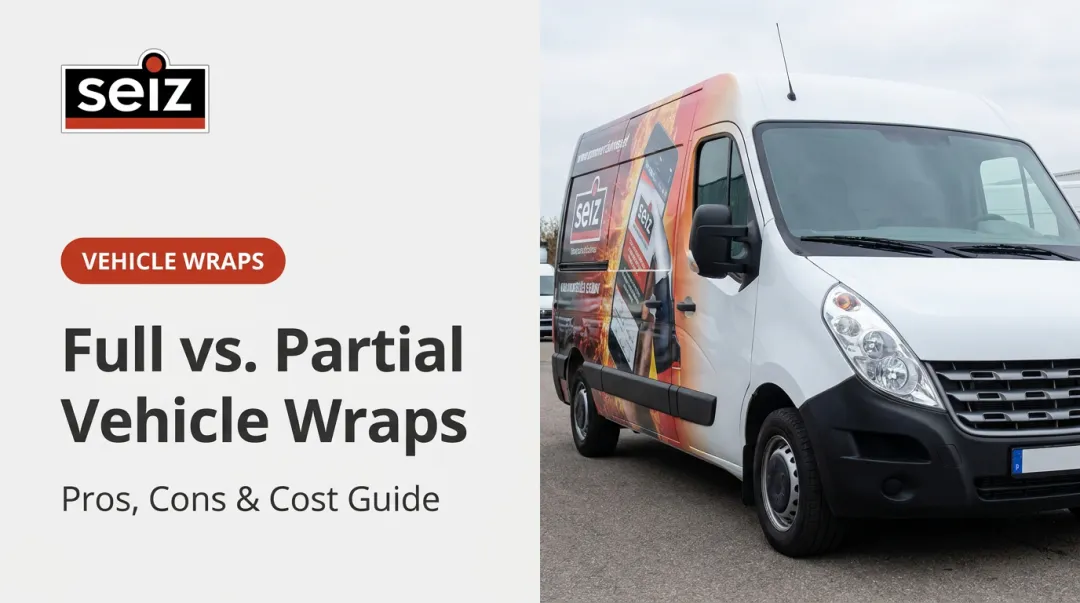
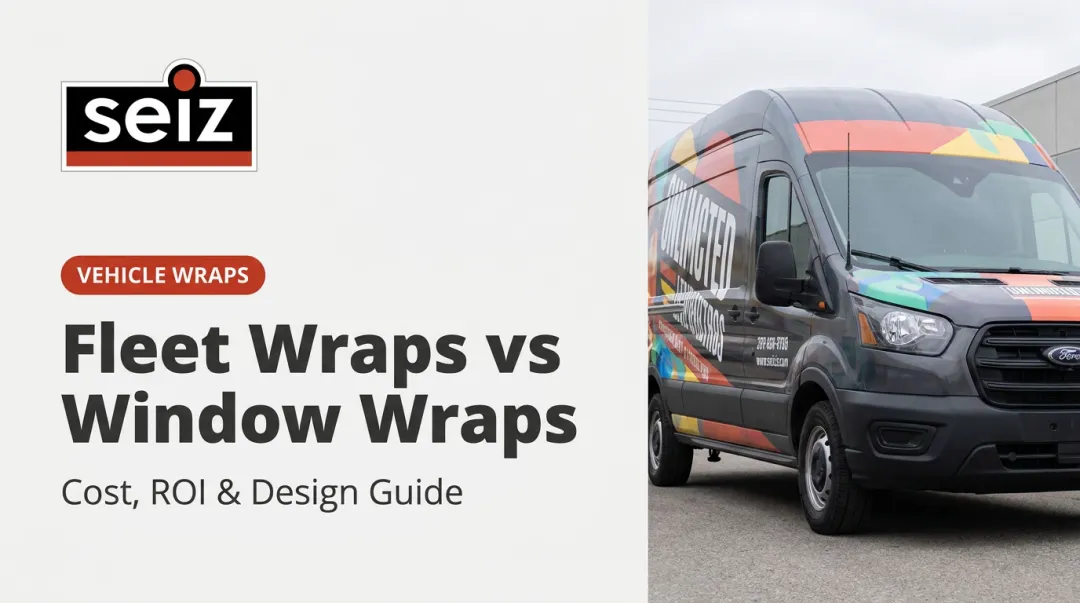
Fleet graphics are vinyl-based visual designs applied directly to commercial vehicles, ranging from simple door decals to complete vehicle wraps. Every company truck, van, box truck, or trailer becomes a branded asset on the road.
The marketing logic is straightforward: your vehicles are already driving through Hot Springs, across Garland County, and throughout Arkansas every working day. That driving time is either generating brand impressions or not. Fleet graphics make sure it does.
The Numbers Behind Mobile Advertising
Research from Geopath cited by the ISA shows that vehicle graphics can generate 101 impressions per mile and up to 70,000 impressions per day for a single wrapped vehicle on active routes. For context, 3M's fleet graphics effectiveness data — citing a Nielsen out-of-home study — found that 64% of consumers noticed vehicle graphics, with cost-per-thousand impressions as low as $0.15.
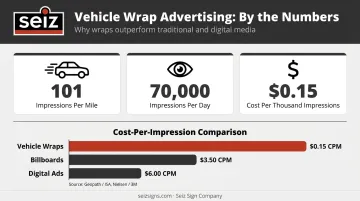
That cost-per-impression is difficult to match with any other local advertising channel, and unlike a billboard, your message moves with your customers.
Why Arkansas Service Businesses Benefit Most
For contractors, HVAC companies, landscapers, plumbers, and delivery operations across Arkansas, vehicles already cover significant daily mileage for operational reasons. Fleet graphics convert that operational cost into a marketing investment — reaching potential customers in the neighborhoods and communities where those crews actually work.
A single service van working Hot Springs neighborhoods daily can realistically reach thousands of residents — people who may need that exact service next week or next month.
Key Design Elements That Make Fleet Graphics Work
Fleet graphics earn their keep in seconds — a driver glancing over at 55 MPH, a homeowner watching a van park across the street, a potential customer spotting your truck at a traffic light. Every design decision either supports that split-second communication or undermines it.
Visual Hierarchy: Lead With What Matters
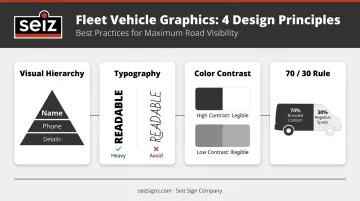
The company name and core service should dominate the vehicle's side panels — largest, most prominent, and placed where the eye goes first. The phone number follows. Secondary details like website URLs or service lists come last, in smaller type.
Overloading a vehicle with too many elements guarantees that viewers retain none of them.
Typography: Readability Over Style
Bold, thick, sans-serif fonts are the professional standard for vehicle graphics. Decorative, script, or compressed typefaces lose their letterforms at distance and speed. The OAAA's Planning for OOH Media guidance specifically flags compressed type and excessive words as readability killers — consistent with what any experienced vehicle wrap designer will tell you from practice.
Proven choices include Helvetica Bold, Arial Black, Impact, and Franklin Gothic Heavy. Script fonts, thin-weight serifs, and condensed decorative faces all break down before the viewer gets close enough to read them.
Color and contrast work the same way — what reads clearly at arm's length often disappears at speed. That's where the next layer of design decisions matters.
Color Psychology and Contrast
Color communicates industry before a viewer reads a single word:
- Blue and white — plumbing, cleaning, water services
- Yellow and black — electrical, construction, safety-focused trades
- Green — landscaping, environmental services
- Red and white — emergency services, fire, urgent response
Whatever palette you choose, high contrast between text and background is essential. The ISA's sign contrast guidance recommends characters contrast with their background by at least 70% for reliable legibility.
Logo Placement and the 70/30 Rule
Place your logo in the upper two-thirds of side panels and on rear doors — where dwell time from passing drivers and pedestrians is highest. Keep logos away from door handles, wheel wells, and body panel seams, which distort printed images.
The 70/30 rule applies throughout: roughly 70% of the vehicle's visual space carries key brand messaging and design elements, while 30% stays as intentional negative space. That breathing room is what lets the eye focus on what matters most. Ignoring it produces a design that looks busy from 10 feet and unreadable from 50.
Types of Fleet Graphics: From Decals to Full Wraps
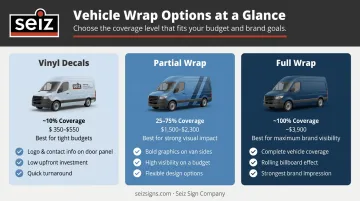
Fleet graphics come in three formats, and the right choice depends on your budget, vehicle count, and how aggressively you want your vehicles working as mobile advertising.
| Option | Coverage | Best For |
|---|---|---|
| Vinyl decals / spot graphics | Logo, contact info, specific panels | Tight budgets, minimal brand presence |
| Partial wraps | 25%–75% of vehicle surface | Strong visual impact while using vehicle base color |
| Full wraps | Complete vehicle coverage | Maximum visibility, dramatic brand transformation |
According to a 2025 Sign Builder Illustrated trade article, example pricing for a Ford F-150 ranges from roughly $350–$550 for standard lettering, $800–$1,200 for die-cut kits, $1,500–$2,300 for partial wraps, and around $3,900 for a full wrap. Actual costs depend on vehicle size, design complexity, and material coverage.
Full wraps also offer a secondary benefit: quality cast vinyl is designed to come off cleanly from sound factory paint, protecting the original surface for the wrap's full service life.
Choosing the Right Option for Your Business
A single service van on the road in Hot Springs can justify a full wrap — every mile driven puts your brand in front of new eyes. A larger fleet might start with consistent partial wraps or professional decals to achieve brand uniformity across multiple vehicles efficiently.
Whichever format you choose, design quality is what separates a vehicle that generates leads from one that blends into traffic. A well-executed partial wrap outperforms a cluttered full wrap every time.
The Graphic Design Process for Fleet Marketing
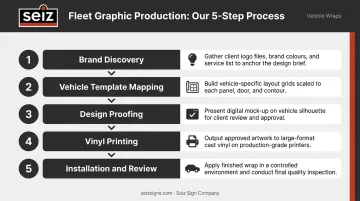
Professional fleet graphic design follows a structured workflow. Here's what that process looks like from start to road-ready vehicle.
Step 1 — Brand Discovery The designer needs your logo, brand colors, core services, and target customer. If no brand assets exist, logo and color development should happen first.
At Seiz Sign Company, in-house graphic artists can build a brand identity from scratch. Because those designers work alongside the production and installation team, logos are built to work across vehicle surfaces from day one — not retrofitted after the fact.
Step 2 — Vehicle Template Mapping Professional designers work from vehicle-specific templates that account for door handles, mirrors, body curves, and panel seams. A design mapped to the wrong template will look misaligned, distorted, or awkwardly interrupted on the actual vehicle. This step is especially critical for mixed fleets where the same brand needs to appear consistently across different vehicle makes and sizes.
Step 3 — Design Proofing and Approval Mock-up renderings show the approved design on the actual vehicle model before any vinyl is printed. This is where color accuracy, logo sizing, and message clarity get confirmed. Skipping or rushing this step is where most preventable errors enter the process.
Step 4 — Production and Vinyl Printing Once approved, the design goes to large-format printing using cast vinyl and UV-resistant laminates. Seiz Sign Company handles this in-house, with a vinyl printer capable of output up to 16 feet wide. Graphics Production Manager Jorge Barboza has overseen vinyl applications at Seiz since 2002. He confirms material quality and print accuracy before any vehicle sees a sheet of vinyl.
Step 5 — Installation and Final Review Professional installation requires a controlled environment: proper temperature, clean surface preparation, and careful application technique. The results — clean edges, no bubbles, no lifting — depend entirely on this stage.
Key checks before sign-off:
- Surface is fully cleaned and prepared before application begins
- Temperature and humidity fall within acceptable ranges for the vinyl type
- Edges, seams, and cutouts are inspected for lifting or misalignment
- Finished installation is compared directly against the approved proof
A post-installation review confirms the finished work matches the approved proof.
Maintaining Your Fleet Graphics for Long-Term Impact
Quality fleet graphics are an investment. Proper care protects that investment and extends the graphic's useful life.
Care Best Practices
Follow manufacturer-recommended guidelines for the vinyl product installed on your vehicles:
- Hand-wash with mild, pH-neutral detergent and soft cloths
- Pressure washing: if used, keep below 1,200 PSI, water temperature under 180°F, nozzle at least 12 inches from the surface with a 40-degree tip (per Avery Dennison's care guidelines)
- Park in shade when vehicles aren't in use — UV exposure and heat reduce vinyl durability over time
- Check with your installer before using automated car washes, as manufacturer recommendations vary by vinyl brand
Lifespan Expectations
High-quality finished fleet graphics using cast vinyl with UV-resistant laminate can be covered under warranties of up to 7 years through programs like 3M's MCS Warranty for finished graphics using certified components. Actual longevity varies based on several factors:
- Vinyl film type and laminate system
- Surface orientation (horizontal panels degrade faster than vertical)
- Climate and UV exposure levels
- Wash method and installation quality
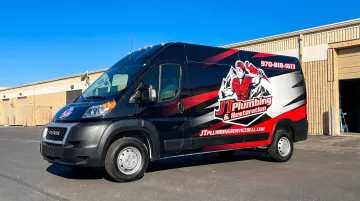
Periodic inspections are worth scheduling. A small edge lift or minor peel caught early is a quick repair — left unaddressed, it can spread into full delamination that requires panel replacement. Most installers recommend a visual check every six months.
How to Choose the Right Graphic Design Partner for Your Fleet
Not every sign shop or print vendor has the specialized expertise fleet graphics require. Here's what to evaluate before committing.
Look for these three capabilities when evaluating vendors:
- Full-service production under one roof — design, printing, and installation handled internally, so color accuracy stays consistent and turnaround stays predictable
- Fleet-specific design experience — ask to see actual fleet portfolios, not just general design work; a qualified designer understands how a brand reads in motion, across vehicle models, and from varying distances
- Local presence — an Arkansas-based provider can meet in person for brand reviews, respond quickly to panel repairs, and coordinate mobile installation statewide without the lag time national vendors introduce
If you're looking for a partner that checks all three boxes, Seiz Sign Company has served Hot Springs and Arkansas businesses since 1908. They offer in-house graphic design, large-format vinyl printing, and professional installation — from single-vehicle projects to multi-unit fleet branding — with mobile installation available statewide.
To discuss your fleet branding needs, contact Seiz Sign Company at (501) 623-3181 or visit them at 1231 Central Avenue, Hot Springs, Arkansas.
Frequently Asked Questions
What are fleet graphics?
Fleet graphics are vinyl-based designs — including decals, partial wraps, and full wraps — applied to commercial vehicles to brand them as mobile marketing tools. They generate brand impressions wherever the vehicles travel throughout the day.
What is the 70/30 rule in graphic design?
In fleet graphic design, the 70/30 rule means roughly 70% of the vehicle's visual space is devoted to key brand messaging and design elements, while 30% remains as intentional negative space. That open space prevents visual clutter and makes the most important information easier to read.
What should be included on a fleet vehicle graphic?
The essentials are: company name, core service or industry, phone number, website or call-to-action, and logo. Any required contractor license numbers should be included in a less prominent area to satisfy compliance without competing with the primary brand message.
How long do fleet vehicle graphics typically last?
Finished fleet graphics using quality cast vinyl with UV-resistant laminate can be warrantied up to 7 years under 3M's MCS Warranty. Actual lifespan varies based on material, climate, installation quality, and how well the vehicle is maintained.
Do I need a professional designer for fleet vehicle graphics?
Yes — professional design makes a measurable difference. Vehicle-specific templates, brand color accuracy, visual hierarchy for highway readability, and production-ready file formats all require specialized expertise that general graphic design tools or DIY approaches rarely deliver at the quality level fleet graphics demand.