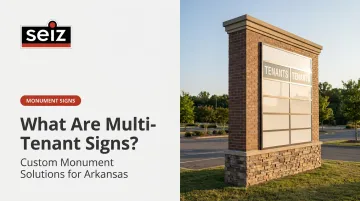
Property owners and business tenants often aren't sure which sign format fits their property, how panel layout works, or what a realistic budget looks like. Questions about zoning, panel hierarchy, and material choices pile up fast.
This guide breaks down what multi-tenant signs are, which property types need them, the common formats available, and what actually drives cost. We're drawing on Seiz Sign Company's 118 years of hands-on signage experience across Arkansas.
Key Takeaways
- Multi-tenant signs display several businesses on one shared structure, commonly at shopping centers and office parks
- Formats include monument, pylon, directory, and wall/blade signs, each suited to different visibility needs
- Panel hierarchy, durable materials, and LED illumination drive sign performance over 10+ years
- Local zoning and permitting rules restrict sign size, height, and count in every market
What Is a Multi-Tenant Sign?
A multi-tenant sign is a single freestanding or wall-mounted structure that displays the names, logos, or branding of multiple businesses operating within one commercial property. Compare that to a single-tenant sign, which identifies just one business at its own location.
The industry sometimes calls these joint-tenant signs, and the structure typically follows a clear format:
- A header panel at the top identifying the property name or the lead tenant
- Individual tenant panels below, arranged by size and visual priority
- A shared base, pylon, or wall mount tying everything together
You'll find multi-tenant signs most often at:
- Shopping centers and strip malls
- Office parks
- Medical and professional complexes
- Mixed-use developments
Tenant panels are usually modular, meaning a business can be added, removed, or updated without tearing down the entire sign. This flexibility matters since tenant turnover happens throughout a property's lifespan.
A Real Example From Hot Springs
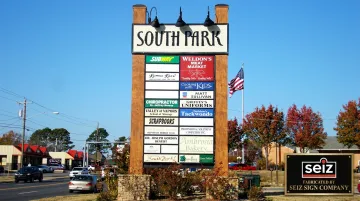
Seiz Sign Company fabricated the South Park multi-tenant directory sign, which displays individual branded panels for Subway, Weldon's Meat Market, Ambrosia Bakery, and a chiropractic office, all on one shared structure. The layout uses a bold header panel at top with color-coded, individually sized panels below, guiding visitors to the exact business they're looking for.
Achieving that level of clarity takes technical know-how behind the scenes. As a licensed, full-service electrical sign contractor operating since 1908, Seiz Sign Company works with property owners and their tenants from concept through installation. The team uses structural supports like round pipe, square tubing, or I-beams, often concealed behind decorative pylon covers for a more finished look.
What Is Considered a Multi-Tenant Property?
In commercial real estate, a multi-tenant property is defined as one leased to two or more tenants, sharing common areas, parking, and often a single street address.
Examples relevant to Arkansas property owners include:
- Shopping centers and strip malls
- Multi-suite office buildings
- Medical and professional complexes
- Mixed-use developments combining retail, office, and residential space
Why one shared sign instead of several standalone signs? Local zoning codes typically cap the number of freestanding signs allowed per lot. A property with eight tenants can't legally put up eight separate pole signs along the road frontage.
A unified signage strategy solves two problems at once:
- Keeps the property compliant with sign-count restrictions
- Gives every tenant visibility they wouldn't get from a small, individual sign competing for space
This is exactly why landlords and developers often coordinate multi-tenant signage as part of the leasing process rather than leaving each business to fend for itself.
Types of Multi-Tenant Signs
The right format depends on property layout, how fast traffic moves past the site, and what the local sign code allows. Each type below solves a different visibility problem.
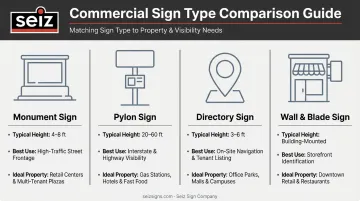
Monument Signs
Monument signs are low-profile, freestanding ground signs, often built with aluminum, metal, or composite panels set into a landscaped base. The sign has no visible support structure, sitting close to the ground with an architectural, upscale appearance.
Best for: Properties with strict height restrictions, or owners who want a permanent, polished entrance identifier. Some overlay districts, including the Malvern Avenue corridor in Hot Springs, actually require monument signs and prohibit taller freestanding structures altogether.
Pylon Signs
Pylon signs stand taller on steel or aluminum columns, with elevated, illuminated tenant panels designed for maximum roadside visibility.
Best for: Properties along highways or major thoroughfares where several tenants need exposure to fast-moving traffic. Structural columns can be dressed with a decorative cover so the sign still looks finished rather than purely industrial.
Directory & Wayfinding Signs
These signs list tenant names and suite numbers, typically placed within office parks, medical complexes, or larger developments with interior corridors.
Best for: Properties where visitors risk getting lost: large parking areas, multi-building campuses, or complexes with dozens of suites sharing one entrance.
Wall & Blade Signs
Wall signs (often channel letters or cabinet signs) mount flat against the building facade. Blade signs project perpendicular from the building, giving pedestrians a walk-by view.
Best for: Retail strips and dense pedestrian districts where individual storefronts need close-up brand recognition rather than roadway visibility.
Key Benefits and Design Considerations
Beyond visibility, multi-tenant signs solve a practical budget problem: several businesses split the cost of one prominent structure instead of each paying for a separate sign.
That shared structure still needs to represent every tenant clearly, which comes down to material choice.
Material and branding options include:
- Cut vinyl graphics for a cost-effective tenant panel
- Dimensional letters (aluminum, acrylic, or metal) for a premium, raised profile
- Channel letters for illuminated individual tenant identification
- Routed aluminum or polycarbonate faces for durable, weather-resistant panels
Panel Hierarchy and Layout
Anchor tenants typically get larger panels positioned higher on the structure, with secondary tenants sized proportionally below. Good layouts also plan ahead for turnover, leaving room to swap a panel without redesigning the whole sign when a business closes or a new one moves in.
LED Illumination and Energy Savings
Switching from older lighting to LED isn't just a visibility upgrade. A Department of Energy comparison of neon versus LED channel-letter signage found LED fixtures use roughly 60% less wattage per sign than neon. That's a meaningful reduction in annual operating costs, though actual savings depend on current fixture wattage and local electricity rates.
Seiz Sign Company's Licensed Sign Electricians work through the Entergy Solutions Program with CleaResult, and Project Manager Eric Schmitt manages that relationship directly. Rebates through this program typically offset 20–40% of total project cost for property owners converting to LED sign lighting, and Seiz handles the rebate paperwork on the customer's behalf.
Zoning, Permitting, and Maintenance
Local sign codes restrict height, square footage, and sign count, and those rules can change block by block. Hot Springs' Malvern Avenue Overlay District, for instance, permits monument signs only for commercial properties along that corridor.
Seiz Sign Company handles the full permit process: sign code research, zoning compliance review, overlay-district approvals, structural drawings, and inspection scheduling. President David Hamilton has served as Past Vice-Chairman on the City of Hot Springs Code Committee, giving the company direct insight into how local ordinances get applied in practice.
On maintenance: weather-resistant materials and swappable panel designs keep long-term upkeep costs down, since a damaged or outdated panel can be replaced without touching the rest of the structure.
How Much Do Multi-Tenant Signs Cost?
Pricing varies widely based on sign type, size, materials, illumination method, and how many tenant panels the structure needs to accommodate. Monument signs generally cost less than pylon signs of comparable tenant capacity, largely because pylon structures require more steel, taller foundations, and more complex electrical runs.
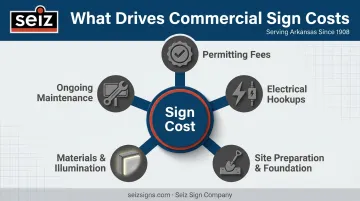
Cost factors beyond fabrication include:
- Permitting fees, which vary by jurisdiction and overlay district
- Electrical hookups for illuminated panels
- Site preparation and footing/foundation work
- Ongoing maintenance and panel-swap labor
A useful quote checklist covers:
- Overall height and sign dimensions
- Number of tenant panels needed
- Material selection and illumination type
- Power supply access and foundation engineering
- Permit scope for the specific jurisdiction
Because every property's zoning situation and site conditions differ, published price ranges rarely hold up in practice.
The most reliable path is a custom quote. Seiz Sign Company's team, including Sales Executives Eric Schmitt and Robert Manning, can walk through design, permitting, and installation specifics for any Arkansas property. Call (501) 623-3181 to start that conversation.
Frequently Asked Questions
What is a multi-tenant sign?
A multi-tenant sign is a single shared sign structure, freestanding or wall-mounted, that displays the names or logos of multiple businesses operating on the same commercial property.
What is considered a multi-tenant?
A multi-tenant property is commercial real estate leased to two or more businesses that share common areas, parking, and typically one street address.
How much should a shop sign cost?
Pricing depends on sign size, materials, and illumination method, so costs vary from project to project. Contact Seiz Sign Company for a custom quote tailored to your property.
What is the difference between a monument sign and a pylon sign?
Monument signs are low-profile ground signs, best for properties with height restrictions or upscale entrance branding. Pylon signs stand taller on steel or aluminum supports for maximum visibility from fast-moving roadway traffic.
Do I need a permit for a multi-tenant sign in Arkansas?
Yes, in most cases. Local zoning rules vary by city and even by overlay district, so consult a local licensed sign company like Seiz Sign Company before finalizing a design.
Can tenant panels be replaced when a business changes?
Yes. Multi-tenant signs are typically designed with modular tenant panels, allowing a business's panel to be updated or swapped without rebuilding the entire sign structure.

![How Much Does Commercial Sign Installation Cost? [2026 Data]](https://file-host.link/website/seizsigns-iej5ny/assets/blog-images/83c25108-8156-418f-95b0-3c6c08c2f982/1783011396512636_93394f85e0d043e48b387100828a67be/1080.webp)