
Many businesses assume digital is the automatic upgrade. Few stop to ask whether a fixed, always-on message actually fits their budget, category, and campaign length better.
This guide breaks down the practical, measurable benefits of static billboards, plus the specific situations where a printed face still outperforms a rotating screen.
Key Takeaways
- Delivers 100% share of voice, with zero rotation or competing ads on the same face
- Requires lower technology overhead, keeping costs predictable for 3+ month campaigns
- Builds strong long-term recall through repeated exposure, despite lower single-glance impact
- Stays visible around the clock with no power dependency or screen malfunction risk
- Excels at one sustained message rather than fast-changing promotions
What Is a Static Billboard?
A static billboard is a printed vinyl (or, less commonly today, hand-painted) advertisement mounted on a fixed structure. One message runs for the entire length of the campaign. No rotation, no software, no shared screen time.
You'll typically find these boards along highways, major commuter routes, and busy intersections. In markets like Hot Springs and Garland County, that includes corridors such as the Malvern Avenue/HWY 270 area, where high daily traffic counts make fixed exposure especially valuable.
That fixed, always-on presence is exactly why a static billboard functions as long-term brand infrastructure rather than a one-off attention grab. It's built for sustained visibility and recognition, not quick-turn promotions that need to change every week.
Key Advantages of Static Billboards
These aren't abstract marketing benefits. They're tied to outcomes businesses actually track: cost per impression, recall, reliability, and budget predictability.
Printed billboard inventory also remains commercially significant. Lamar Advertising reported roughly 79,600 bulletins and 79,700 posters in its 2025 fleet, compared to about 5,500 digital billboards.
Clear Channel Outdoor's America segment showed a similar split: over 32,000 printed displays versus roughly 2,000 digital ones. Static hasn't gone anywhere.
Full-Time Exclusivity and Share of Voice
A static board carries one message only. No rotation, no competing advertisers sharing that face during your flight. Your brand owns that space 24 hours a day for the length of the contract.
Compare that to a typical digital billboard loop. According to OAAA, digital boards commonly rotate among six to eight advertisers, with messages changing every six to eight seconds.
That means your ad might get roughly one-seventh or one-eighth of the actual screen time, even though you're paying for placement on that board.
| Format | Advertisers per face | Screen time share |
|---|---|---|
| Static billboard | 1 | 100% |
| Digital billboard (typical loop) | 6-8 | ~12-16% per rotation |
Why this matters: eliminating rotation dilution means every impression counted is an impression of your message, not a competitor's. This advantage matters most when:
- You want zero risk of appearing beside a direct competitor's ad
- Your message (phone number, address, tagline) is meant to run unchanged for months
- Your category is competitive enough that shared attention actually costs you customers
KPIs impacted: total impressions delivered, share of voice, and brand recall consistency.
Predictable, Lower Long-Term Cost Per Impression
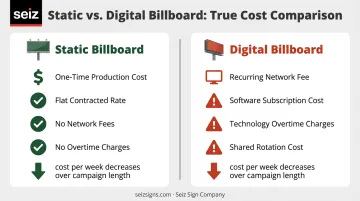
Static billboards involve a one-time production and installation cost, followed by a flat contracted rate. There's no ongoing network fee, no software subscription, no technology overtime charge.
That structure matters for budgeting. Production costs amortize across the length of the campaign, so the longer the flight runs, the lower your effective cost-per-week becomes. A three-month campaign spreads that upfront design and print cost much further than a three-week burst would.
Seiz Sign Company's static billboard network, for example, offers 24/7/365 advertising with no overtime charges across its 90-plus locations and 225 faces in Hot Springs and Garland County. That's a flat, contract-locked rate: no surprise technology fees showing up mid-campaign.
- Fixed pricing model with no recurring network costs
- Production expense spreads out over the full flight length
- No premium charged for evening, weekend, or holiday exposure
When this matters most: small-to-midsize local businesses committing to a three-month-or-longer run built around one core message benefit most from contract-locked pricing.
KPIs impacted: cost per impression, total campaign spend, budget predictability.
Reliability and Durability With Zero Technical Downtime
Static billboards have no power dependency and no network connection to fail. There's no risk of a frozen screen, a software glitch, or a blank display during peak commute hours.
That's not a minor detail. Digital billboard manufacturer Daktronics documents specific power and internet requirements for its digital displays, including dedicated electrical circuits and a minimum internet connection per unit.
Every one of those dependencies is a potential point of failure that a static face simply doesn't have.
A malfunctioning digital display can actively hurt brand perception. A printed face is mechanically simple, so it just stays up and stays visible.
- No grid outage risk affecting your ad's visibility
- No remote monitoring or IT troubleshooting required
- Fully visible regardless of local connectivity issues
When this matters most: in areas with less consistent power or network infrastructure, and for advertisers who prioritize guaranteed visibility over creative flexibility.
KPIs impacted: uptime and reliability rate, brand consistency, maintenance cost.
What Happens When You Overlook Static Billboards
Skipping static formats entirely, and relying only on rotating digital slots, tends to create predictable consequences:
- Diluted share of voice from splitting attention with five to eight other advertisers on the same face
- Higher long-term cost per impression once recurring rotation and network fees stack up over an extended campaign
- Missed repetition-based recall that builds familiarity and trust in a local market over time
- No always-on fallback if a digital board goes down during a critical exposure window, like a weekend rush or a local event
None of these are dealbreakers on their own. Together, they add up to weaker long-term brand-building — which is exactly the gap Seiz Sign's mix of static and digital faces across Hot Springs and Garland County is built to close.
How to Get the Most Value from Static Billboard Advertising
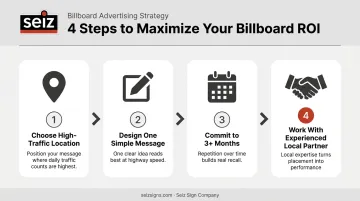
Static billboards deliver their strongest ROI when four factors line up: the right location, a disciplined message, adequate campaign length, and an experienced partner who knows local requirements.
Choose a high-traffic, high-visibility location. Verify actual traffic counts instead of guessing. Seiz Sign Company's network of 90+ locations and 225 faces across Hot Springs and Garland County reflects decades of relationships with local property owners in these exact corridors.
Design one strong, simple message. Industry rule of thumb: fewer than seven words and three or fewer design elements, since drivers only get a few seconds to absorb it. Frequent creative changes erode the cost advantage static is built on.
Commit to at least three months. Repetition is what builds recall on a static board. A single glance doesn't do the work; the fortieth glance does.
Work with an experienced local partner. They can advise on zoning, code, and permit requirements before installation, since sign ordinances vary block by block in markets like Hot Springs.
Conclusion
The core value of static billboards rests on three things: exclusivity, predictable costs, and hardware that simply doesn't fail as often. None of these advantages are flashy, but all three compound the longer a campaign runs.
That's why static works best for sustained brand-building around one core message, not short bursts of frequently changing promotions. For Arkansas businesses, it's a format that's proven itself for generations, and one Seiz Sign Company continues to build, install, and maintain across Hot Springs and Garland County.
Frequently Asked Questions
What is a static billboard?
A static billboard is a fixed, printed advertisement, typically vinyl, that occupies the full face of a structure for the entire length of a campaign. There's no rotation and no shared screen time with other advertisers.
How much does a static billboard cost?
Pricing varies by market size, location, and campaign length, since most billboard operators quote rates individually rather than publish fixed pricing. Seiz Sign Company, for example, prices billboard advertising on a per-request basis after reviewing location and campaign needs.
How much would an electronic billboard cost?
Digital billboard pricing also varies by market and typically reflects a shared-rotation model, where you're paying for a slot among several other advertisers rather than exclusive face time. The operator generally quotes rates directly, based on location and demand.
What is the difference between a static billboard and a digital billboard?
Static billboards give you 100% exclusive face ownership with flat, contract-locked pricing and no ongoing technology fees. Digital billboards rotate among multiple advertisers, offer more creative flexibility for frequently changing messages, and carry ongoing network costs.
How long should a static billboard campaign run to be effective?
Most advertising professionals recommend at least three months, since static billboards rely on repetition to build recall. Shorter flights don't give commuters enough repeated exposure to build genuine brand familiarity.
Are static billboards still effective in today's advertising market?
Yes. According to Out of Home Advertising Association of America (OAAA) data, U.S. out-of-home revenue reached a record $9.46 billion in 2025, and printed billboard inventory still far outpaces digital at major operators nationwide. Static billboards remain a commercially significant, proven format.